Thomas W. Taylor
( 1838 – 1904 )
The Right Man in the Right Place
Native Chester Countian, photographer Thomas W. Taylor was a respected leader in the West Chester community. His winning personality, competitive spirit, athletic and leadership skills earned him a place as Captain of the popular Brandywine Baseball Club and West Chester Rifle Team. He used his affiliations in local organizations to effectively network and create a prosperous niche for himself. He opened his studio about 1862 and reopened it in 1863 after completing his service in the 124th Regiment of the Pennsylvania Volunteers. He was joined in business by his sons Charles and T. Barton Taylor in the late 1880s and 1890s. The studio was finally sold in June of 1899, ending the Taylor Studio name on portrait and commercial photographs.
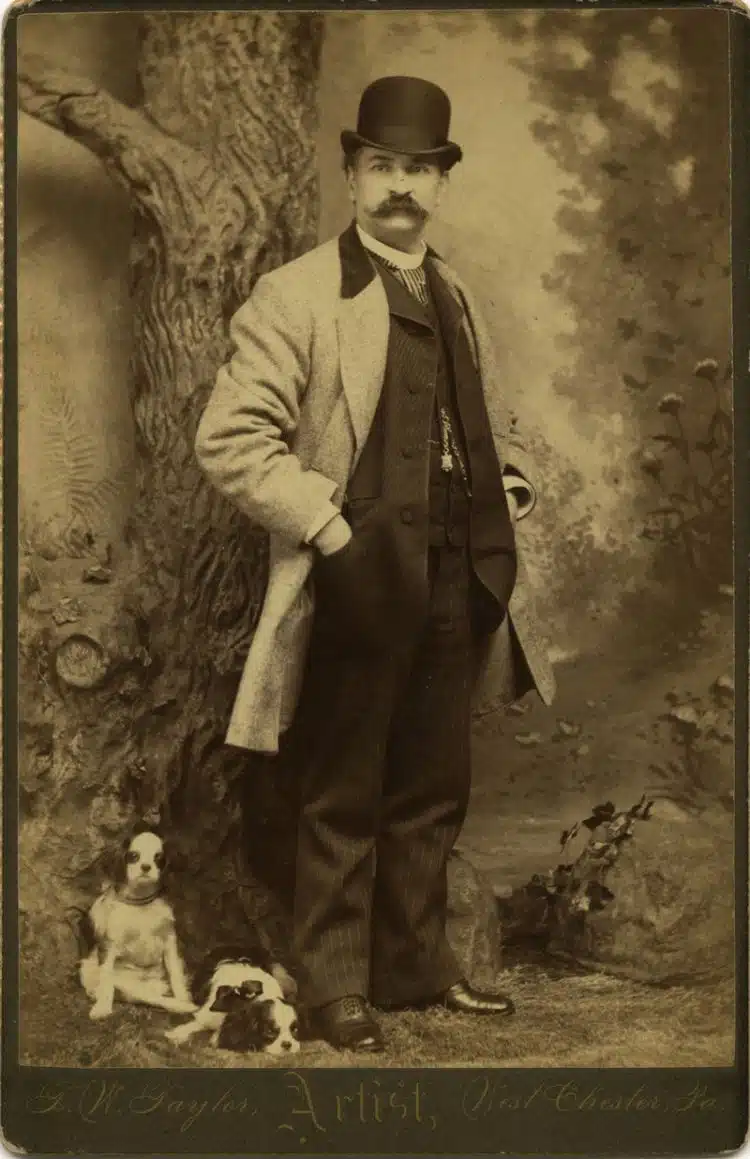
Early Life and Education
Taylor’s youth was shaped by family tragedies and constant change. His story was not unusual for that time period. Thomas W. Taylor was born December 23, 1838, the fifth child of Richard and Jane MacAfee Taylor of Thornbury Township, Chester County, PA. In 1843 when he was five years old, his father died, forcing the family to sell their farm to pay their debts. The four children were dispersed among the relatives. According to Orphan’s Court Minor’s Estate papers[1] the two older boys boarded with their Uncle Amos and Aunt Elizabeth McAfee Highfield. The couple had no children and were glad to have the boys with them while they attended school.
Jane Taylor moved with the two younger children, Thomas and Elizabeth, to West Chester. However, tragedy struck again when daughter Elizabeth died in 1848, followed by Jane Taylor’s death in 1850. Thomas Taylor then joined the Highfields, who had moved by this time to Lancaster city, Lancaster County, PA[2] where Amos worked as a carpenter. At some point in the early 1850s the Highfields moved to Philadelphia[3]. Here Thomas had the opportunity to study photography with McClees and Germon[4] who operated a prominent portrait studio. The partnership of these two photographers lasted from 1848-1855[5]. Thus Taylor had to have studied with them sometime between 1852 and 1855 when he was in his teenage years.
The Orphan’s Court in the December term of 1860, recognized Thomas W. Taylor as having reached his full majority age of 21. His debts for his school tax and boarding were paid in full and he received his share of inheritance from his father’s estate of $112.55.[6] This would be equivalent to about $3,570.00 in today’s (2019) money.[7] This sum was good seed money for a young person starting out.
Taylor’s First West Chester Studio
T.W. Taylor may have had his first studio in West Chester by 1862 before his military service. He is recorded on the tax list for that year, although no occupational title is given[8]. More evidence to support this theory is forthcoming.
As the Civil War intensified and the President called for more troops, Taylor enlisted in Co. E, 124th Pennsylvania Volunteers for nine months service from August 12, 1862, through May 16, 1863. At the time of his enlistment, he gave his occupation as photographer.[9] Taylor was promoted to Full Corporal on October 17, 1862, and saw action with his regiment in the battles of Antietam and Chancellorsville.[10]
After his service, Taylor returned to reopen his photo gallery in Townsend’s Building[11] as advertised in The Village Record on June 27, 1863:
Since Taylor stated in this advertisement that he will “resume photographing at his Old Stand” this is compelling evidence that he was in business before he went into the service. He also invites his “old customers” to return. Evidently he had his own studio at least by 1862.
A Curious Typo
We can be sure that Taylor was working as a photographer in West Chester by 1862 because of the military, tax list and newspaper documentation given above, but two curious facts suggest that he may have been working there earlier. One suggestion can be found in Samuel R. Fisher’s biographical sketch in Henry Ruoff’s Biographical and Portrait Cyclopedia of Montgomery County, Pennsylvania. The biography states that Fisher “studied under the direction of Thomas Taylor of West Chester, PA.”[12] Fisher purchased the studio of deceased West Chester photographer Nathan Parker on August 31, 1861, and opened it for business.[13] Therefore we can infer that Taylor was working as a photographer in West Chester at least by 1861.
A second curious item makes us wonder if he was there by 1860. It is a listing in Boyd’s Chester County Directory for 1890-1891 with a glaring typo.[14] The advertisement for Taylor’s studio states, “established 1840” we know this is a typo since Taylor was only two years old at the time. But should it have read established 1860? We will never know what year it was supposed to say, but it raises questions that need to be resolved.
It could also be that Taylor was working for another photographer before his military service. During the period between 1860 and 1862 there were six other photographers in the borough. Eber Woodward was well established and doing a good volume of business, he could have used an assistant. Previously mentioned was Nathan Parker, who died in 1861. Since he was having financial difficulties at the time of his death, we know from his accounts that he had no employees. And then there was S. R. Fisher, who succeeded Parker in his studio. Could Taylor have helped him get it up and running? Then there were the three Taylor brothers, Jacob, Jesse and Alfred, from Wilmington who were also working in West Chester. They were unrelated to Thomas Taylor. Alfred’s studio was at the 30 East Gay Street address in Townsend’s building where Thomas later occupied in 1863. Unfortunately, there is no paper trail to let us know if it was possible that Thomas Taylor worked for any of these other photographers.
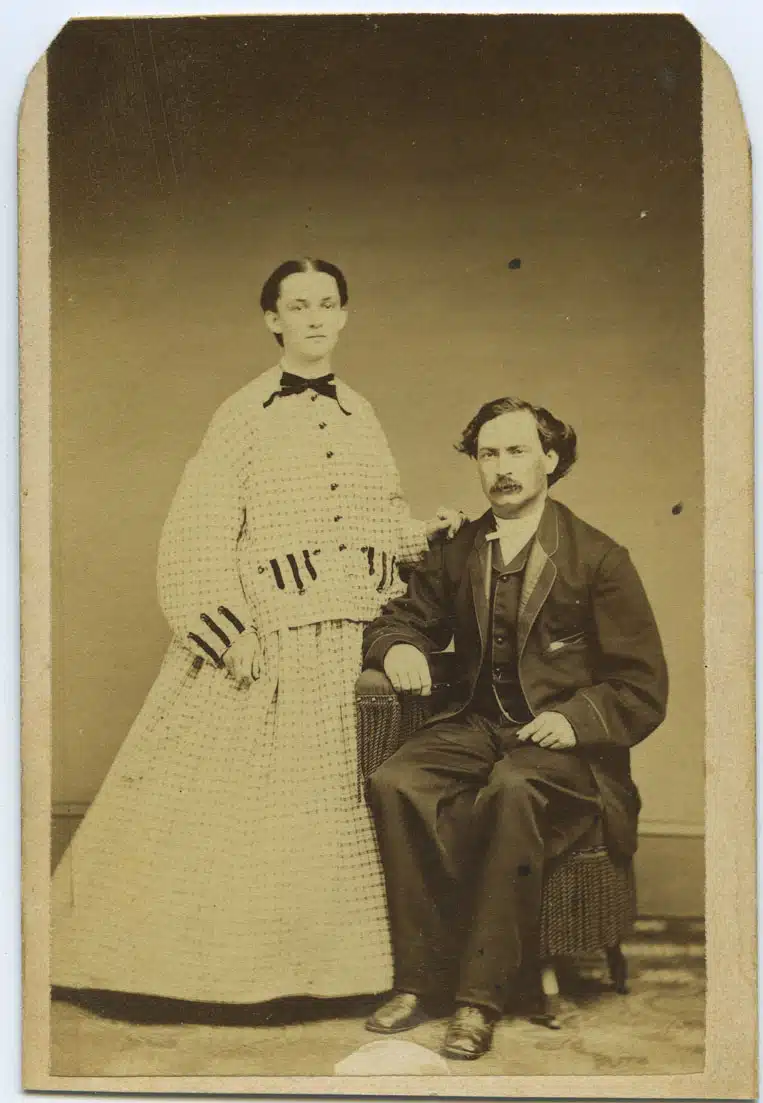
T. W. Taylor, “Taylor and wife” [This may possibly be Taylor’s first wife, Martha J. Townsend Taylor who died shortly after giving birth to a daughter. The woman is wearing a maternity dress in this portrait.], 1864, albumen carte-de-visite, courtesy of Chester County History Center, West Chester, PA.
His First Marriage
On September 29, 1863, Taylor married Martha J. Townsend, daughter of a West Chester shoemaker. Their happiness was brief however, Martha died soon after giving birth to a daughter, also named Martha. His wife was only 21 years of age upon her death on May 7, 1864. Unable to care for the infant, the child was raised by her grandparents, Richard and Harriet Townsend of West Chester.[15]
The Brandywine Baseball Club
The Brandywine Baseball Club was organized in the mid-1860s and played at a field known as the “Walnut Trees” in an undeveloped stretch of Price Street, West Chester.[16]
Thomas Taylor was one of the early organizers, playing with the Brandywines for 18 years, usually on second base, and spent five more years as manager. He was captain of the team in 1867 when it joined the Pennsylvania Association of Base Ball Players.[17] He became known around town as “Captain Taylor” or nick-named “Cap”. One of his fellow players described him in a retrospective article which appeared in the Daily Local News on July 1, 1920, “Tom Taylor, a wonderful combination of fun, good fellowship, clever, kind, always ready to do a favor to a friend… Cap’s temperamental structure could develop a “rash” in mighty short order if things did not run smoothly.”
The team’s captain was responsible for making the season happen. He secured the playing field, recruited and oversaw the players, issued the challenges to other clubs for matches, and played in every game. Taylor’s stats were outstanding. In 1875 he played in all 29 games, going to bat 171 times, made it to first base 88 times and ran home 71 times.[18] That July, the Brandywines played the Actives of Reading, PA, unfortunately, the Actives were the better team that day, defeating them 23-10. As was the custom, the Brandywines entertained their opponents at the Sherman House Hotel, with dinner and music by the West Chester Cornet Band. The manager of the opposing team made a speech complimenting their opponents. Manager Mishler said: “Captain Taylor is the right man in the right place, and with your unlimited support will make the Brandywine Base Ball Club a gratifying success.”[19]
On a number of occasions through the years, Taylor photographed the team. Some of these photographs are noted in the local newspapers. The Daily Local News of December 22, 1875, reported: “THE CHAMPION NINE PICTURIZED – in the large show photograph case of Prof. T.W. Taylor, on East Gay Street, may now be seen the pictures of the Brandywine Base Ball Club, gotten up in Mr. Taylor’s most artistic style. The pictures are all “true as steel,” and the nine as they are grouped together in one large frame, forms quite an attractive feature to the picture display. “The Champions of Chester and Montgomery Counties,” which inscription the card upon the frame bears, is well and truthfully applied. Viva la Brandywine.”
Some games were worthy of capturing for posterity, as was the case with the game with the Huston Baseball Club of Chester. The Daily Local News of August 21, 1883, reported: “…Whenever they do come Capt. Taylor has made arrangements for photographing the two nines while the game is in progress. He will take two negatives by the instantaneous process, and will no doubt produce two excellent views of the contesting parties while the excitement of the game is at its highest. Look out for him.” The Local followed up on August 30, 1883, “Good Results – The photographs taken of the Brandywine and Huston clubs on Tuesday last by Capt. Taylor and his able assistants we learn promise to be fine ones. The plates have been developed, but the work of printing will not be completed for several days yet. The Captain is determined to have them fully up to his usual style, which is sufficient to insure them satisfactory to all concerned.”[20]
As Captain of the Brandywines, Taylor was a recognizable and popular man around town.
A Broken Leg
One ordinary morning on busy High Street, West Chester, there was the sound of a crash, a horse whinnied loudly, and a man screamed in anguish. That crying voice was that of Thomas W. Taylor, when he drove the horse and York Wagon rented from the Mansion House livery stable through a narrow passage stacked with building materials before the First National Bank. In avoiding a pile of bricks and lumber with his right wheel, his left wheel ran up over a pile of sand, overturning the wagon and hurling Taylor to the ground. The wagon was badly mangled, and the horse slightly injured. The story was reported in the Village Record on August 23, 1864.
In his civil lawsuit against Edward Taylor of the First National Bank of West Chester[21] he described his injuries as: “bruised and greatly injured in the back and breast and right leg…was broken below the knee and the ankle…seriously sprained.” He “suffered great pain and was prevented from practicing his profession as Daguerreotypist.” For his suffering he sued the bank for $3,000, claiming that they did not adopt due diligence in taking proper precautions to fence in their building materials. Furthermore Taylor claimed that it cost $800 “to hire competent artists to conduct the business in the necessary absence.” Taylor hired Mr. Addis of Philadelphia[22] to operate the business for five months.
Unfortunately, the board of arbitrators assigned to the case ruled that the First National Bank was not guilty but awarded photographer Taylor $700 for his pain and suffering in the accident.
Among the Court of Common Pleas papers on the case is a list of witnesses called by Taylor. Included are photographers Eber Woodward (his competitor in West Chester), Joseph Waith (ambrotypist from Wilmington) [23] and Marshall Battin (a fledgling photographer who partnered with Charles Shrieves to open a studio in the Borough later that year).
There must have been a camaraderie between the photographers in the borough. When Taylor was not able to make the baseball match between the Brandywines and the Columbia team, photographer John Odiorne took Taylor’s place at second base. This was unusual since Taylor never missed a game. The Village Record of July 21, 1866, reported that the Brandywines won at a score of 51 to 45. Odiorne played well, catching a fly ball and making five runs.
Taylor’s business was only fair for the 1864-65 tax year, bringing in $268 dollars according to the IRS tax assessment listing. He paid a $15 fee for an occupational license.[24]
A Solemn Photograph
The nation was shocked by Abraham Lincoln’s assassination on April 14, 1865. The outpouring of grief was palpable. On April 22, 1865, the President’s funeral train, draped in mourning retraced the route Lincoln followed to his first inauguration on the Pennsylvania Railroad from Harrisburg to Philadelphia. The train traversed through Chester County beginning at Penningtonville (Atglen) and ending at Eagle (Devon). Handbills were posted in the area giving times when the solemn train would pass. All along the tracks thousands of local residents waited to watch the train pass by, leaving floral bouquets beside the rails. According to photo historian Robert O. Brown, Thomas W. Taylor was there with his camera to record the scene.[25] In order to capture such a view, he must have been in the know as to where the train would stop for coal and water. I have never seen Taylor’s photograph of the funeral train and would like to know if it exists in public or private collections.
Home Life
Taylor married Minnie F. Hummell at the Rehoboth Methodist Episcopal Church in Frankford, Philadelphia on April 2, 1867.[26] She was the daughter of Jacob Hummell and Mary Brognard Hummell. In the coming years the couple had four children, Charles (born 1868), Frederick (born 1870), Bertha Leona (born 1872) and T. Barton (born 1875). Frederick died at age 3 possibly from childhood disease.
The First Premium
Taylor took pride in his award-winning displays of photographs at the county fairs. These displays were an ideal occasion to introduce the public to his range of services, and he capitalized on these prizes to market his studio, naming it the “First Premium Gallery.” His awards were often listed on the imprint of his cartes-de-visite and cabinet cards, creating a means to date his photographs.
His first award was at the Chester County Agricultural Fair as reported by the Jeffersonian, October 5, 1867. He won first place for his photograph titled “Champions Nine” of the Brandywine Baseball Club, of which he was the captain. A carte-de-visite of the Brandywines from about this time period, is in the collection of the Chester County History Center.
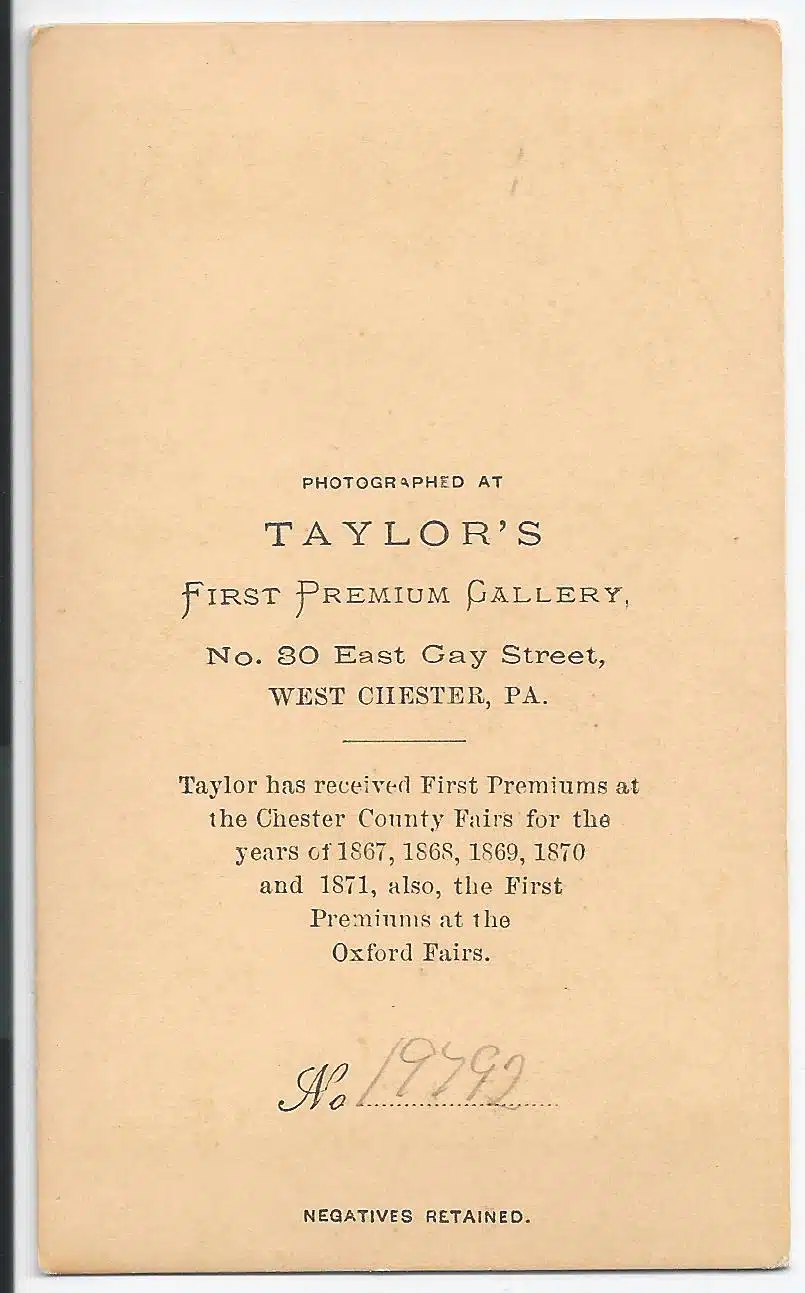
Taylor also exhibited at the Oxford Fair where he took first place in 1871 as reported by the Jeffersonian newspaper.[27] The first CDV imprint mentions the Oxford fair with the following text: “Taylor has received First Premiums at the Chester County Fairs for the years of 1867, 1868, 1869 and 1870. Also, the First Premium at the late Oxford Fair.”[28]
A report in the Daily Local News of September 24, 1880, of the Chester County Fair gave a glimpse of what his displays looked like: “Thomas W. Taylor, photographer and artist, West Chester, handsome display of every description of photographs. An elegant life-sized crayon portrait of Smedley Darlington; a splendid collection of cabinet and 8 x 10 photographs, together with a very large and beautiful display of smaller sizes of photographs.” Smedley Darlington was a well-respected principal of the Darlington Seminary and later served in the U.S. House of Representatives.
Taylor began winning medals for crayon portraits in 1882 according to the imprint on a cabinet card.[29] Through the years, Taylor won ten prize medals for crayons according to a cabinet card imprint.[30] Over his career, Taylor won 50 first premiums for “Finest Crayons, Pastels, Ink and Plain Photographs” as listed in an advertisement in the Chester County Teacher’s Institute program for 1893.
A Coatesville Studio in 1867
In 1867 Taylor opened a branch studio in Coatesville along with his brother, William A. Taylor, under the name of T. W. Taylor & Brother. Taylor was capitalizing on his recent award of First Premium for a display of photographs at the Chester County Agricultural Society Fair in West Chester. The studio advertised photographs of all sizes, ambrotypes, ivorytypes and porcelain pictures.[31] It was located in Harlan’s building on Main Street, two doors west of Fourth Avenue. No further information is available on this studio regarding dates of operation. His competition in Coatesville at that time would have come from John Branson’s gallery.
The West Chester Studio
By 1867 Taylor’s studio in West Chester was located where it would remain for the rest of his career. The April 20th edition of the Jeffersonian advertised his gallery at 30 East Gay Street, West Chester. He offered cartes-de-visite at $2 per dozen, large photographs at $1 and ferrotypes finished in 5 minutes, eight for only 50 cents. The Jeffersonian of April 27, 1867, noted that “His establishment is on Gay Street, two doors west of High Street, where it has been established for many years.” After the streets were renumbered in West Chester in 1879, Taylor’s studio remained in the same location even though the address was then changed to 10 West Gay Street.[32]
The largest part of Taylor’s business was studio portraiture in the format of cartes-de-visite, cabinet cards, photographs of all sizes and crayons. He not only took portraits of an excellent quality, but he also copied old photographs of those who had passed on, to make copies for all the family. He made a wise business move in 1872, when he purchased the negative archives of C. Alfred Garrett, who was the successor to Eber Woodward, the negatives went back into the late 1850s.[33] This gave him a valuable stock of past portraits he could draw on, rather than doing copy work which always lowered the clarity of the subjects.
Taylor constantly worked to make improvements and innovations in his business. In 1873 he replaced the skylight[34] in his gallery and also redecorated with new wallpaper, paint and hanging baskets of flowers.[35]
As reported in the Jeffersonian on May 4, 1874, Taylor had a small fire in his gallery, but sustained minor damages only ruining a drape. “Mr. Taylor was in the act of making a chemical preparation while nearby stood a quantity of gun cotton and a bottle of alcohol, and while operating with a lamp the flames communicated to the cotton and thence to the alcohol and in an instant a large drape hanging nearby was in flames. By active and prompt means Mr. T. extinguished the flames but not without burning his hands to some extent.” The chemicals mentioned here were used by photographers to make collodion wet plate negatives.
Not satisfied with the appearance of his gallery, Taylor had it redecorated in 1876 with English Brussels carpeting, new wallpaper and an installation of his best photographs framed and displayed on the walls.[36] He received a glowing review which was published in the West Chester and Philadelphia Guidebook and Industrial Journal in 1876 and is worthy of being reproduced here in full:
“The Photograph Gallery of Thos. W. Taylor.
Among the many new branches of the arts and sciences which have been added to the list of wonders of the nineteenth century, few have been more rapidly developed and applied with practical usefulness, than photography. Its employment in portraiture would have been glory sufficient to give it an enduring halo; but the far the more valuable form of application to the purposes of manufacture and commerce has given it a high position among its kindred arts.
One of the most earnest and practical gentlemen who have made this pursuit their study for many years past, is Mr. Thos. W. Taylor, of West Chester. Not content with following in the rut which others have worn, he has struck out a new path for himself, and made various improvements in the business. Although quite a young man, Mr. Taylor has the reputation of being the best photographer in Chester county. He first started business in West Chester in 1863, in the building now occupied by him, 30 East Gay Street. In this short space of time he has accomplished more and met with greater success than any photographer in the county. His photographs have always taken the highest premium wherever exhibited. For the last nine years he has received the first premiums at the Chester County Fair, and has also received the first premiums at the Oxford Fair.
His business is thoroughly systemized. It is just like entering a store where you can purchase goods of any quality or price. He has samples of every possible variety of photographs from which to choose the style, size and class of portrait which you may require. You can have them colored or uncolored, mounted or unmounted, framed or otherwise. Mr. T. does all kinds of landscape photography. In the gallery and in the large case outside are arranged samples of photographs, which for variety and beauty and artistic effect, are only equaled by the first-class art establishments of Philadelphia and other large cities. In these pictures there were no deep tints, no distinct black or white, no strong positive coloring, yet the lights and shadows were given with such peculiar excellence, the contour of the figures were rounded off with such grace and harmony, the positions seemed so easy and natural, the exquisite details of form were so well brought out, and the whole figure rounded off with such artistic grace that you could not do otherwise than look on with pleasure and delight, feeling that you had before you an achievement of the highest and purest style of photographic art. We would not, however, have the reader suppose that these were fancy pictures in which there was only a faint semblance of the original; on the contrary, every picture was a true portrait, life-like, we had almost said idealistic, in which you could see the soul sparkling from the eye and beaming in the countenance, brilliant, yet quiet and subdued, such a warmth of tint, yet so mildly toned. The most prominent of these pictures was that of the Brandywine base ball club, consisting of Thomas W. Taylor, Alfred Bushong, Elwood Worrall, Wm. Brooks, John Gheen, Fred Wollerton, Charles Shepherd, William Kames and Cabel Harman. Among the well-known citizens of West Chester and vicinity, whose photographs hang here in large frames, may be mentioned Hon. Washington Townsend, Wm. B. Waddell, Esq., Evans Rodgers, President of Agricultural Society of Chester county, Judge Butler, Judge Wollerton, Wm. Jefferis, D. M. McFarland, James T. Mullin, and nearly every prominent citizen of Chester county. The gallery has been lately fitted up, and is really handsome.”[37]
Taylor’s refurbishments went beyond beautifying the reception rooms, he kept up with all the latest trends in portraiture. In the 1860s and early 1870s when the carte-de-visites popularity was very high, Taylor’s style was very simple – subjects were artfully posed seated on a fringed photographer’s chair before a plain background, or standing beside a drape, frequently their face was vignetted so that there was no background distraction. When the larger cabinet card came into style at 4 ½ x 6 ½ inches there was opportunity for more creative use of background. According to the Daily Local News of July 30, 1878, Taylor purchased from” New York an elegantly painted background entitled the “Fairy Bower”. A background appearing in many of his cabinet cards in the Chester County History Center collection shows a charming Victorian house with a park like surrounding of trees.
Copy work was also an important part of every photographer’s business. In the March 21, 1878, edition of the Daily Local News it was reported that Taylor had taken carte-de-visite sized photographs of two well-known deceased citizens and had blown them up to life-size. The portrait of George Matlack was finished in watercolors and that of the confectioner L.A.W. Pyle enhanced with ink.
It was announced in the Daily Local News on May 1, 1879, that Taylor had added a new reception room in his gallery. A larger reception area tells us that he had a constant flow of customers who needed room to wait for their sitting.
Taylor, Lauretta Smedley (born 1874), ca. 1882), albumen cabinet card, collection of the author. [Photo 8]
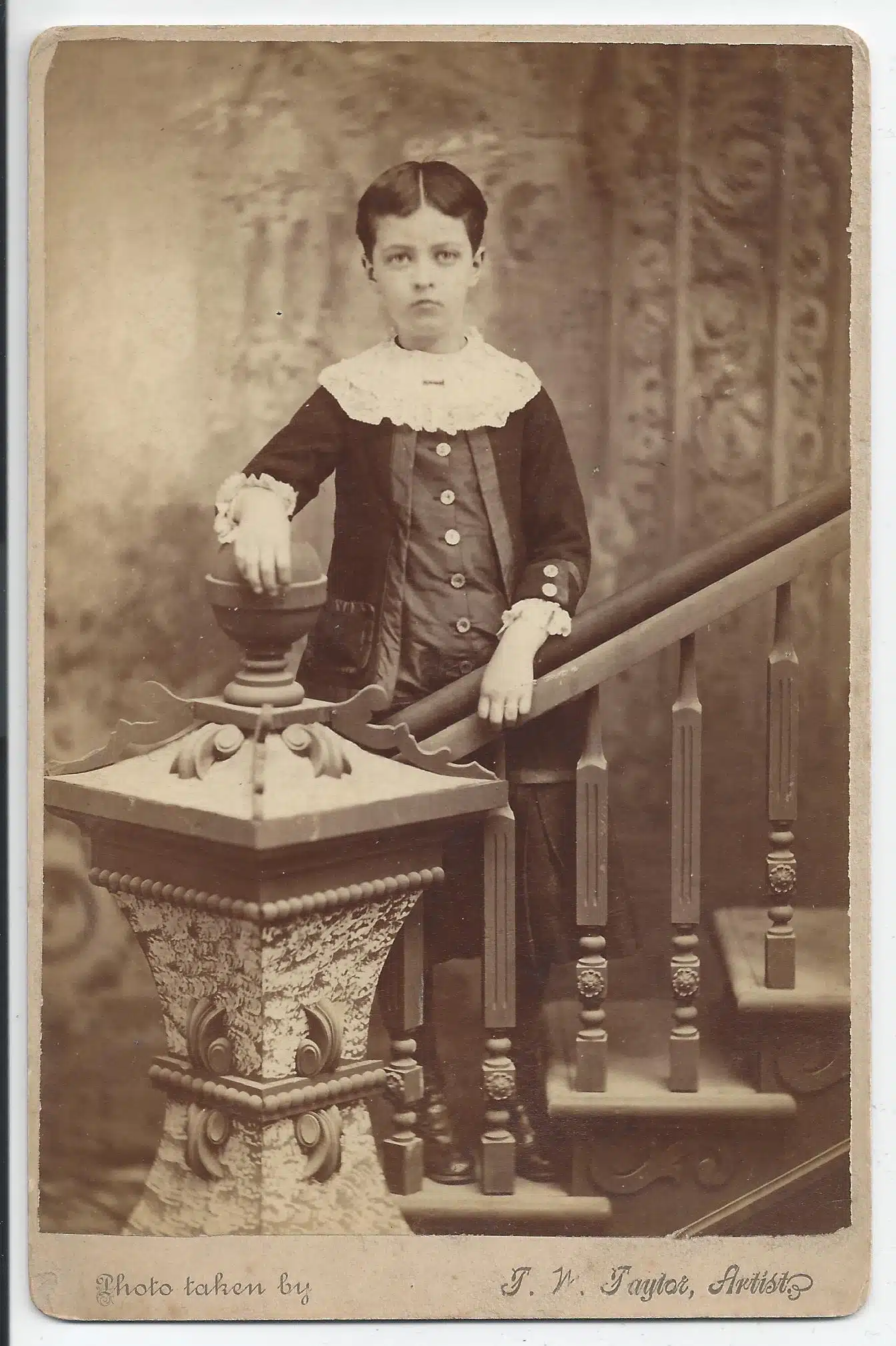
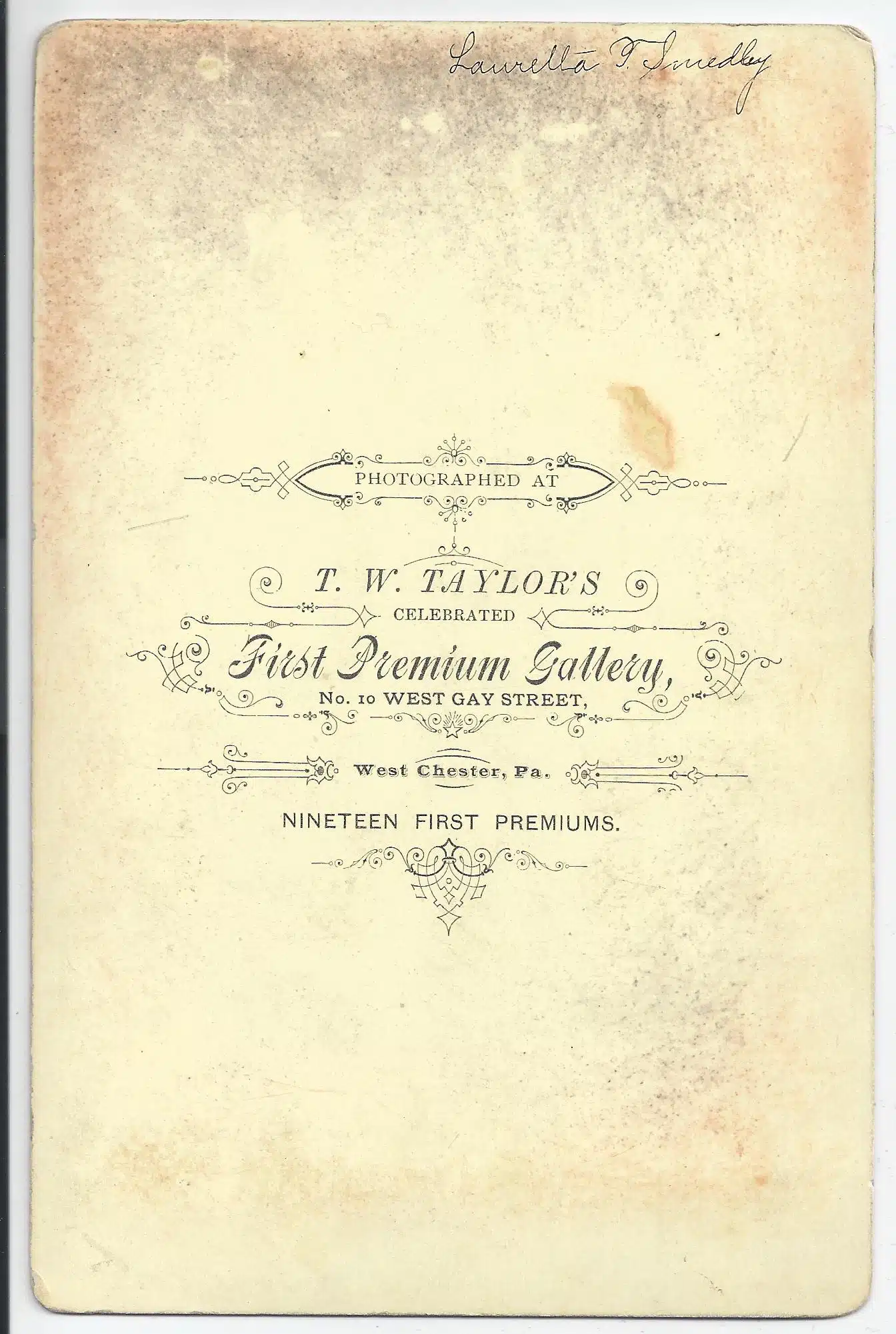
As time went on, Taylor collected many props which enhanced the atmosphere he created for each cabinet card portrait. In 1880 he purchased an elegant balustrade for posing subjects.[38] The elegantly faux painted balustrade included an ascending staircase for added interest. Customers could choose between a rustic gate or a wrought iron gate for their portrait. A variety of papier mâché rocks and a masonry railing were also very tasteful. Or perhaps the inclusion of a plaster Roger’s statue would inform the viewer of the subject’s artistic cultivation and good taste.
Taylor, Unidentified Sisters, ca. 1886, albumen cabinet card, collection of the author. [Photo 38] Note 32 premiums awarded.
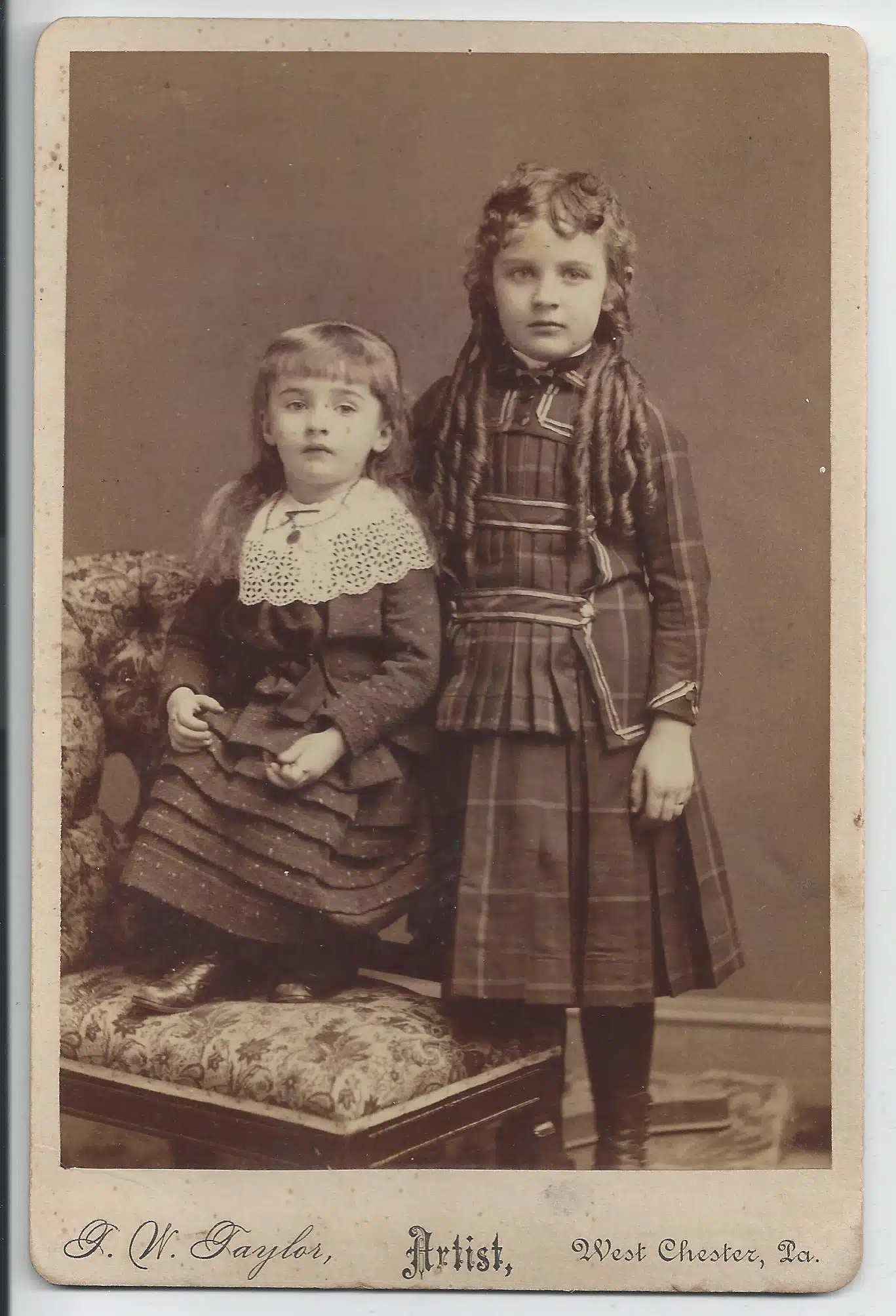
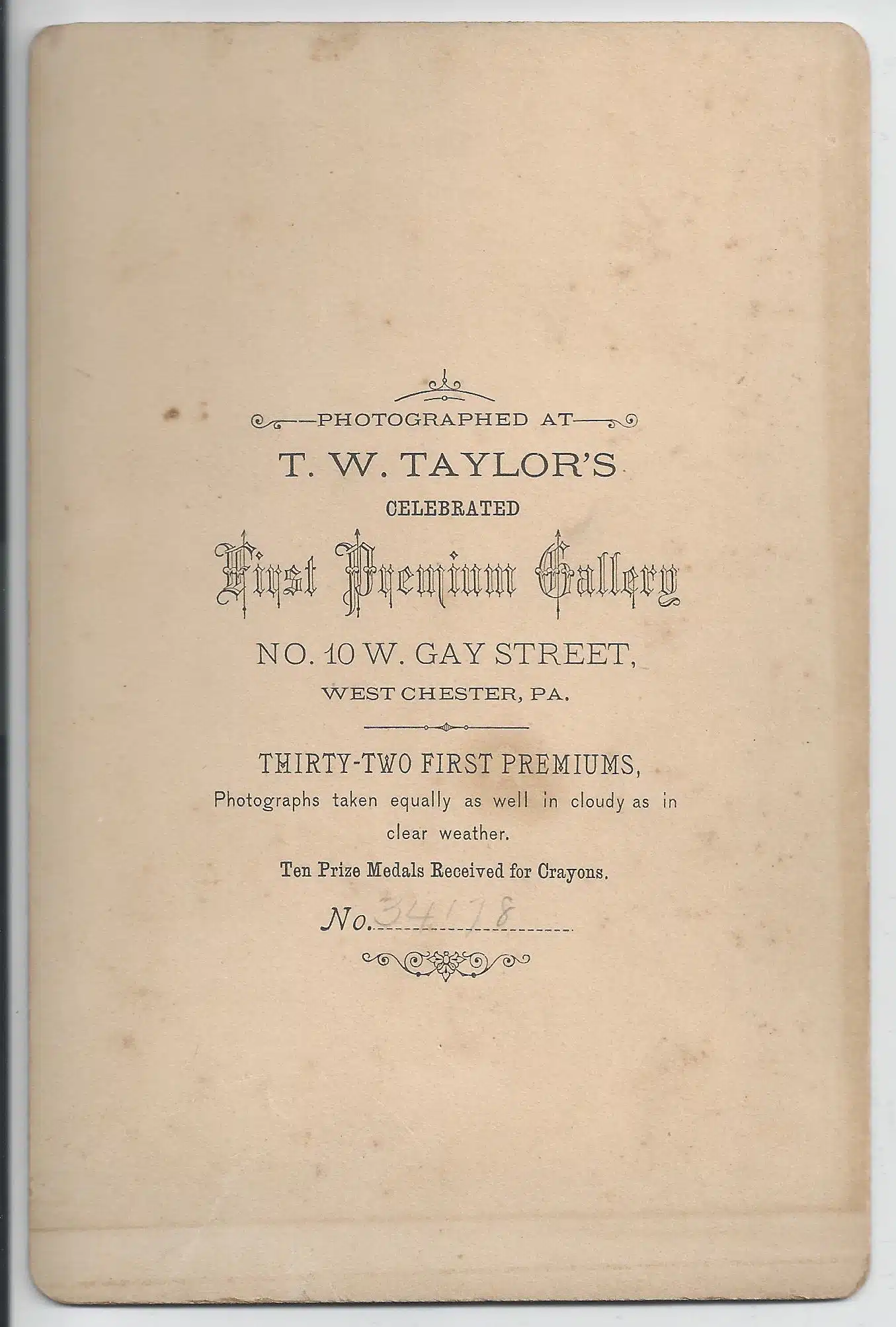
Taylor also provided child-sized furniture and props especially for children. According to the Daily Local News on July 29, 1879, he purchased a small lounge chair for photographing children, this can be seen in many of cabinet card portraits. He also had special props to coax a smile out of a restless toddler as reported by the Daily Local News on August 31, 1881:
“We dropped in yesterday at Taylor’s photograph establishment and while where was attracted by a novel little toy he has for attracting the attention of small children while taking their “photos”. It consists of a metal bird resembling a canary which is made to open its bill and sing at the will of the operator. He has a new background representing a bay window which is becoming quite popular.”
This description brings to mind the phrase “watch the birdie” which photographers used while poised to snap the shutter at just the right moment. Photographing babies was especially challenging in the era of slow shutter speeds. Here is one notable example of a sitting that photographers find especially daunting recounted in the Daily Local News of April 7, 1881:
“PHOTOGRAPHING THE BABIES: – Four ladies, each carrying a babe, marched into the photograph establishment of T.W. Taylor, Esq. on West Gay Street, a day or two ago, and wanted their little ones grouped together and a photograph taken of them. Mr. Taylor explained to them that taking the photograph of one small child was a pretty big undertaking, but one he was always equal to, and how it would be with four he did not know, but would try. The ladies then stated that they had all been schoolmates at Millersville Normal School; had graduated at the institution about the same time; had all married about the same time and their children were nearly the same age, which was the reason they wanted the pictured of the little ones taken in a group. This caused Mr. Taylor to take more interest in the matter than he otherwise would have done, and said they should have them, and have them well. He succeeded in getting an excellent negative of the little fellows, which makes a pretty, and taking the circumstances into consideration, a highly interesting one.”
Visiting Taylor’s gallery during this time period was a truly positive experience for the customer. In 1885 he advertised that his studio would be open all day on Christmas.[39] This was so he could take portraits using his new winter background scene. A delightful cabinet card in the Chester County History Center’s collection shows Taylor’s own daughter, Bertha, sledding in a winter woodland scene. The natural effect was created by the sled poised on a pile of sand – which reflected light much like snow. After the negative was made, Taylor hand retouched it, painting in descending snowflakes. Charming cards like this made wonderful gifts for the season.
Taylor was frequently called upon to take cabinet card portraits of members of organizations. One such opportunity came his way in about 1886 or 1887 when he photographed all 42 members of the political club known as the West Chester Pioneer Corps. Each member was photographed in parade dress before a scenic background decorated with papier mâché rocks and tree stumps. Each albumen print is hand-colored showing the members wearing red shirts, white pants and black boots and carrying gleaming axes.[40]
Taylor also photographed all 81 members of the Fame Fire Company No. 3 in 1891. Their cabinet cards were organized in a specialized flat cabinet or frame for display.[41]
The Daily Local News reported on February 6, 1886, that Taylor was opening a second studio on the corner of Gay and Church Streets that had been for former studio location of C. Alfred Garrett and Eber Woodward. In 1872 he had brought the negative archives of those two studios. An article in the Morning Republican dated August 31, 1896, stated that Eber Woodward had taken about 25,000 negatives during his career[42]. Perhaps moving the archives was logistically impossible, such that Taylor decided to leave them in situ.
Besides running the business, Taylor took on students as assistants from time to time. The best known of these was W. Francis Grubb, a local man, who then opened his own studio in West Chester in 1886 to compete with his teacher!
Other photographers who assisted him in business included Theodore B. McGinley[43] and Edward M. Valentine.
The Railroad War of 1877
Taylor continued his military service in the Wayne Fencibles, a West Chester based militia. He was commissioned as a Fourth Sargent in September of 1875.[44] He kept up his reputation as a crack shot as captain of the Wayne Fencibles Rifle Club and the West Chester Rifle Club.
The Wayne Fencibles was mustered into service in 1877 to assist in quelling a riot known as “The Railroad War” in Pittsburgh, Pennsylvania. This railroad strike was the result after the Panic of 1873 and four years of economic depression brought the railroads to cut staff and decrease trainman’s salaries by 35%. The strike began in Martinsburg, West Virginia after workers received the third wage cut that year. Strikes were then organized on rail lines from New York to California, with the worst violence occurring in Pittsburgh, PA. [45]
On July 19th when strikers prevented the movement of the trains, Lieutenant Governor General Albert Pearson called for the Pennsylvania National Guard to keep the trains moving. However, when local militias arrived they identified with the strikers and failed to keep order. On July 22nd, the First Division of the Pennsylvania National Guard was brought in from Philadelphia to restore order. They were met by a crowd of over 2,000 people surrounding the Pennsylvania Railroad’s Union Depot. The troops tried to disperse the crowd by threatening them with several cannons and fixing bayonets on their rifles. When a single shot resounded, the troops responded by firing into the crowd, killing 20 people, which included a woman and three children. Twenty- nine others were gravely wounded. This horrific incident incited looting and burning of the railroad yard over the next 24 hours.
When the smoke lifted, two square miles of the city were destroyed by fire. The Pennsylvania Railroad sustained $4 million in losses including 104 engines, over 50 passenger cars, over 1,300 freight cars, 39 buildings destroyed including the Union depot and roundhouse.[46]
It was then that the Wayne Fencibles were called upon. The minute book of the Wayne Fencibles recounts their itinerary, here is an extract:
“July 22, 1877 – Received Orders to hold ourselves in readiness to mark to the Rioter’s War
July 23, 1877 Went to Camp at Paoli Parade Ground
July 26, 1877 Left Malvern for Pittsburg [sic]
July 27, 1877 Arrived in Pittsburg and went into camp
July 29, 1877 Took out the first freight cars that left Pittsburg since the Strike.
August 4, 1877 Removed to Roup’s station (Shadyside Camp)
August 8, 1877 Broke Camp and left for home
August 9, 1877 Arrived home.”
Thomas Taylor’s obituary recounts his role in quelling the rioters in better detail:
“He was with this company when it, with many others, was called out to quell the rioters at Pittsburg in 1877 and had the honor of commanding the squad which took the first locomotive out of Altoona and ran it to Pittsburg. It was a dangerous service, for an angry threatening mob was packing densely all around and in the railroad yards. The squad detailed took possession of the cab of the engine with rifles loaded with ball cartridges and ready to fire at the first onslaught of the mob. The promptness and steady behavior of the men concerned is said to have led the leaders of the mob to conclude that they were United States regulars. They were cursed and threatened but no shots were fired and mob rule was broken.”[47]
West Chester Rifle Team
Taylor was an excellent sharpshooter. This was another sport that was attractive to his competitive nature. He belonged to the informal Fencible Rifle Team, but he desired to have a more organized team to shoot formal challenge matches. March 5, 1879, the West Chester Rifle Team was organized at Taylor’s studio that evening.[48]
The team held regular practices for members to compete with each other. The best shot won the honor of winning the team gold medal. Any member winning it three times in a row got to keep the medal, instead of passing it to the next winner. The first to keep the medal was Captain Taylor as reported in the Daily Local News, October 9, 1879.[49]
The team became affiliated with the Pennsylvania Rifle Association[50] and began issuing challenges to other clubs. That year the West Chester Rifle Team was undefeated in all their matches with area teams from Philadelphia, Camden, Norristown, Bombay Hook and Phoenixville. The individual scores were printed in the Daily Local News of each contest. Sometimes even reproductions of the targets were published, turning the marksmen into local celebrities.
To cap off the year, the West Chester Rifle Team won the State Championship against the Pennsylvania Rifle Team of Philadelphia.[51] The teams shot targets at 200 and 100 yards at the range in Media on October 13, 1879. West Chester took the victory by 11 points over the competitors. Taylor sent news of the victory via a telegram to Sheriff McFarland and soon the whole town was informed. When the team’s train arrived at West Chester station, the streets were crowded with hundreds of people. A band paraded the team members up Market Street to High, and around Church and Gay Streets. The parade terminated at the doorway of the Republican headquarters where the man who would become governor of Pennsylvania, Charles H. Pennypacker, emerged from the doorway to give a spontaneous speech. He praised Captain Taylor and his team who, in one year of organization vanquished the best marksmen in the state. Cheers went up for Taylor and team, it was a night to remember. A letter to the Daily Local News read: “I feel that the vast deal of credit is due to T. W. Taylor for his able captaincy of the West Chester Rifle Team since its organization. By his untiring and energetic spirit he has made of it what it is – the pride of our county and the champion of the state.”[52]
Taylor did not miss this photo-op. The Daily Local News reported on October 17, 1879, that he took a group portrait of the ten members of the victorious rifle team wearing their blue uniforms, as well as individual cabinet card portraits.[53]
But despite these accolades and victories, not everyone was pleased with the rifle team. The farm that the team was invited to use as a practicing area in 1880 was within the borough limits. After complaints of the noise and close proximity to town, Chief Burgess Wood sent Taylor a warning that they would have to remove their practice area:
“To Thomas W. Taylor, Captain of the West Chester Rifle Team – Sir: – It has been represented to me that there has been established within the limits of the borough of West Chester, that which is commonly called a “Rifle Range,” near the public highway, and is a place where human life may in in peril. This is therefore to notify you that hereafter the use of said range for the purpose proposed, to wit: the use of fire-arms within the said borough, will be dealt with as provided by the ordinance relating to disorderly conduct, of which you will please take notice. J. B. Wood, Chief Burgess”[54]
The local farmers were also non-plussed with the group. In 1880, the local newspaper reported that rifle club extended an invitation to one of their competitors to visit Chester County for a rabbit hunt. This notice received a prompt reply from area farmers in the Daily Local News on September 7, 1880:
“ Have They a Rabbit Range Too? – Mr. Editor, I see by a copy of last week’s NEWS that the West Chester Rifle Club has invited the West Philadelphia Club to a grand rabbit hunt sometime in October. Does the West Chester Rifle Club own a rabbit as well as a rifle range? Or do these gentlemen intend to take possession of the property of Chester county farmers for three or four days and sweep what little game we have from the face of our land?
‘Tis high time for the farmers to combine together for mutual protection, and discover, if possible, whether they have any rights which gunners and fishers are bound to respect. The proposition of ten or fifteen gentlemen to invite ten or fifteen gentlemen to hunt upon somebody else’s property is decidedly cool, even in the month of October.”
And then there was the issue of gambling. Mr. Leopold published a challenge in the Phoenixville Messenger on December 15, 1881, suggesting a match for a $100 prize against the Phoenixville Rifle Team. Taylor’s response was swift and was printed in the Daily Local News on December 14, 1881: “Mr. Editor, the member of the West Chester Rifle Team have never shot for money and do not propose to do so now…Still to oblige Mr. Leopold, and help the poor, I will shoot him a match, ..for ten tons of coal. If he wins it is to be given to the poor of Phoenixville; if I win the coal is to go to the poor of West Chester.”[55] A gentleman’s sport is not played for money.
Outdoor Photography
During his career Taylor took many outdoor assignments such as commercial buildings and homes, group portraits, large machinery and accident sites for the court. The Village Record of November 20, 1869, reported that Taylor photographed the Fame Fire Company posed around their steamer. It commented, “They looked as though they had just come out of the band-box, with their bright red shirts, black pants & etc.”
Some outdoor work may have been taken out of Taylor’s own interest to further show his talents and cultivate future business. The Daily Local News for July 19, 1873, reported the following: “NOVEL PHOTOGRAPHS – This morning Capt. T.W. Taylor leveled his camera battery on our borough street laborers at the corner of Church and Chestnut streets, by which he now has a picture novel and exceedingly interesting in all its details. Capt. T. ever has an eye single for educating the public taste to appreciate the photographic art.”
In 1871 George Grant was convicted of murdering West Chester restauranteur Amanda Spence. Murders were rare in nineteenth century Chester County creating a sensation. A hanging had not occurred in the county since 1831. County officials worked hard to make sure that carrying out this death sentence did not become a public spectacle. Grant was hung in the prison yard out of public view on Wednesday, November 13th, 1872. Hundreds of people came into the borough that day hoping to witness the event, some climbing on to rooftops. It was reported in the Harrisburg Telegraph the next day that “T. W. Taylor was on the spot to photograph the scene.[56]”
The West Chester Jeffersonian reported it differently, saying “At an upstairs window, Thomas W. Taylor, of West Chester, a photographer, was standing with his camera.”[57] The photograph that Taylor took that day has not been seen by the author and it is not known if it is extant. Since the county officials erected the gallows in a spot shielded from nearby windows, it is more likely that Taylor took an overview of the huge crowd gathered for the gruesome event.
On October 4, 1877, a horrible train wreck shocked the residents of Chester County. The Pickering Valley Railroad had a derailment after a heavy rainstorm, killing seven passengers and crew and injuring many more who were returning from the Pennypacker reunion in Phoenixville. The storm had washed out a portion of the track near Kimberton and when the train approached in the dark, the engineer had no warning, the locomotive and two passenger cars plunged thirty feet into the ravine. One hundred and thirty people were aboard. T. W. Taylor was hired by the survivors to take photographs of the scene of the accident for use in court.[58]
A coroner’s jury determined that the railroad had not allowed for proper drainage in the area even though the rainstorm was unusually heavy. They also determined that the railroad had run with the locomotive backwards and the cars in improper order, in violation of its own rules. Had the Pickering Valley Railroad followed its rules, one of the cars should have remained on the track, significantly reducing the injuries.
The lawsuit from this case set a legal precedent before the Supreme Court of Pennsylvania. The court found that when a railroad is paid to transport a passenger, it is an implied legal contract that care will be taken to transport the passenger safely. Passengers had the right to sue to be compensated for injuries resulting from neglect on the part of the railroad.
On January 9th of 1878 Taylor made a series of views of ice harvesting operations on the ice ponds of Uriah Hunt Painter located in West Chester and West Goshen Township. The series was titled “Preparing for Summer” and was beautifully mounted in gold edged decorative mounts with printed titles. Skillfully photographed in the freezing weather, subjects are shown cutting the ice on the pond and hoisting large blocks of ice into the ice houses for cold storage. Workers and horses are artfully posed to impress the viewer as to the power of the lifting mechanisms in the ice houses and the skill needed to harvest and handle the blocks of ice. The photographs can be seen as part of the Uriah H. Painter collection in the Chester County History Center.[59]
Taylor also took many group portraits posed out of doors as well. The Chester County Bar Association passed a resolution that Taylor was to be their photographer according to the Daily Local News of February 24, 1879. In the collection of the Chester County History Center is an undated group portrait of the Bar photographed on a plate 11.5 x 17 inches.[60]
Taylor photographed many West Chester businesses during his career, one of note was Rev. Joseph Evans Drug Store on Church Street. The Daily Local News of August 23, 1879, reported: “The beautiful hanging garden at the second story adds very materially to the beauty of the picture.”
In 1880, Taylor landed what could be one of his biggest jobs. The Daily Local News reported on July 10, 1880: “T. W. Taylor, photographer this borough, is taking photographs of persons and buildings for Futhey’s History of Chester County.” Lawyer J. Smith Futhey and historian Gilbert Cope needed illustrations for their 782-page tome titled: History of Chester County, Pennsylvania with Genealogical and Biographical Sketches to be published in 1881. The photographs were used as models for the book’s engravings. How many photographs Taylor took for the volume is unknown.
The Daily Local News did report that Taylor’s portrait of “General” James Jackson, age 102 was made into a woodcut for publication use by Crosscup & West of Philadelphia.[61] Jackson had escaped from enslavement and made a new life for himself in West Chester. His remarkable story was featured as one of just a few African Americans highlighted in Futhey & Cope’s History of Chester County.
Another important job that came Taylor’s way was to be appointed resident artist for the New York Graphic in 1882[62]. This newspaper was making a splash with a fully illustrated format, in order to do this they needed the aid of photographers all around the country who could send them photographs to be used as halftone illustrations. How much material Taylor sent them over the years is not known.
In 1882 Taylor got a request to photograph a newly designed engine made by the Broomall, Stott & Co. in West Chester.[63] He put his largest camera in a spring wagon and transported it to the mill. Since the engine was quite large, Taylor decided to photograph it from the higher vantage point of the wagon. During his preparations, for whatever reason, Taylor jumped out of the wagon. This was the wrong choice since the release of Taylor’s weight catapulted the camera out of the wagon to smash on the road. Taylor did finally take the photograph, but not from a spring wagon.
Taylor enjoyed getting out around the county taking views. Some of these were in the format of stereographs, photographs that appear three-dimensional when viewed through a stereoviewer. The Daily Local News of July 14, 1884, reported that he gave a free exhibition of stereoptican views outside his gallery on Saturday evening, projecting the views upon a canvas. The Local reported that many of the views were taken around the county. One can then assume that the stereoviews were then available for sale in his gallery. Taylor’s stereoviews are rare, only one exists in the collection of the Chester County History Center showing a view of Honorable William Darlington’s home on the southeast corner of Church and Chestnut Streets in West Chester.[64]
One of the Wessie Boys
Thomas Taylor served his community as a member of the First West Chester Fire Company which had its engine house on Church Street between Market and Gay Streets. This was the oldest fire company in the borough, founded in 1799. Not only did he serve as a volunteer fireman, but he also served on many organizational committees for the fire department as well. Taylor served on the elections committee (1881), committee for parade in Norristown (1883), committee for a regulation parade dress (1889) and was elected as a delegate to the firemen’s convention held in Chester (1890s).
In 1889 he had the honor of being the Chief Marshall of a parade to rehouse the fire company’s carriage after it was repaired as the result of an accident. One hundred fire fighters participated in the parade, which conveyed the carriage with royal fanfare. The parade included a brass band, seventy-five firemen in parade dress drawing a hose carriage, the fire truck drawn by a smart looking team and concluded with speeches, serenades and a fine supper.
Taylor was always involved in the Fireman’s Fair held every fall as a fund raiser. The Fair, often held at Horticultural Hall, had tables filled with wonderful articles to tempt visitors to spend their money. They had an art gallery, confectionary table of refreshments, “fancy tables” of homemade goods made by the ladies, a Museum Table of fire company artifacts and souvenir table. Delicious box suppers were available through the sale of advance tickets. In 1891 Taylor was elected chairman of the whole fair.[65]
In 1885 The souvenir table featured photographs of the fire company for sale, unfortunately the newspaper articles did not identify who the photographers were. It could be that they were taken by Thomas W. Taylor or by J. T. Murtagh, a talented amateur photographer who was also a fire department member. Available for sale were photos of the firehouse draped in mourning for General Grant, also decorated for a Fourth of July parade in 1884. Popular items included photographs of their old hand engine recently sold and “Button” hose carriage.[66] In the collection of the Chester County History Center is a carte-de-visite of a hose carriage sitting in the doorway of the fire house, taken in 1882 by T. W. Taylor.[67] A carte-de-visite would make a popular and inexpensive format for a souvenir.
Political Life
Taylor was actively involved in the Republican Party for many years. In 1887 he was nominated for Clerk of Courts and duly elected as a matter of course in the heavily Republican borough.[68] He stepped away from photography during his three-year term in office. During this time, his eldest son, Charles S. Taylor, operated the studio.
Taylor knew how to schmooze when he gave a party for the Judges and members of the Chester County Bar at his home in 1890. The Daily Local News of March 28th gave a complete description of the cordial evening. Card tables were set up for games of Euchre and Whist while others engaged in conversation. Taylor’s daughter Bertha (age 18) and four of her friends were introduced to the visitors. A luncheon was served at 10 p.m. of delicacies of the day: Raw oysters and fried oysters, biscuits, chicken salad, ice cream, fancy cakes, coffee and crackers and cheese. Following this delicious repast, the men entertained themselves with musical selections on piano and song. Taylor himself sang three solos “Over in New Jersey,” “Sallie Rice” and “Who will care for Mother now?” The Local reported: “It was remarked…that this was the largest gathering of the members of the bar that they had ever seen…At a late hour the company separated, having spent an evening of unalloyed pleasure.”[69]
Taylor was doing very well financially to afford such a grand party and also to own a Cavalier King Charles Spaniel valued at $200. The black-tan and white dog was named “Judge” according to the dog license dated October 31, 1890.[70]
Is There Photography After Politics?
After his term of service was over in 1890, Thomas Taylor returned to his studio. Joined by his son, Charles, the establishment was now named in advertisements and on card imprints as Taylor Studio. When Charles went to Coatesville to open a branch studio in 1894, son T. Barton Taylor joined his father in business.
Taylor was good at thinking up enticements for his customers. In 1890 he took a group photograph of all the participants of the Chester County Teacher’s Institute producing a 16 x 20 photograph. The Teacher’s Institute, held in West Chester every summer, generated a lot of business for the borough shopping district with teachers coming to town from far reaches of the county. Taylor advertised in the Teacher’s Institute program that any teacher who purchased one dozen cabinet portraits for $3.00 would receive the 16 x 20 group photo free.[71]
Taylor updated the business through several improvements. He announced to the public that he had the exclusive right for Chester County to make and sell Talcott mounts and had purchased the license in Boston, Massachusetts.[72] Furthermore he threatened other vendors who violated his license would owe him recompense. He offered his customers a dozen cabinet cards on Talcott Mounts for $3.50 and claimed it was a dollar less than others charged.
The Daily Local News of April 13, 1894, reported the following: “T.W. Taylor, our well-known and First Premium Artist, is making a splendid offer in fine Aristo Photographs to the people of Chester County. Mr. James Irwin, his assistant, is now canvassing in the vicinity of Paoli and Berwyn and will explain the nature of this offer. The sittings being limited, there will be no recanvassing.”
A New Studio In Coatesville 1892
The opening of the studio in Coatesville was foretold in 1891 when the Coatesville Weekly Times announced that R. W. Schrack was constructing a new building, and Taylor’s gallery would be on the second floor.[73] In the January 2nd edition, 1892 of the Coatesville Weekly Times Thomas W. Taylor advertised the opening of a new gallery in Odd Fellow Hall on Third and Main Streets, Coatesville.
The Coatesville Weekly Times of May 6, 1893, ran a feature on Charles S. Taylor, who had taken over the operation of the Coatesville studio, reproducing a number of his photographs. The article compliments him: “while quite a young man, he is master of the art.”
Our Own Home, Finally!
The Taylor family had been living in a rented house at 216 W. Chestnut Street in West Chester since at least 1882. Finally on August 17, 1893, the Taylors purchased the house for $4,200.00 from William Burns and wife Elizabeth.[74] Burns was a real estate investor who owned a number of contiguous properties along Chestnut Street.
A Change in Career
According to the Daily Local News of January 26, 1895, Thomas Taylor signed the lease to become the proprietor of the Boldridge Hotel in Downingtown, PA. It was he who changed the hotel’s name to The Pennsylvania House Hotel.[75] Both sons joined their parents in the operation of the hotel. While Taylor enjoyed some success in managing it, they were ready to move on to a new challenge after two years. He sold his lease to J. C. Pierce of Blue Ball, Lancaster County for $3300 according to the Daily Local News of December 28, 1896.
Another turn in Taylor’s career came in 1897 when he purchased 14 & 16 W. Market Street in West Chester to open a restaurant. The purchase price of the property was $12,250; it had a high value being so close to the Courthouse.[76] Taylor remodeled the drug store formerly occupied by Dr. Shoop Hunt and opened his new café according to an announcement in the Morning Republican April 27, 1897. Named Taylor’s Café, his family assisted him in the enterprise. On the first floor was an oyster bar and dining for ladies and gentlemen was provided in an elegant dining room on the second floor.
Indeed it sounded like the end of Taylor’s gallery at 10 West Gay Street when the Daily Local News published the following on April 14, 1897, “Captain Thomas W. Taylor has removed the familiar showcase of photographs which was for years a feature of West Gay Street, in front of the building where his gallery used to be, and at present it is in the U. H. Painter Building on Gay street. The cabinet will be removed to Coatesville.”
In 1898, Charles Taylor decided to leave the family restaurant business and instead, rented the photography gallery at 10 West Gay Street which had been his father’s years ago to make a return to photography.[77] He reopened the studio in November of that year and employed a salesman, Mr. Malsbury, to canvas the town for business.[78]
On February 4, 1898, the Taylor’s sold their home on West Chestnut Street to Timothy and Anna Elizabeth Lane for $1,700, quite a loss from what they paid.[79] The family then moved into the apartment on the third floor above the restaurant. The 1890s were rocky economically with financial panics in 1893 and 1896 followed by a recession beginning in 1899.[80]
Taylor was always involved with his organizational memberships and political life. In 1899 he served on the committee to organize the Centennial of the Borough of West Chester, overseeing the official photographing of the event. The Chester County History Center has in its collection a photograph taken by T. W. Taylor of the Centennial Committee. [81] Levis P. Marshall finally bought Taylor’s studio in June of 1899 and took many of the photographs during the West Chester Centennial.
Upon the death of West Chester Borough Councilman Robert L. Hayes,[82] Taylor was elected to complete the term. In 1903, he was reelected to another term.[83] But Taylor’s health was failing to sustain his busy life and he was noticeably slowing down. The doctors were unable to identify the source of his debility and he became so weak he was confined to bed. After eight weeks in this condition, Thomas W. Taylor died on April 3, 1904, at the age of sixty-six.
On the day of Taylor’s funeral, local stores were closed out of respect. The attendance at the service was one of the largest the town had ever seen with Taylor being so active in community life. The entire First West Chester Fire Company was in attendance. Taylor’s casket was laid out in the parlor of the family’s home on Market Street, where members of the public had an opportunity to pay their last respects. Among those calling were the members of the McCall Post of the G.A.R., the West Chester Police force and public streets department and the Borough Council. Rev. W. R. Laird of the Church of the Holy Trinity officiated at the service and Taylor was laid to rest in Oaklands Cemetery.
Taylor was survived by his wife, Minnie, sons Charles and T. Barton; his daughters, Mrs. Bertha Miller and his daughter by previous marriage, Martha, now married and living in New York. At the time of his death, T. Barton Taylor had taken over managing the restaurant and Charles was now a clerk at the Mansion House Hotel.
When Taylor’s estate was settled, it did not paint a pretty picture for the survivors. Taylor’s Café was in debt for $2500 worth of oysters, liquors and cigars. The Taylors were also holding a $8700 mortgage on the café. Thomas left all his property to his wife Minnie,[84] but the indebtedness forced his wife to sell it. As a result, the café was sold at public sale on August 3, 1905, to family friend George McFarland for $100.[85]
The 1890s was a turbulent decade economically for most Americans. Trying to open a new business in a field in which you were unfamiliar was tough during this time. Although Taylor did not gain riches during the turbulent economic climate of the 1890s in the hotel and restaurant business, he will be remembered for his successful career as photographer, sportsman and respected community leader.
To have kept his studio going as the “first premium gallery” Taylor had to withstand the competition through the years. During the 1860s he was able to establish himself in the business community despite the dozens of carte-de-visite photographers who came and went in short order and three major competitors, Eber Woodward (1854-1867), C. Alfred Garrett (1864-1877) and J. S. Beecher (1867-1878). After the flurry of carte-de-visite photographers abated after the financial Panic of 1873, a new major competitor appeared on the scene, Edward S. Marshall (1876-1887). Taylor was firmly established by that time. But Marshall was able to get two jobs Taylor had secured previously, photographing the ice harvesting operation of Uriah Hunt Painter and sending views to the New York Graphic. Taylor was challenged in the later 1880s by his own student, W. Francis Grubb (1886-1900). By the time Taylor was seeking other business options and his sons were helping to keep the studio running, portrait artist William F. Haverstick (1895-1911) found an opportunity in the borough.
He was so successful because of the central location of his studio on Gay Street with a large eye-catching display case out front, the prize-winning quality of his work at local fairs and his personal popularity within the community. He had the best-appointed studio with comfortable and luxurious waiting area, choice of backgrounds and props as well as choice of finish and presentation. He was well known and respected throughout the community for his military service, as Captain of the Brandywines Baseball Club, and membership in First West Chester Fire Company, McCall Post of the G.A.R. and West Chester Rifle Club. Taylor was active politically in the Republican Party which had a stronghold in the borough at that time. His family were also members of the affluent Church of the Holy Trinity in West Chester.
Over four decades, Thomas W. Taylor and the Taylor Studio produced high quality images that still survive in many family photograph albums and local collections. The artistry of his work and his creative productivity are demonstrated in the prolific number of surviving examples. Truly, Thomas W. Taylor was West Chester’s “first premium” photographer during the nineteenth century.
© Pamela C. Powell, 2020
T. W. Taylor, carte-de-visite imprint with IRS tax stamp signed “Taylor”, [1864-1866], collection of the author. [Photo 32 verso only]
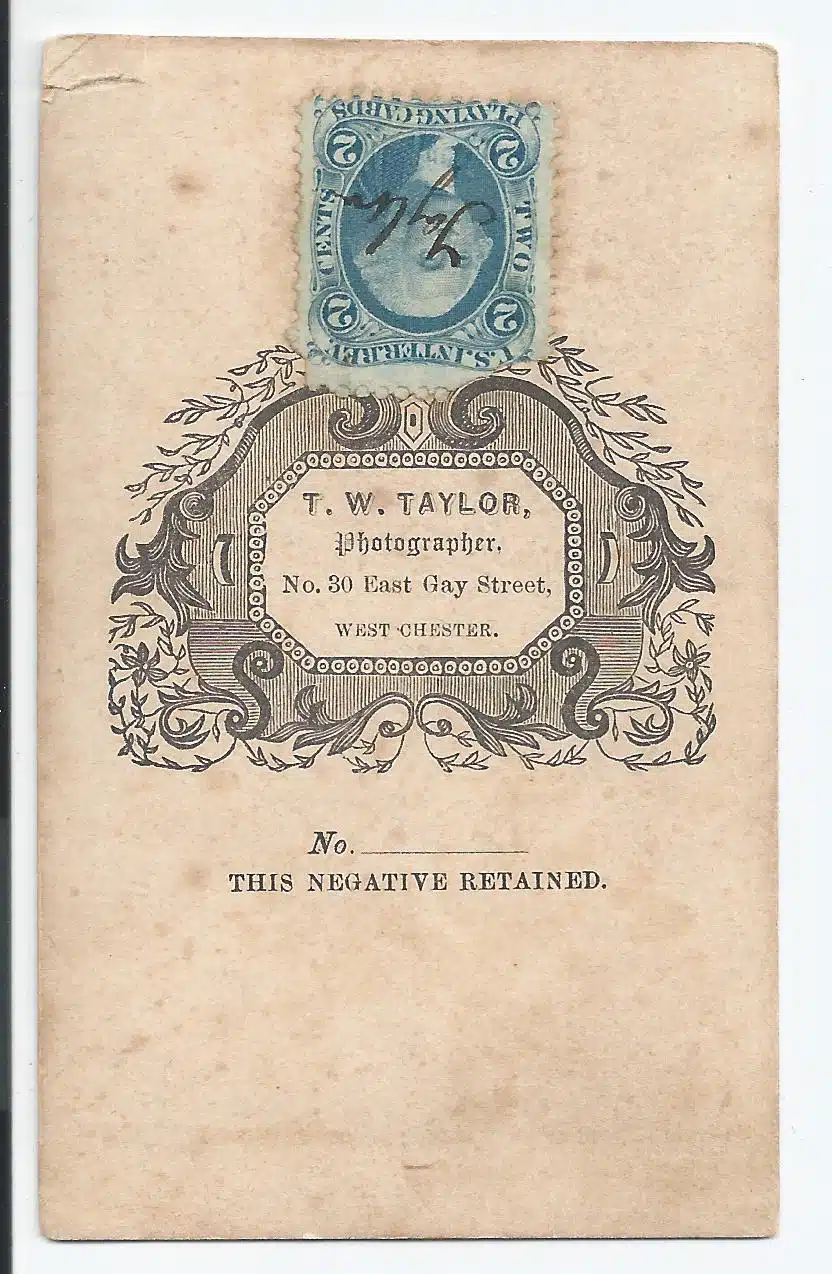
T. W. Taylor, unidentified man, [1864-1866], albumen carte-de-visite. Collection of the author. [Photo 33]. Note imprint with IRS tax stamp.

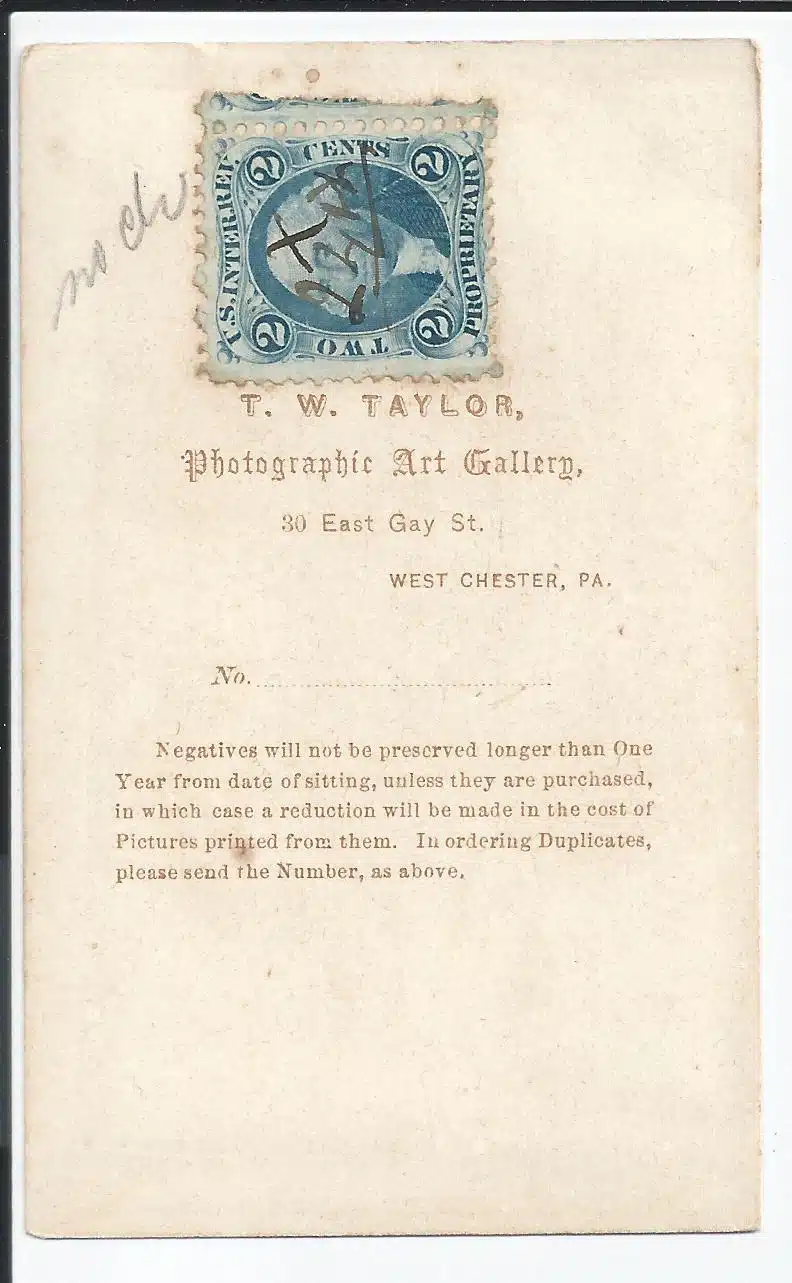
T. W. Taylor, carte-de-visite imprint, 1868-1869, collection of the author. [Photo 82 verso only]

T. W. Taylor, carte-de-visite imprint, 1868-1869, collection of the author. Note that sometimes the finger pointed the other way. [Photo 83 verso only]
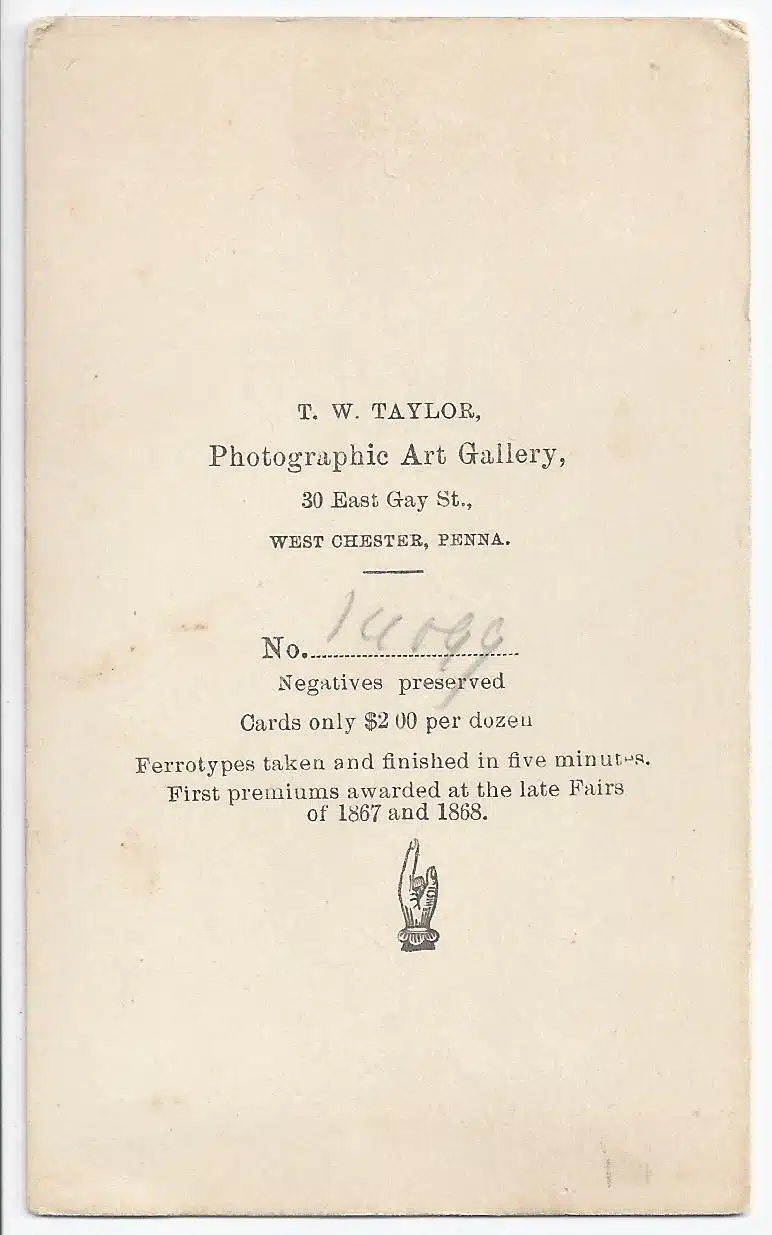
T.W. Taylor, carte-de-visite imprint, 1869, collection of the author. [Photo 85 verso only]
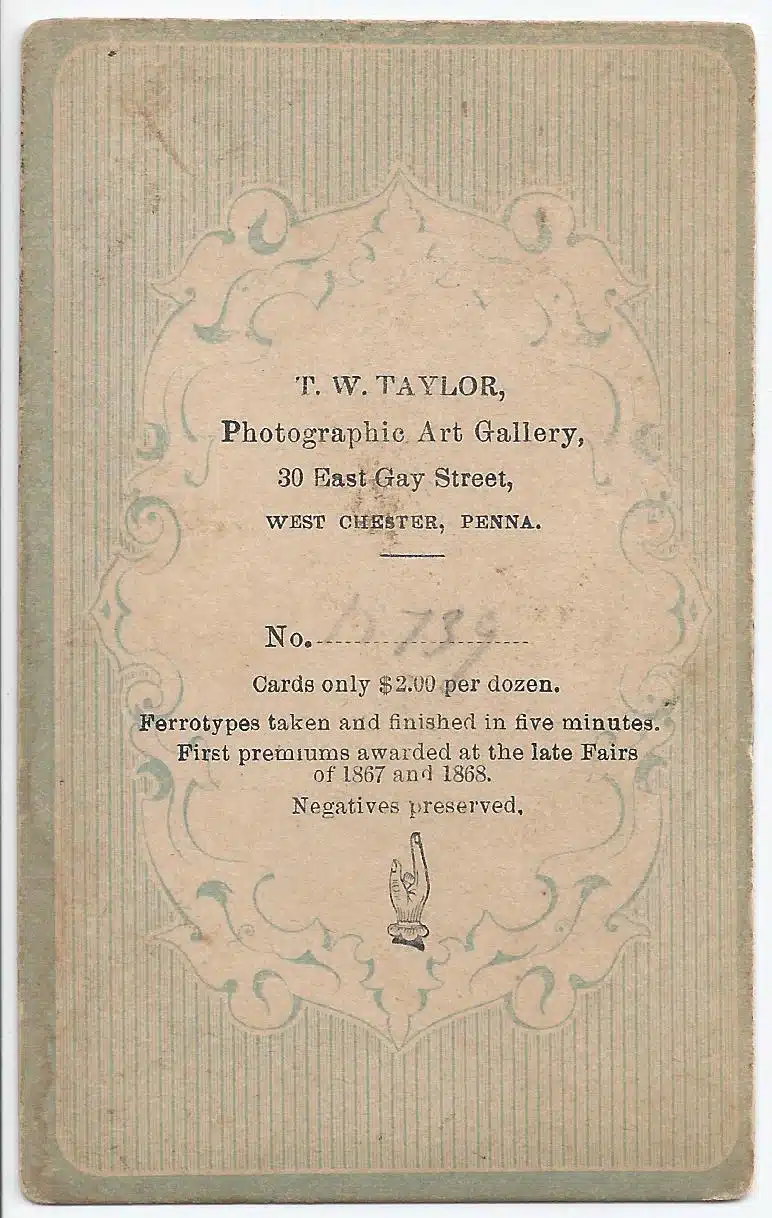
T. W. Taylor, Unidentified infant, 1868-1869, albumen carte-de-visite, collection of the author. Note the awards given at exhibits in 1867 & 1868 fairs. [Photo #84]


T. W. Taylor, unidentified young woman, 1870-1871, albumen carte-de-visite, collection of the author. [Photo 81]
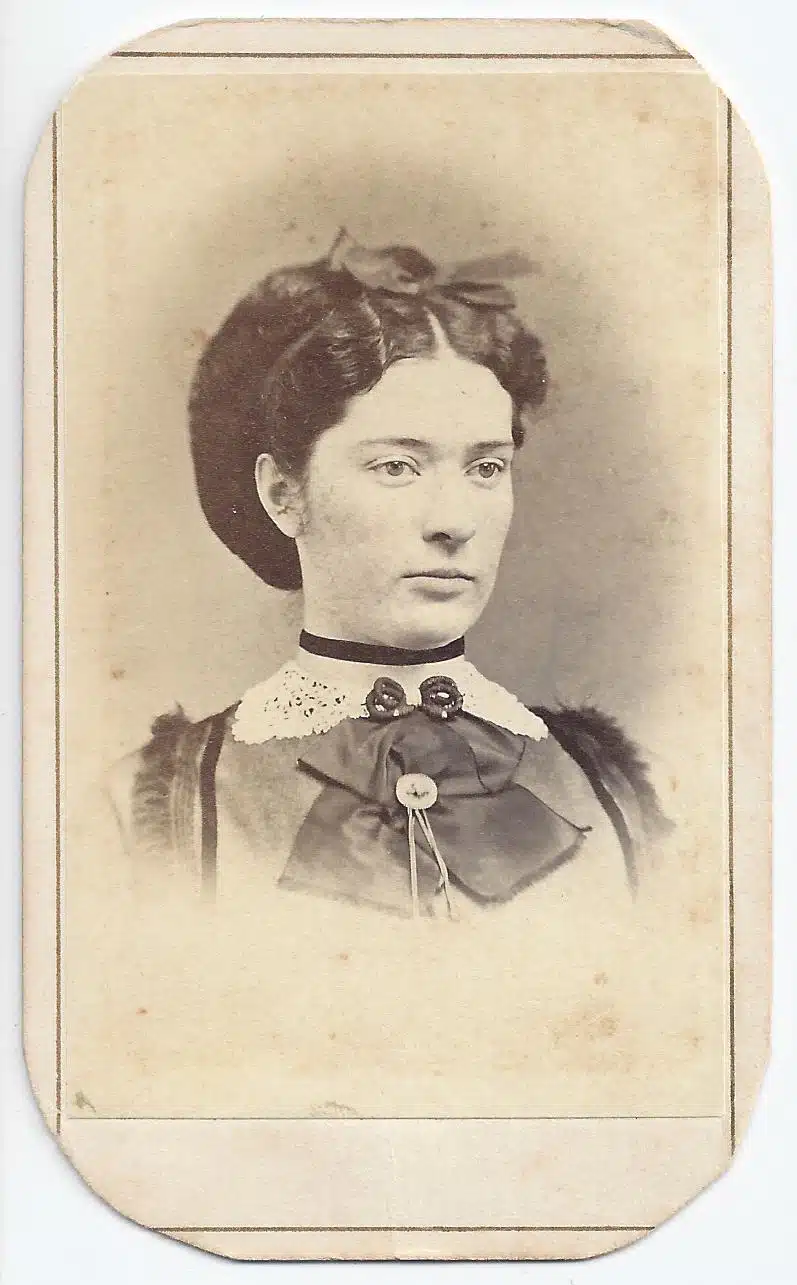
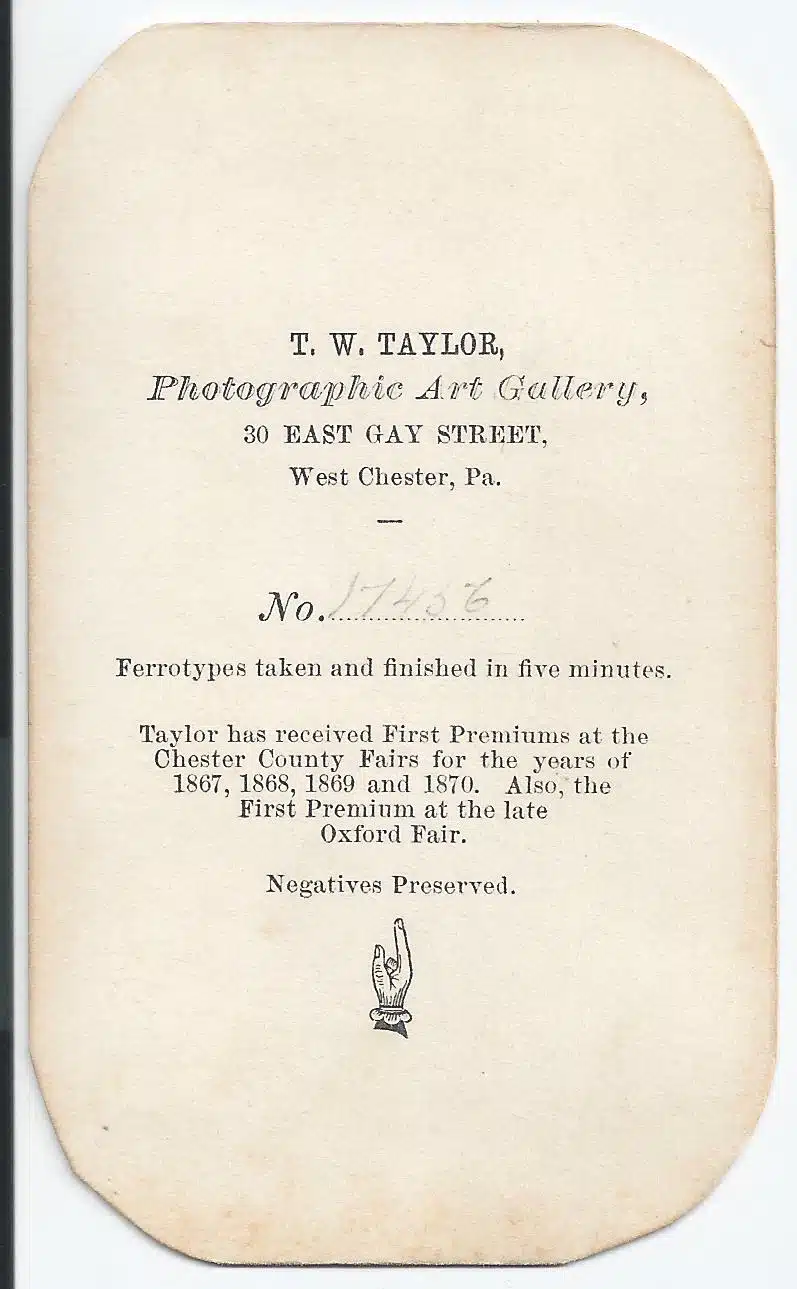
T. W. Taylor, carte-de-visite imprint, 1871-1872, collection of the author. [Photo 80 verso]
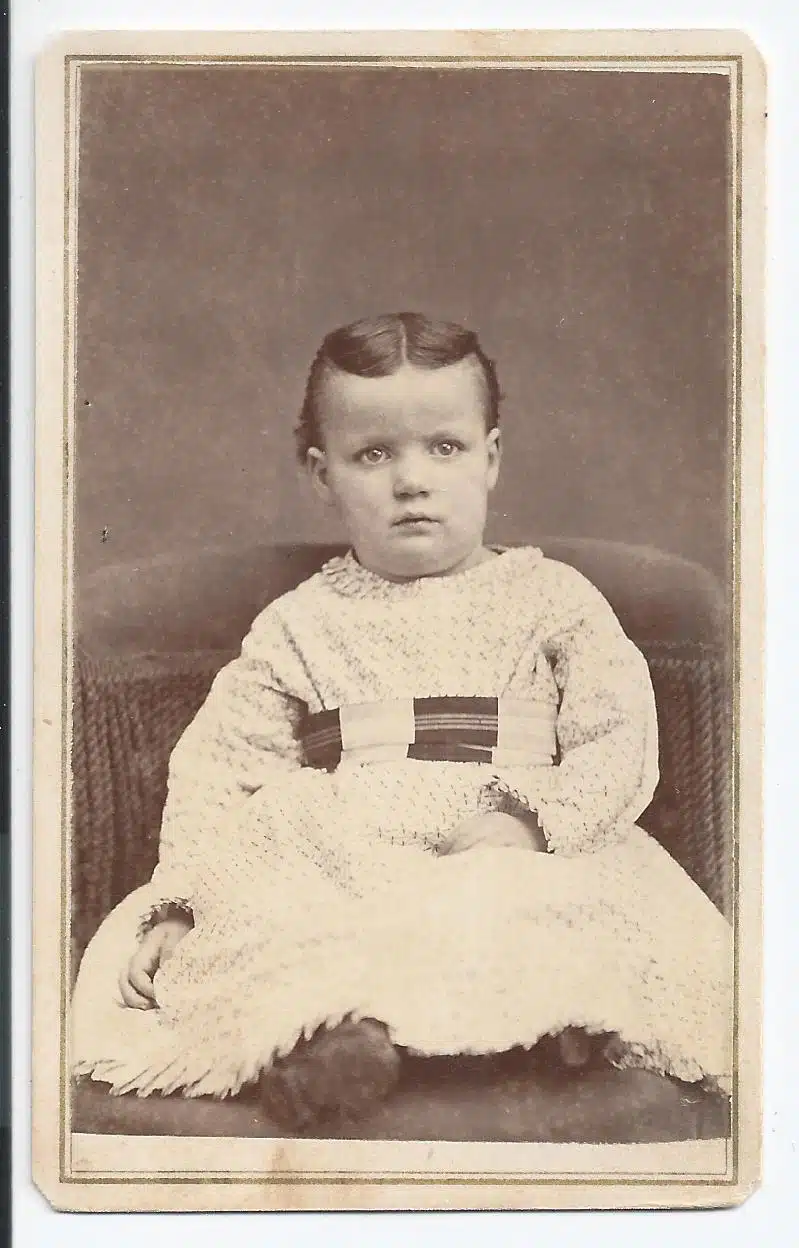
T. W. Taylor, unidentified toddler girl, 1874-1875, albumen carte-de-visite collection of the author. [Photo 15]
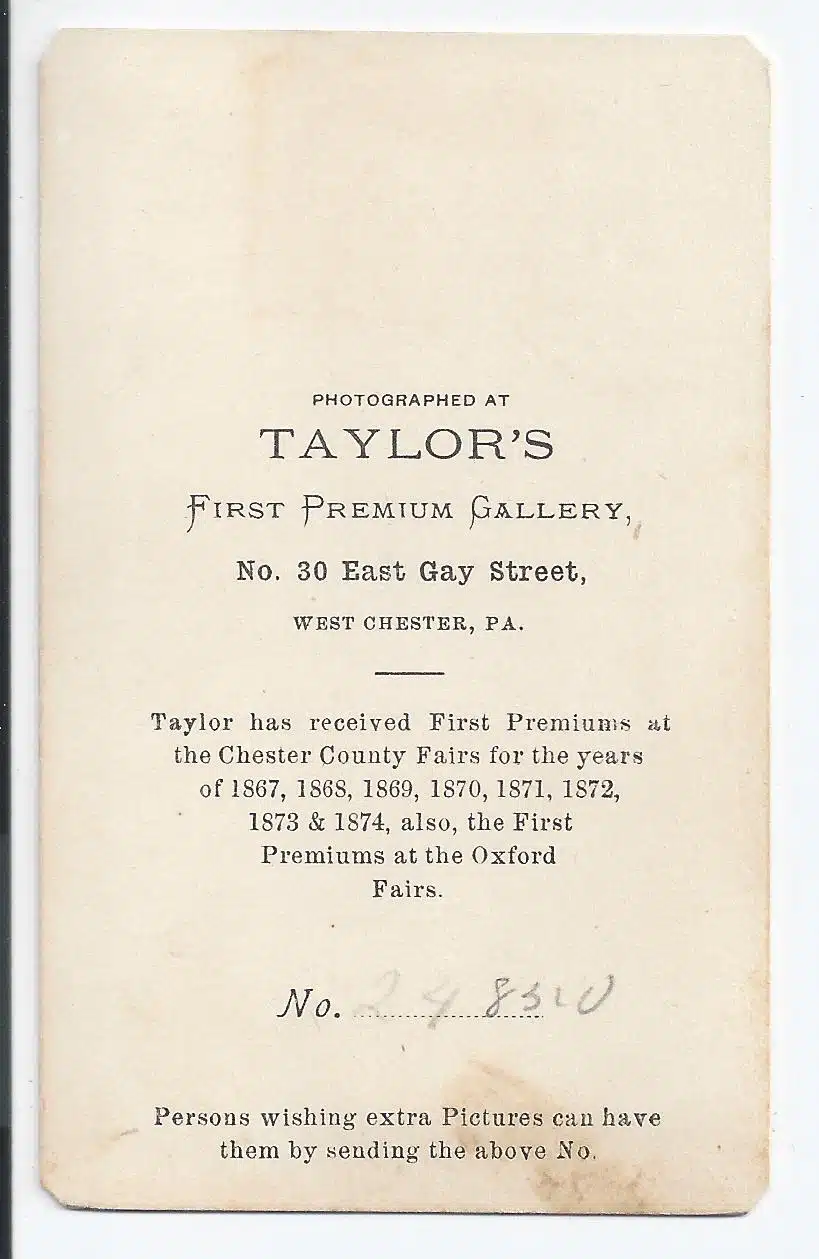
All after 1879 when West Chester’s streets were renumbered
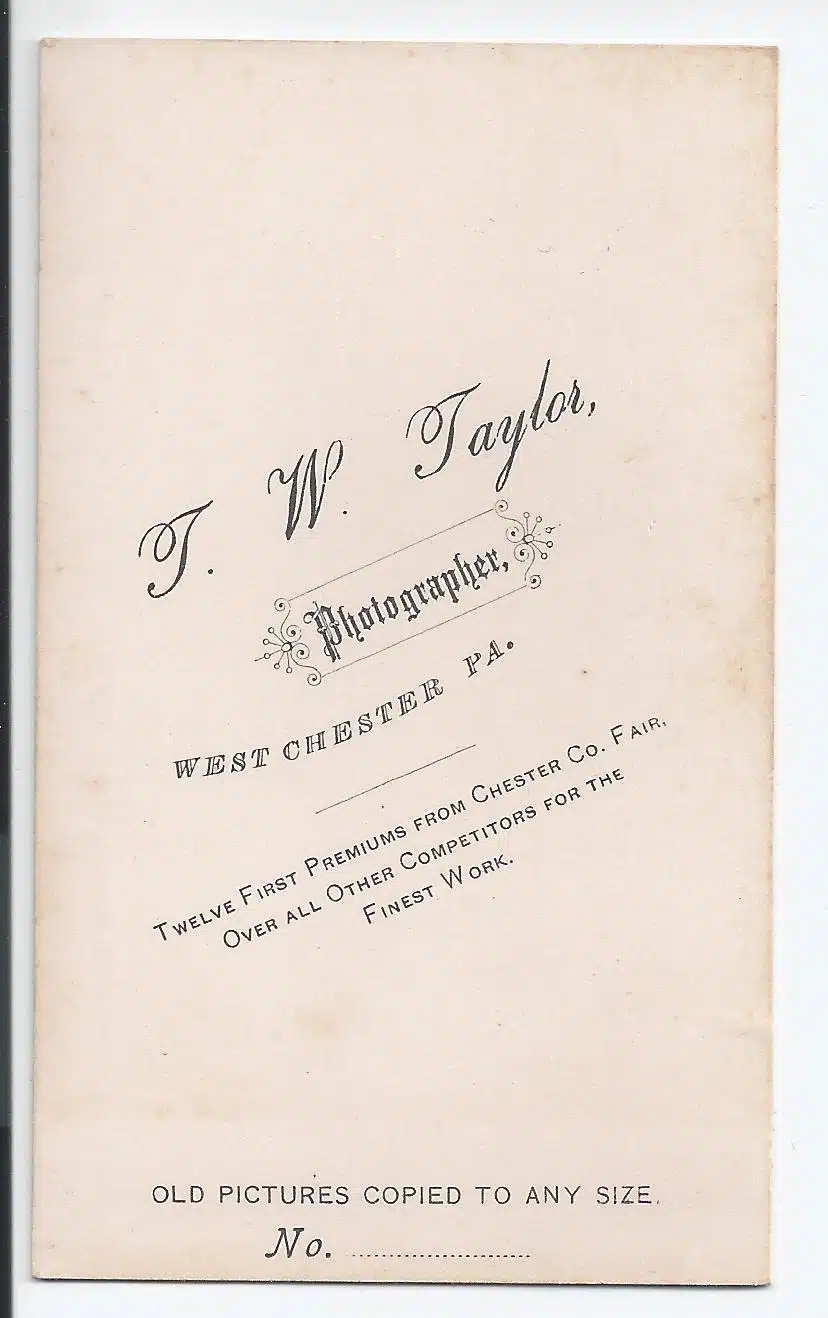
T. W. Taylor, unidentified little girl, ca. 1879, albumen carte-de-visite, collection of the author. [Photo 4] Note the advertisement of 12 first premiums.

T. W. Taylor, unidentified girl, [1880-1882], albumen carte-de-visite, collection of the author. [Photo 23] Note 15 first premiums.

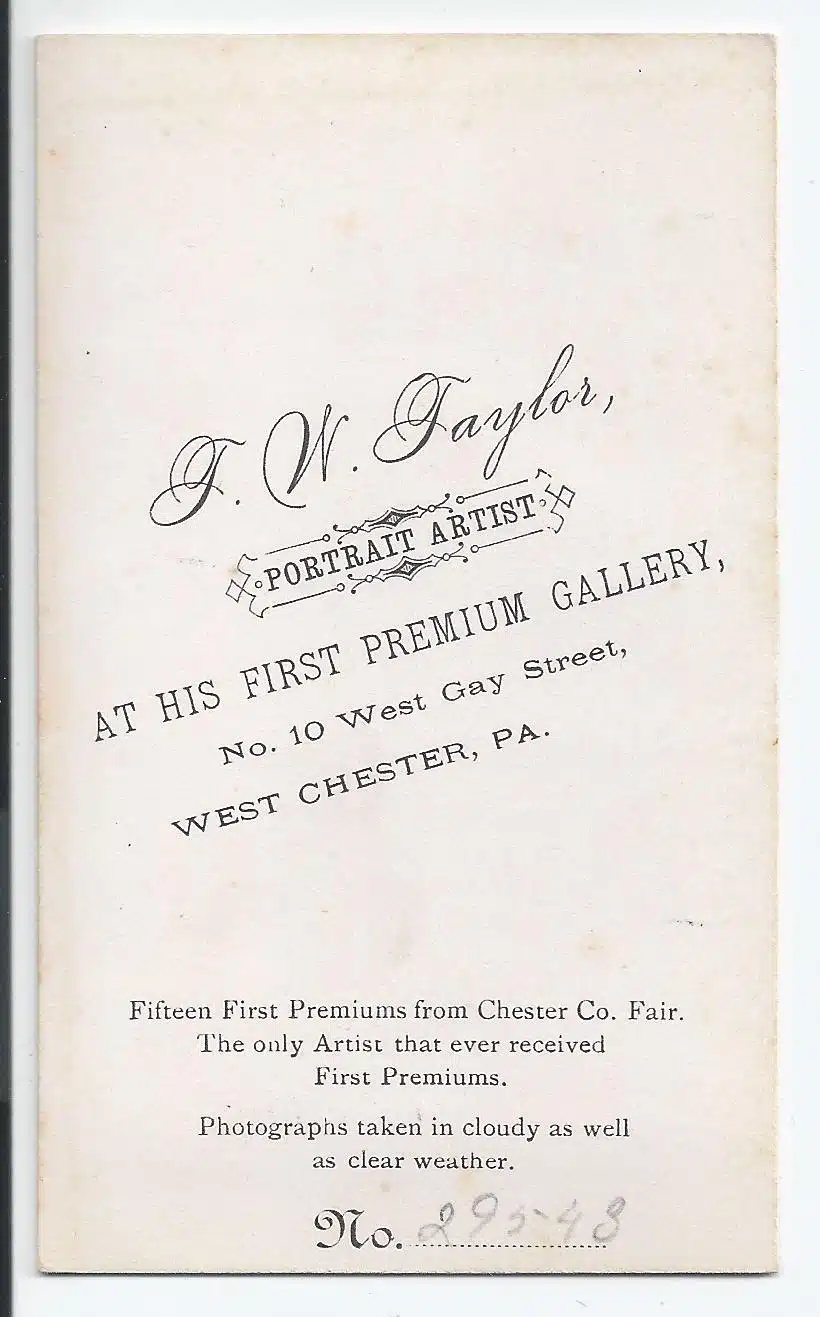
T. W. Taylor, Unidentified Quaker woman, ca. 1883, albumen carte-de-visite, collection of the author. [Photo 77] Note 24 premiums plus medal for crayons in 1882.
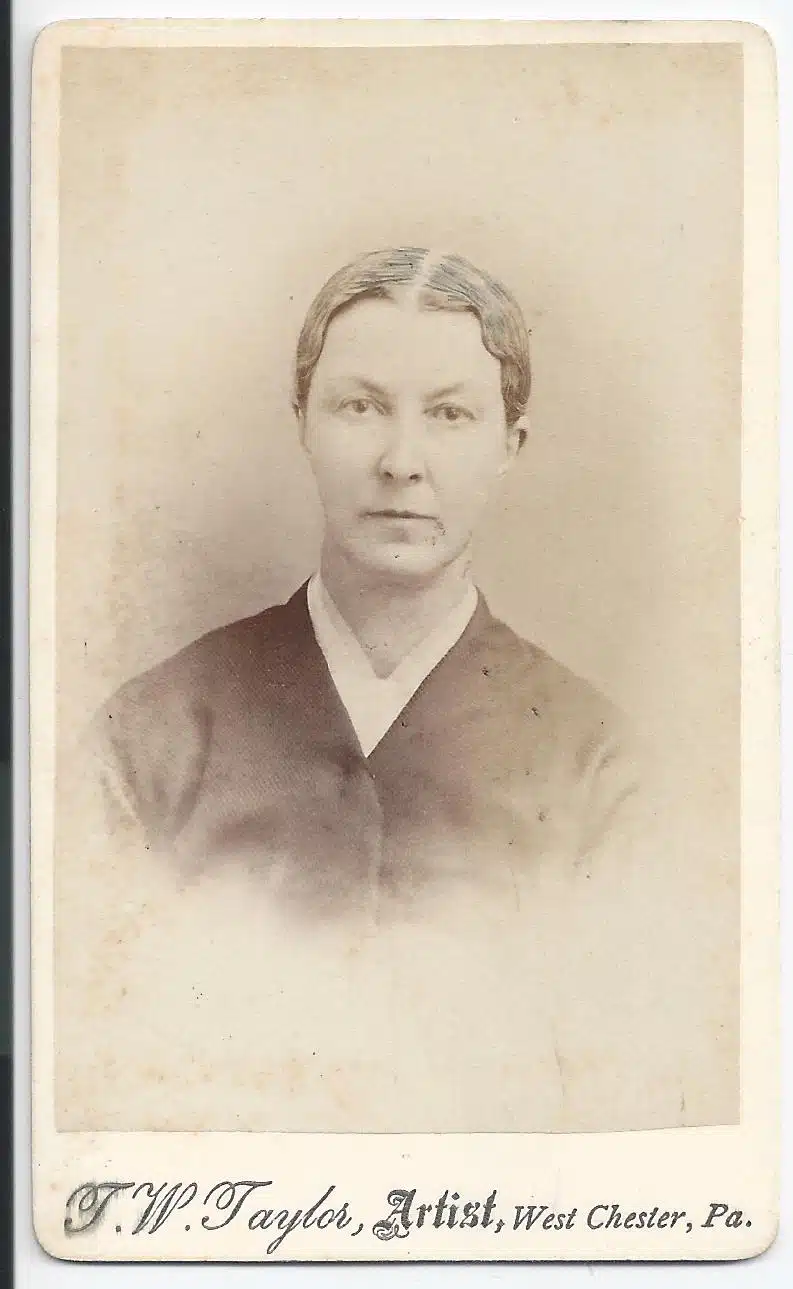

T.W. Taylor, carte-de-visite imprint, ca. 1883 – 24 premiums, collection of the author. [Photo 78 verso]
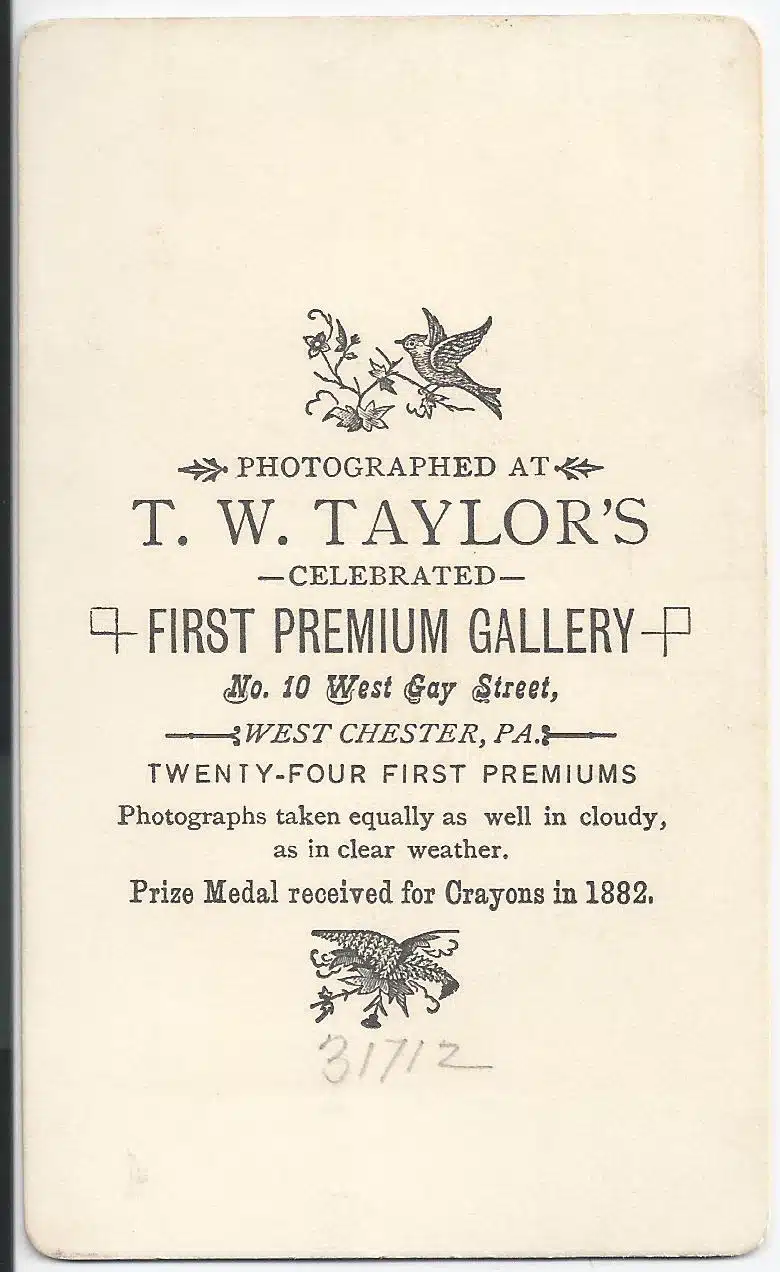
Cabinet cards
Taylor, copy photograph of elderly woman, 1890s, albumen cabinet card, collection of the author. [Photo 22]


Taylor, unidentified little boy, 1890s, albumen cabinet card, collection of the author. [Photo 53]

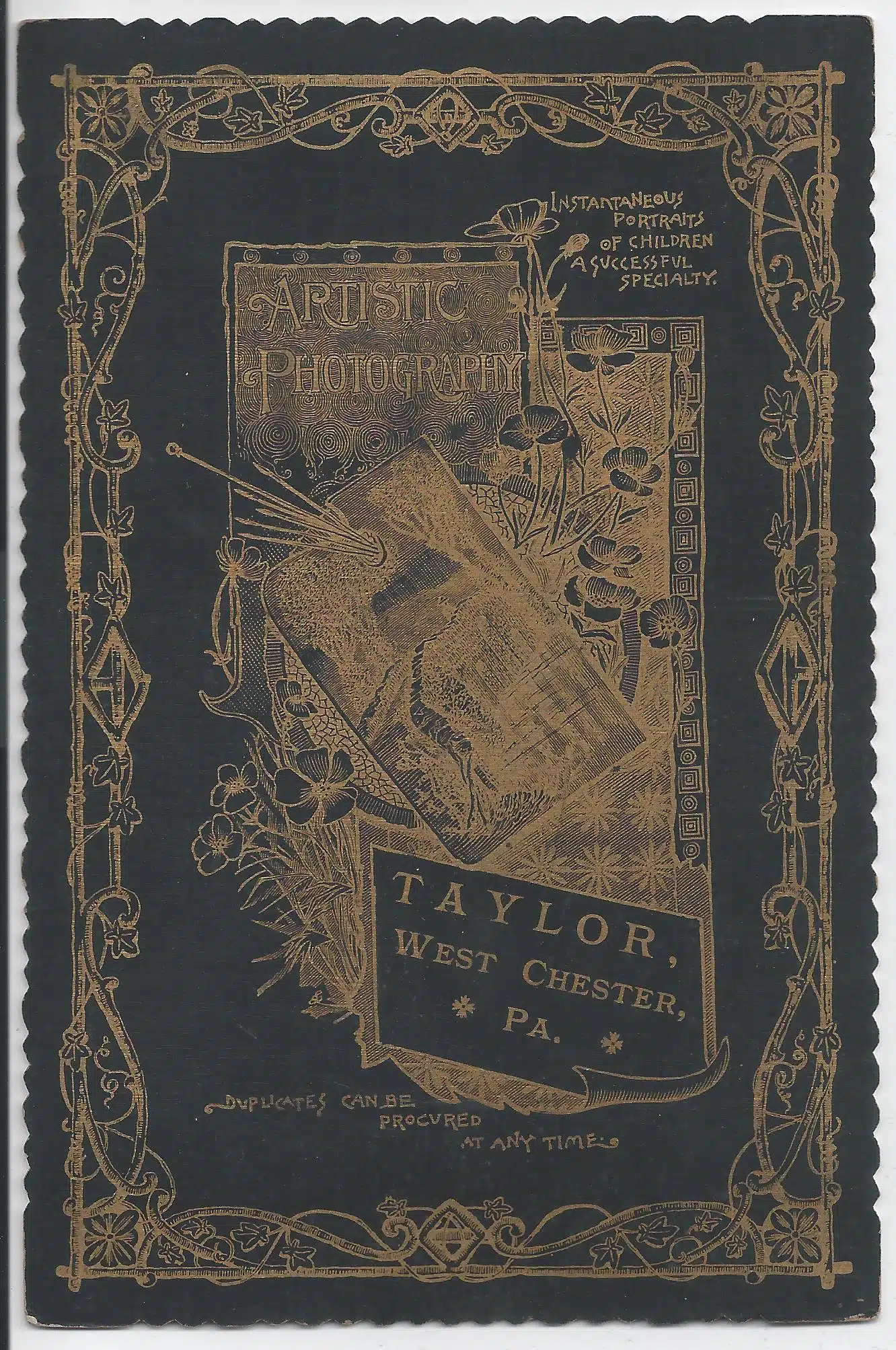
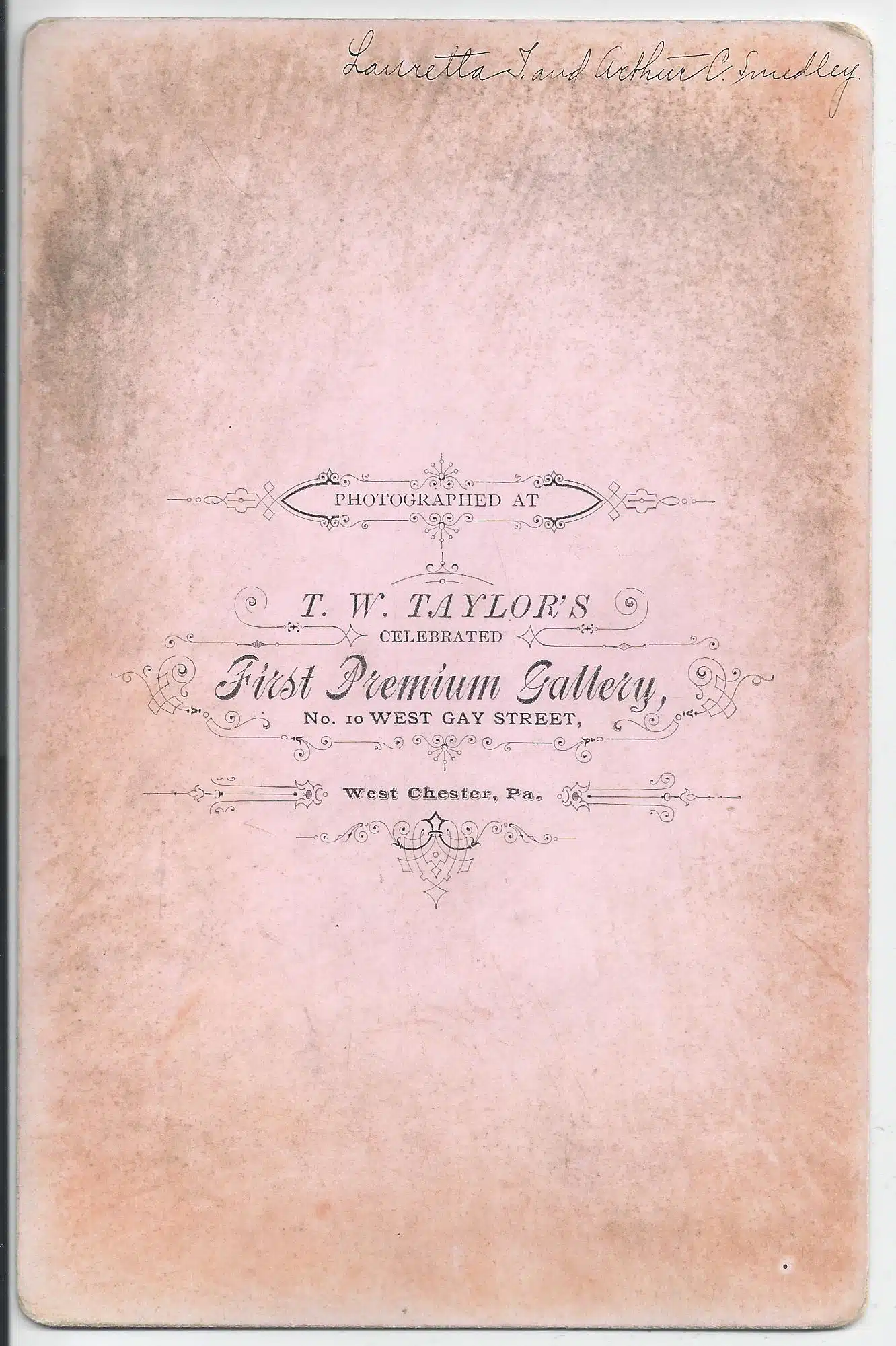
Taylor, Lauretta & Arthur C. Smedley (born 1877), ca. 1880, albumen cabinet card, collection of the author. [Photo 5] note 10 W. Gay Street address after streets renumbered in 1879.

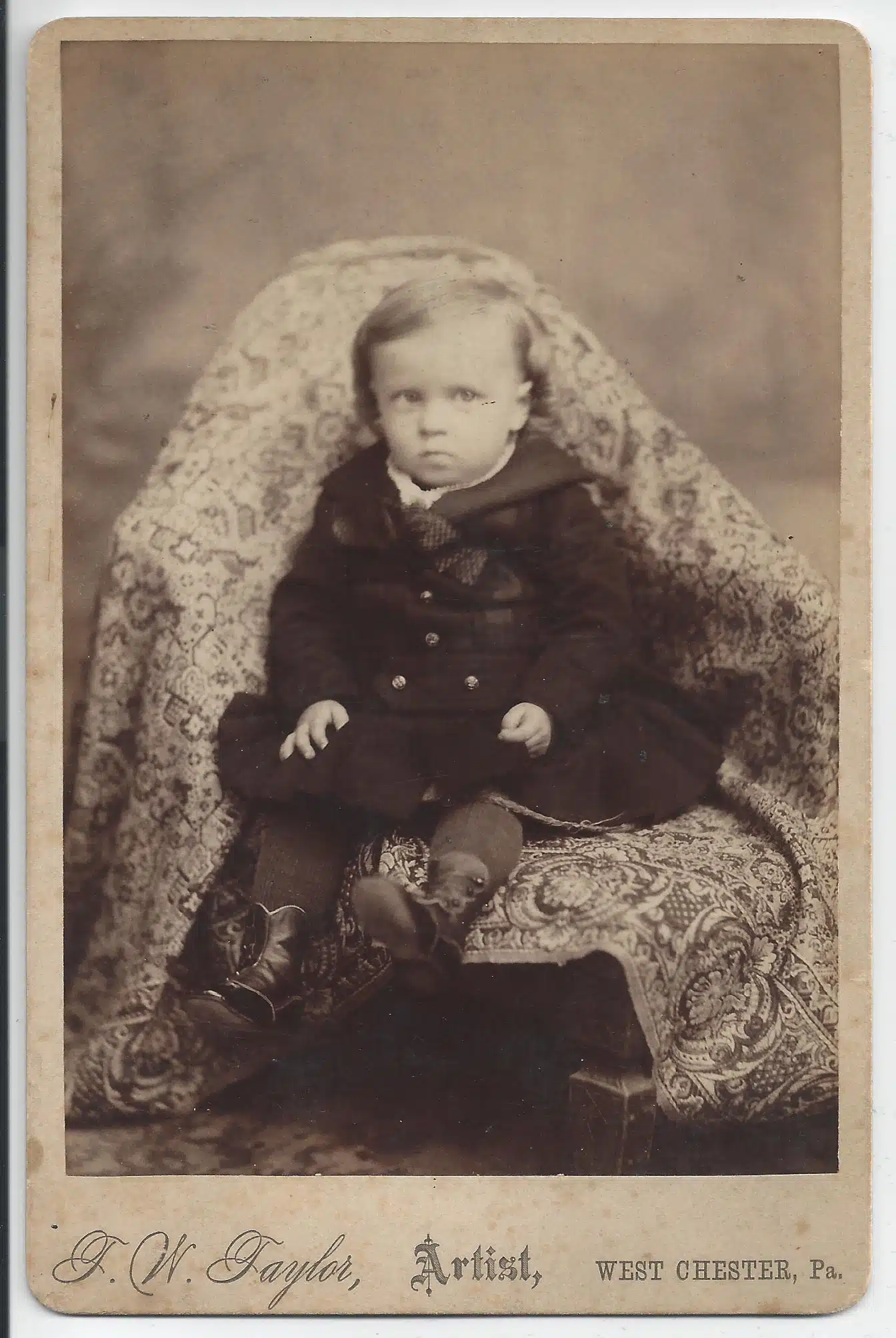
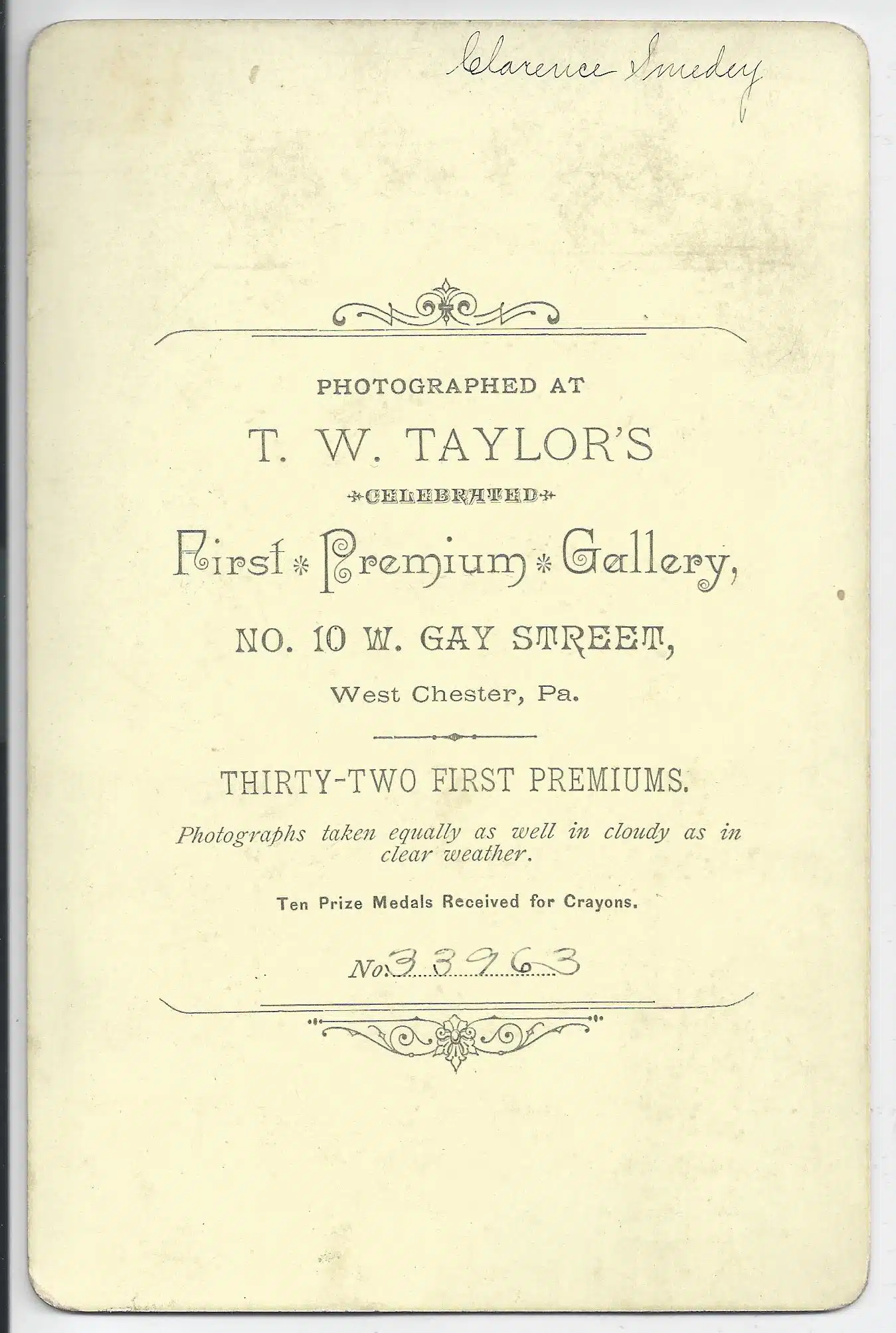
Taylor, Clarence Smedley (born 1883), ca. 1886, albumen cabinet card, collection of the author. [Photo 9] Note 32 premiums awarded.
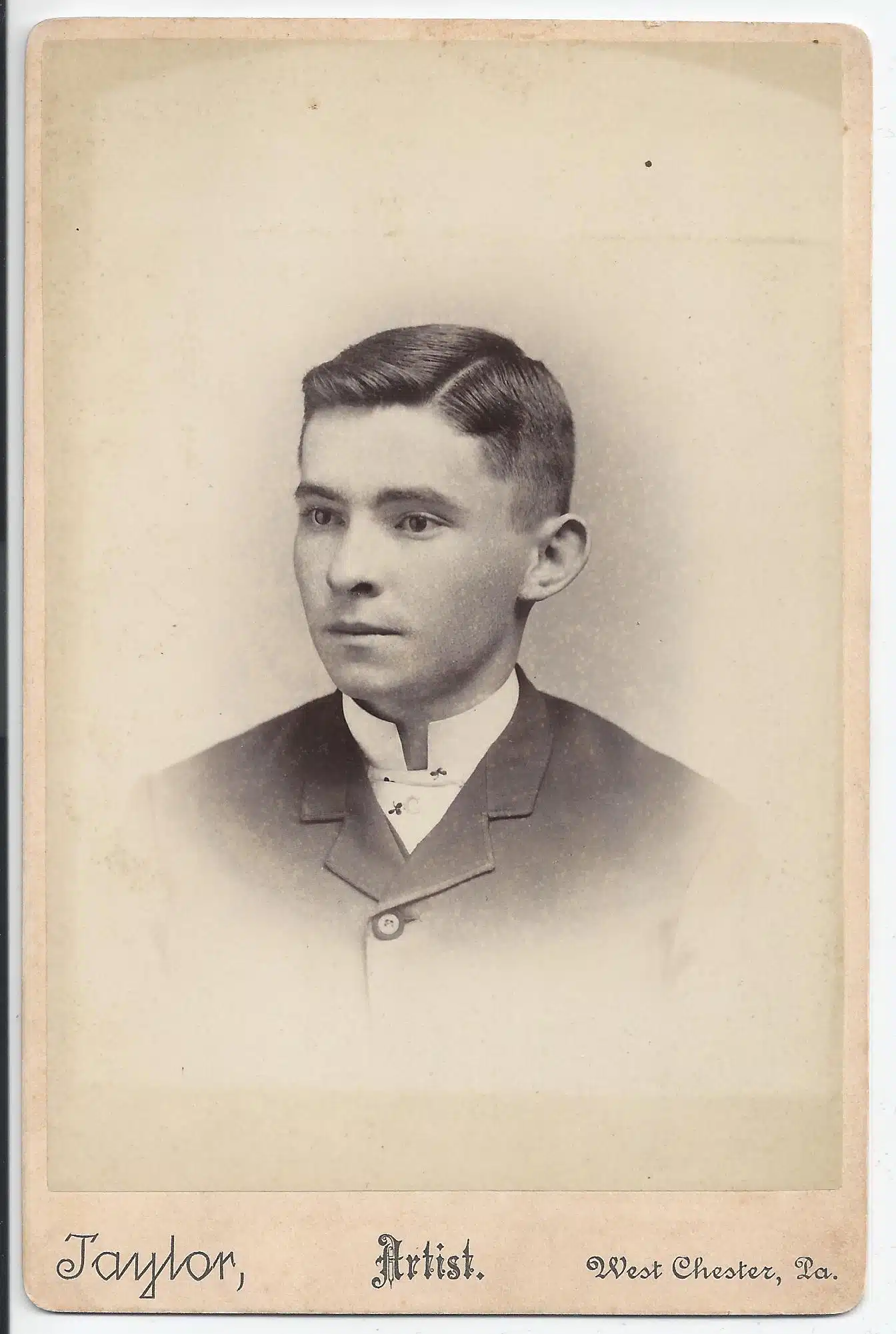
Taylor, unidentified young man, ca. 1888, albumen cabinet card, collection of the author. [Photo 39]. Note the 34 first premiums.

T. W. Taylor, Floral arrangement, “from John G. Gladman”, 1889, albumen cabinet card, collection of the author. [Photo 111] This is Taylor’s own copyrighted imprint design.

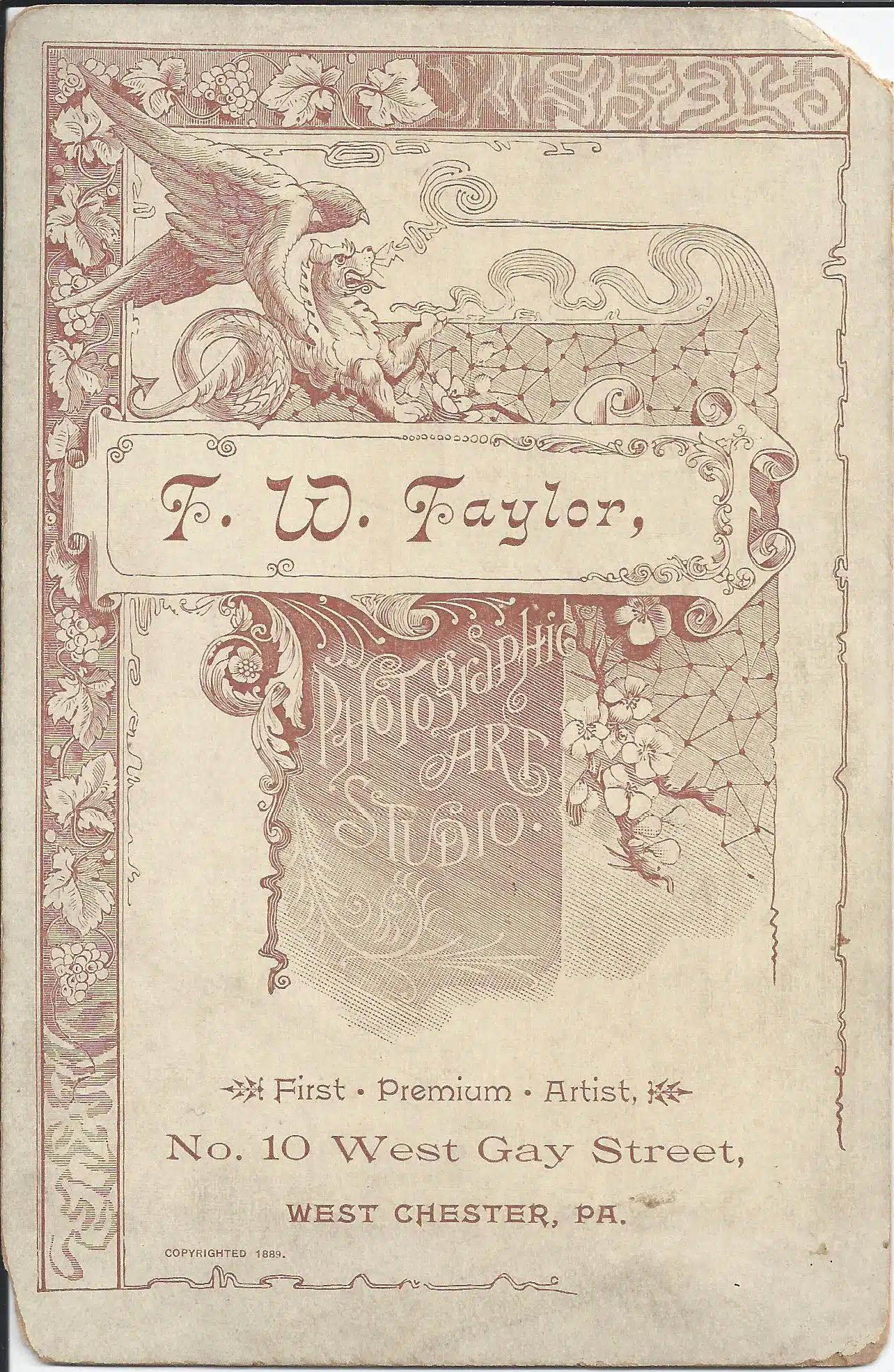
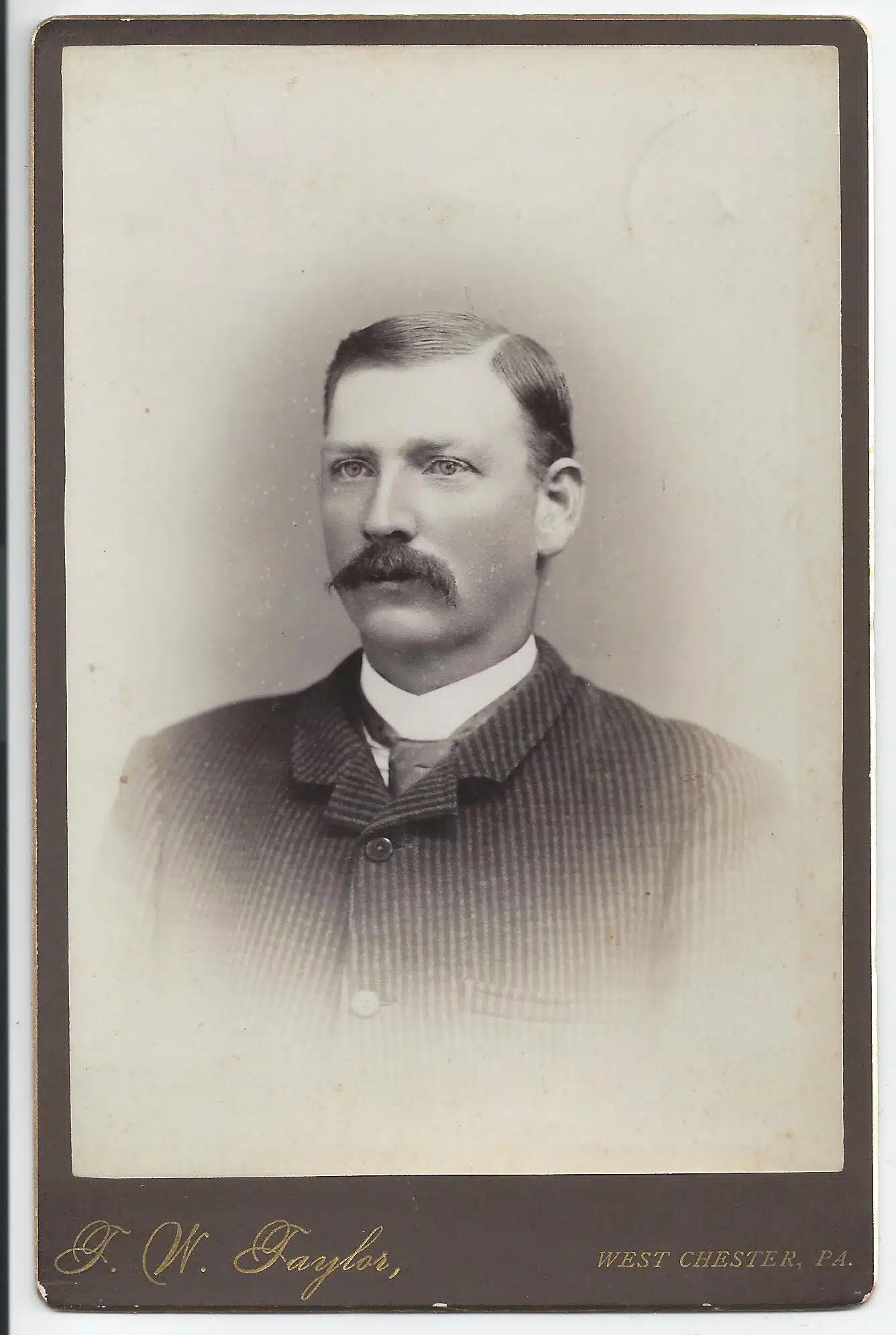
Taylor, unidentified gentleman, ca. 1890 – albumen cabinet card, collection of the author. [Photo 76 ]
Unique items
Taylor, Edith L. Martin, 1892-1893, albumen cabinet card, collection of the author. [Photo 64] This portrait was made at Taylor’s Coatesville studio operated by son Charles Taylor.

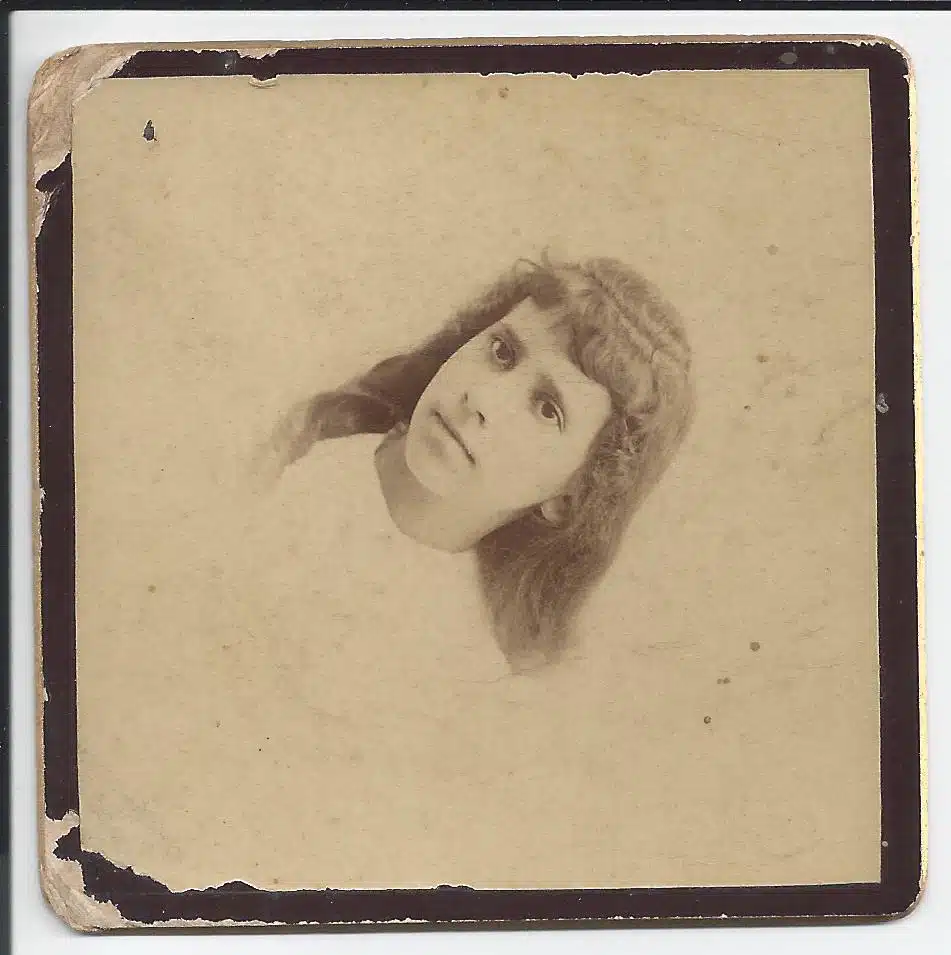
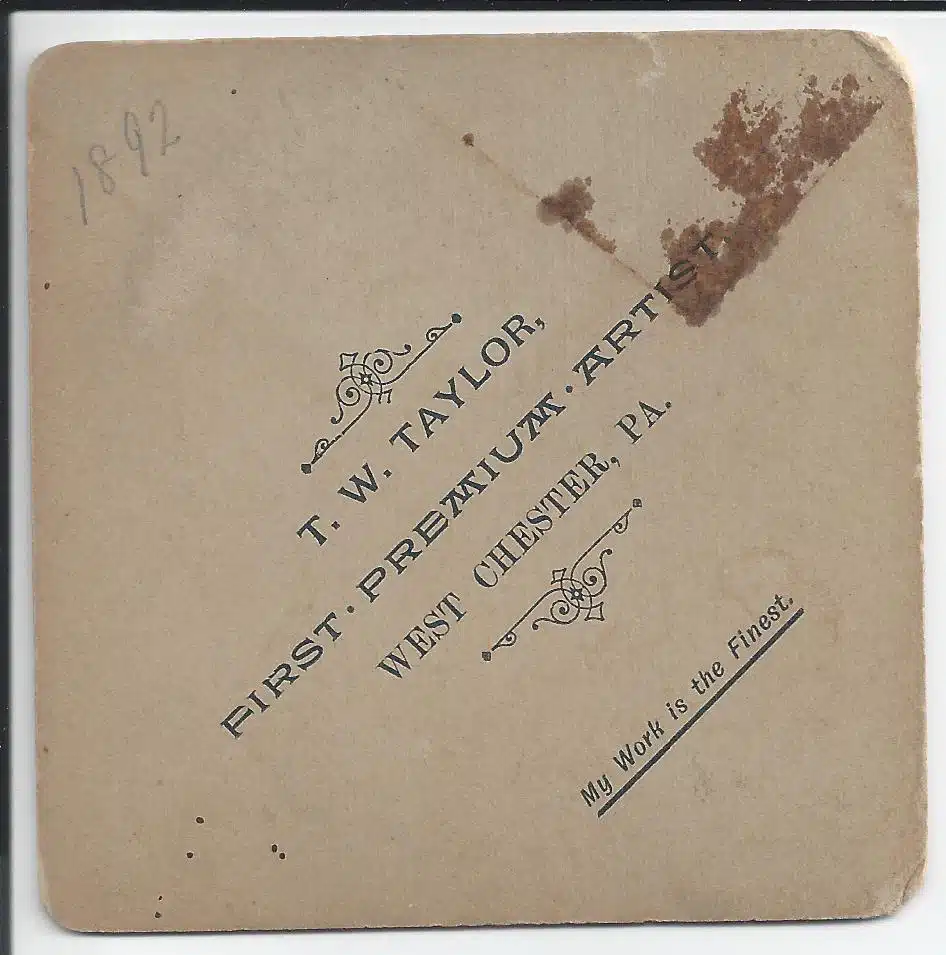
Taylor, unidentified young woman, 1892, albumen carré card, collection of the author. [Photo 18]
-
Chester County Archives, West Chester, PA, Orphan’s Court, Minor’s Estate, 1843 Taylor. ↑
-
The National Archives in Washington D.C.; Record Group: Records of the Bureau of the Census; Record Group Number: 29; Series Number: M432; Residence Date: 1850; Home in 1850: Lancaster North East Ward, Lancaster, Pennsylvania; Roll: 788; Page: 306a. ↑
-
The move to Philadelphia is mentioned in Taylor’s obituary and is verified by Amos and Elizabeth Highfield listed in the 1860 Federal Census in Ward 15 in Philadelphia. ↑
-
Obituary, Daily Local News (West Chester, PA), 4 April 1904. ↑
-
James E. McClees, Craig’s Daguerreian Registry, Daguerreian Registry Home Page (craigcamera.com) ↑
-
Orphan’s Court Minor’s Estate, 1843, Thomas Taylor, Chester County Archives and Records Services, West Chester, PA. ↑
-
Website: Measuring Worth, https://www.measuringworth.com/calculators/uscompare/relativevalue.php ↑
-
West Chester Tax List, 1862, Chester County Archives and Records Services, West Chester, PA. ↑
-
Samuel P. Bates, History of the Pennsylvania Volunteers, 1861-1865. (Harrisburg: B. Singerly, 1870) Volume IV, p. 99. ↑
-
Obituary, Daily Local News (West Chester, PA) 4 April 1904. ↑
-
The Village Record (West Chester, PA) 27 June 1863. ↑
-
Henry Wilson Ruoff, ed. Biographical and Portrait Cyclopedia of Montgomery County, Pennsylvania, (Philadelphia: Biographical Publishing Company, 1895), p. 257. ↑
-
Pamela C. Powell, “Nathan Parker’s War of Words with Isaac Rehn”, Daguerreian Society Annual, 2019, p.75. ↑
-
W. Andrew Boyd, comp., Boyd’s Chester County Directory, 1890-1891. Containing a Complete, General and Business Directory of West Chester, Phoenixville, Coatesville and Oxford, Pennsylvania. (Washington, D.C.: W. Andrew Boyd, 1890), p. 109. ↑
-
1870 United States Census; Census place: West Chester, Chester, Pennsylvania; Roll: M593_1325; Page:166B: Family History Library Film:552824. ↑
-
Daily Local News, (West Chester, PA), 10 April 1901. ↑
-
Daily Local News, (West Chester, PA), 20 July 1948. ↑
-
Daily Local News, (West Chester, PA), 2 November 1875. ↑
-
Daily Local News, (West Chester, PA), 29 July 1875. ↑
-
Daily Local News, (West Chester, PA) 30 August 1883. ↑
-
Chester County Archives, West Chester, PA. Common Pleas Appearance Papers #1, April 1865. ↑
-
The Village Record (West Chester, PA), 6 September 1864. ↑
-
William A. McKay, A Directory of Delaware Photographers 1839-1900 and Beyond, (New Castle, Delaware: Oak Knoll Press, 2018), page 225. ↑
-
Internal Revenue Service Tax Assessment List, May 1864, Division 1, District 7, West Chester, Pennsylvania. ↑
-
Robert O. Brown, Collector’s Guide to 19th Century Traveling Photographers, as referenced in Carl Mautz, Biographies of Western Photographers, (Nevada City, California: Carl Mautz Publishing, 2018), p. 591. ↑
-
Historical Society of Pennsylvania; Philadelphia, Pennsylvania; Historic Pennsylvania Church and Town Records; Reel: 944. ↑
-
Jeffersonian, (West Chester, PA), 11 February 1871. ↑
-
Thomas W. Taylor, Wilmer E. Smedley, carte-de-visite CDV#1755 Photo Archives, Chester County History Center, West Chester, PA. ↑
-
“Prize medal received for Crayons in 1882” Thomas W. Taylor, Clara Knerr, CC#586 Photo Archives, Chester County History Center, West Chester, PA. ↑
-
Thomas W. Taylor, Mary Agnew Taylor, Cabinet card copy photograph, CC#1232 Photo Archives, Chester County History Center, West Chester, PA. ↑
-
Handbill for T.W. Taylor & Brother, undated. Newspaper Clippings file: Coatesville business houses. Library collection. Chester County History Center, West Chester, PA. ↑
-
Daily Local News, (West Chester, PA) 18 October 1879. ↑
-
Jeffersonian (West Chester, PA), 6 July 1872. ↑
-
Jeffersonian (West Chester, PA), 15 April 1873. ↑
-
Daily Local News, (West Chester, PA), 15 April 1873. ↑
-
Daily Local News, (West Chester, PA), 24 March 1876 and 10 June 1876. ↑
-
A.S. Brown, comp. West Chester and Philadelphia Railroad Guidebook & Industrial Journal, (Lancaster, PA: A. S. Brown, 1876), 66-67. ↑
-
Daily Local News, (West Chester PA), 24 September 1880. ↑
-
Daily Local News, (West Chester, PA), 24 December 1885. ↑
-
Thomas W. Taylor, West Chester Pioneer Corps., Photo/DN34/Box 1, Photo Archives, Chester County History Center, West Chester, PA. ↑
-
Undated newspaper clipping from an unidentified paper, Library manuscript collection MS78101, Chester County History Center, West Chester, PA. ↑
-
Morning Republican (West Chester, PA), 31 August 1896. ↑
-
Daily Local News, (West Chester, PA), 26 December 1945. ↑
-
Wayne Fencibles Minute Book Ms78090. Library Manuscript Collection, Chester County History Center, West Chester, PA. ↑
-
Paul Dickson, The Great Railroad War of 1877, American Heritage, spring 2020, Volume 65 issue 2. ↑
-
Wikipedia, The Great Railroad War in Pittsburgh, https://en.wikipedia.org/wiki/Pittsburgh_railroad_strike_of_1877 ↑
-
Obituary, Thomas W. Taylor, Daily Local News, (West Chester, PA), 4 April 1904. ↑
-
Daily Local News, (West Chester, PA), 5 March 1879. ↑
-
Daily Local News, (West Chester, PA), 9 October 1879. ↑
-
Daily Local News, (West Chester, PA), 19 April 1879. ↑
-
Daily Local News, (West Chester, PA), 14 October 1879. ↑
-
Letter to the editor, Daily Local News, (West Chester, PA), 14 October 1879. ↑
-
Daily Local News, (West Chester, PA), 17 October 1879. ↑
-
Daily Local News, (West Chester, PA), 20 May 1880. ↑
-
Daily Local News, (West Chester, PA), 14 December 1881. ↑
-
Harrisburg Telegraph, (Harrisburg, PA) 14 November 1872. ↑
-
The Jeffersonian, (West Chester, PA), 16 November 1872. ↑
-
Daily Local News, (West Chester, PA), 2 October 1878. ↑
-
T. W. .Taylor, Preparing for Summer albumen photographs, Uriah H. Painter Collection, DN40/Box1/File 1, Photo Archives, Chester County History Center, West Chester, PA. ↑
-
Thomas W. Taylor, Chester County Bar Association, Photo OV/A24 Photo Archives, Chester County History Center, West Chester, PA. ↑
-
Daily Local News, (West Chester, PA), 19 January 1880. ↑
-
Daily Local News, (West Chester, PA)), 3 January 1882. ↑
-
Daily Local News, (West Chester, PA), 14 June 1882. ↑
-
Thomas W. Taylor, Home of Hon. William Darlington, West Chester, PA, [1870s] stereograph collection, Photo Archives, Chester County History Center, West Chester, PA. ↑
-
Daily Local News, (West Chester, PA), 8 September 1891. ↑
-
Daily Local News, (West Chester, PA), 27 November 1885. ↑
-
Thomas W. Taylor, Hose Carriage of the First West Chester Fire Company, CDV2406 Photo Archives, Chester County History Center, West Chester, PA. ↑
-
Obituary Thomas W. Taylor, Daily Local News, (West Chester, PA), 4 April 1904. ↑
-
Daily Local News, (West Chester, PA), 28 March 1890. ↑
-
Dog Register 1855-1912, Entry 522 page 304. Chester County Archives and Records Services, West Chester, PA. ↑
-
Program, Chester County Teacher’s Institute for 1890, ephemera file, Chester County History Center, West Chester, PA. ↑
-
Daily Local News, (West Chester, PA), 16 June 1890. ↑
-
Coatesville Weekly Times (Coatesville, PA), 21 March 1891. ↑
-
Deed, U10 Volume 242 page 490, Land Records, Chester County Archives and Records Services, West Chester, PA. ↑
-
Chester County Democrat, (West Chester, PA), 14 March 1895. ↑
-
Deed E11, Volume 252, page 174, Land records, Chester County Archives and Records Services, West Chester, PA. Note: Taylor assumed a mortgage of $6,000 on the property according to Mortgage Book K3 Volume 59 page 80. ↑
-
Morning Republican (West Chester, PA), 11 June 1898. ↑
-
Morning Republican (West Chester, PA), 15 September 1898. ↑
-
Deed V11 Volume 268, page 72, Land Records, Chester County Archives and Records Services, West Chester, PA. ↑
-
Wikipedia, List of Recessions in the United States, https://en.wikipedia.org/wiki/List_of_recessions_in_the_United_States ↑
-
Thomas W. Taylor, The Executive Committee of the West Chester, Pennsylvania Centennial, 1899. Photo/OV/A25 Photo Archives, Chester County History Center, West Chester, PA. ↑
-
Robert L. Hayes, Findagrave https://www.findagrave.com/memorial/208053982/robert-l-hayes ↑
-
Daily Local News (West Chester, PA), 4 April 1904 ↑
-
Thomas W. Taylor, Wills & administrations File #29924, 1904. Chester County Archives & Records Services, West Chester, PA. ↑
-
Thomas W. Taylor Estate, Orphan’s Court File #7482. Chester County Archives & Records Services, West Chester, PA. ↑