Levi Crowl
( 1820 – 1890 )
One Dollar and Upwards
Itinerant daguerreotypist Levi Crowl came to West Chester with business partner Philip Price intending to stay for a short time in 1850. Instead he established a prosperous studio which he sold to Eber Woodward in November of 1854. He then migrated south to Fayetteville, North Carolina for the winter trade returning to West Chester in the summer of 1855. Crowl returned to Fayetteville in November of 1855 and operated his studio through March of 1856. He then relocated to Wilmington, North Carolina operating a prominent studio until the spring of 1861. When the Civil War erupted, Crowl returned to Oxford to enlist in the 124th Regiment of the Pennsylvania Volunteers. After his service was over, he worked as a photographer only briefly near Oxford, then became a postal mail agent on the railroad.
The Crowl family of East Nottingham, Pennsylvania descended from Alexander Crowl who immigrated from Scotland in 1784 to settle with other Scots Irish in the southwestern section of Chester County.[1] Levi Crowl was the son of Alexander Crowl, Jr. (1777-1827) and his second wife Elizabeth McCormick. When his father died, Levi was only seven years old. Neighbors James Hutchinson and Mathew Gibson[2] were appointed as guardians for Levi and his brother William.[3]
Through his father’s will, Elizabeth and the eldest son, Finley, were to manage the family farm and make sure that the younger children received schooling. Then after four years, Alexander Crowl’s personal property could be sold and distributed to the family members according to the will. He requested that the farm be kept in the family, either as a whole or divided. Young Levi received a share in the estate.[4]
At age 21, Levi purchased 38 acres and 41 perches of the family land in East Nottingham in April of 1841 from his elder brother, James Latta Crowl.[5] He farmed[6] this property until he sold it in April of 1850 for $963.[7] That’s when Levi’s career as a daguerreotypist began.
It was in the May 28, 1850, edition of the American Republican, Price and Crowl announced their arrival in West Chester to take daguerreotypes.
“Col’d Daguerreotype Portraits – Price & Crowl have taken rooms in Everhart’s Building on Market Street, West Chester, where they propose remaining a short time and respectfully invite the Ladies and Gentlemen of West Chester and vicinity who may want a real good picture to call and see their specimens. They guarantee their pictures to give perfect satisfaction or no charge. For children a clear day between 1 and 5 is preferable. In dress avoid white, blue or light pink.”
In mid-June Price and Crowl took the opportunity to exhibit “cases of daguerreotypes” at the Chester County Horticultural Society’s exhibit in Horticultural Hall in West Chester.[8] Business for daguerreotype portraits must have been good because in September, they moved their studio into the Hemphill Building across the street from the Chester County Courthouse.[9] This building with its prominent location and better lighting from the tall windows enhanced their business. So much for the intention of spending only a short time, the partners found a lucrative market here to establish a business instead of becoming itinerants.
During this time in 1850, Price and Crowl had competition from two other daguerreotypists. Chalkley Valentine a local dentist, was also taking likenesses on Market St., West Chester. Their main competition came from Thomas Van Osten who made headlines while there from July to October 1850.
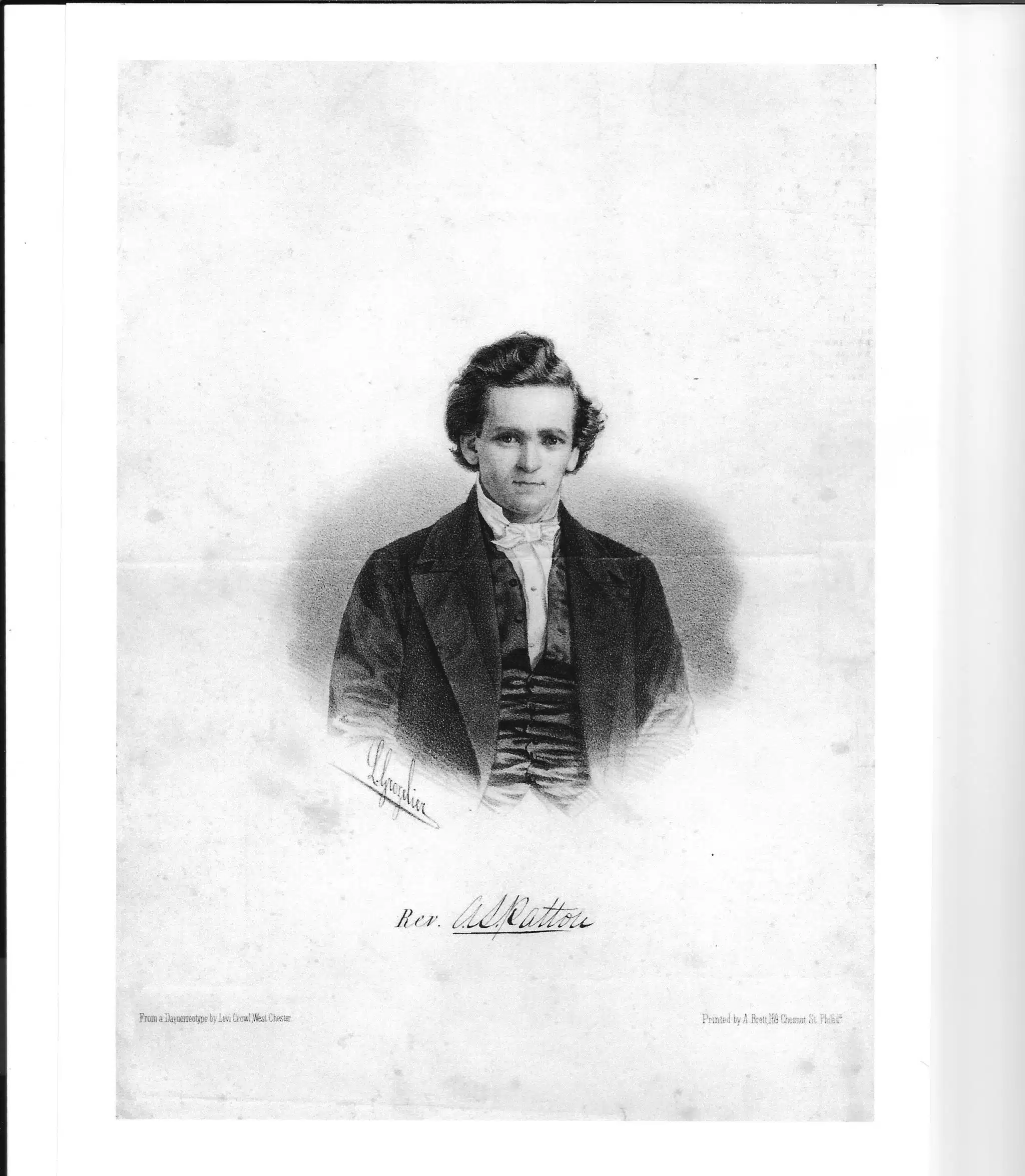
By December of 1850, Crowl’s partnership with Price was dissolved and Crowl announced his intention to continue the business in the Hemphill Building.[10] An excellent example of Crowl’s portrait daguerreotypes was shown to me by a CCHC visitor back in the 1990s. In the case beneath the daguerreotype plate was the inscription: “Taken in W Chester by Levi Crowl, Daguerrian 1850.” Even if there are no documented examples readily available in public collections, we can assess the quality of his work through a daguerreotype that was used by an artist to create a print. The only example in the CCHC collection is a lithograph of Rev. A. S. Patton drawn by L. Grozelier[11] and is reproduced here.
Rev. A. S. Patton, lithograph by L. Grozelier drawn from a daguerreotype by Levi Crowl, West Chester and printed by A. Brett, Philadelphia, undated. Courtesy of Chester County History Center, West Chester, PA.
To keep up the clientele, Crowl constantly advertised in West Chester’s many small newspapers. Most of his advertisements are only two lines, featuring some eye-catching quip along with his location. Here is a sampling of his advertisements:
“Crowds are daily visiting Crowl’s Daguerreotype Rooms, in West Chester, is an evidence of his ability to take good pictures, and he still invites the public to give him a call in Hemphill’s Building, High Street, directly opposite the Court House.” From the American Republican, January 7, 1851.
“The Pictures that I saw taken at Crowl’s Daguerreotype Rooms excel anything that I have ever seen. Rooms free for admission, in Hemphill’s building, High Street, directly opposite the Court House.” From the American Republican, January 14, 1851.
“Why is it that the ladies are all visiting Crowl’s Daguerreotype Rooms? Because he flatters them in taking good and correct pictures. He also respectfully invites the gentleman give him a call at his rooms in Hemphill’s Building, High street directly opposite the Court House.” From the American Republican January 21,1851.
“DAGUERREOTYPES are best appreciated when our friends are lost – then do not delay, but call at Crowl’s Daguerreotype Rooms and get your picture taken….” From The Village Record February 18, 1851.
Crowl’s business flourished, he was still operating his Daguerreotype Rooms in 1852. He is recorded in West Chester’s Tax list for 1851 and 1852 as a single freeman at the tax valuation of 150 for a tradesman.
The Horticultural Society Exhibitions were key for the trades to showcase their wares. The Society’s 1852 report mentioned “a very handsome display of daguerreotypes by Levi Crowl of West Chester, was much admired.”[12] His competition at the exhibit were two other West Chester daguerreotypists, Chalkley Valentine and M. B. Yarnall.
He constantly relied on the newspaper to keep his name before the public. Crowl faced competition from daguerreotypists Norris Peters and M. B. Yarnall in 1852 & 1853. Here are a few of Crowl’s advertisements:
“Person’s having their daguerreotypes taken at Crowl’s, should avoid in dress, white, blue or light pink. Rooms in Hemphill’s Building, High Street, directly opposite the Court House.” From The Jeffersonian, August 10, 1852.
“The Whigs on Saturday were somewhat disappointed in speakers, but many were not disappointed in getting a superior picture taken by CROWL at his rooms in Hemphills Building, High Street, directly opposite the Court House.” From Register and Examiner October 5,1852.
Crowl had some unusual customers too. The Jeffersonian of October 12, 1852, reported “Mr. Levi Crowl of West Chester, took the daguerreotype of three fine fat sheep, on Saturday last.”[13]
He advertised in the Register and Examiner of December 7, 1852, that he had plenty of fancy cases and gold medallions just perfect to put your daguerreotype portrait in for holiday gift-giving. His trade must be going well since in the 1853 West Chester Tax List his tax valuation increased to 300.
During 1853 his tax status changed when he married Amanda Mercer, and the couple moved into a rented house. Levi Crowl also bought a “58-foot unseated [undeveloped] lot on Market Street.”[14] The couple had their first son, Frank, on December 28, 1853.[15]
His daguerreotype business continued to be strong as reflected through these following advertisements:
“A HORSE DAGUERREOTYPED – on Tuesday last, Capt. Holman brought his splendid Norman Stallion to our Borough and had him daguerreotyped by Crowl, who as he always does, made a correct and beautiful picture.” From the American Republican April 19, 1853.
“GREAT railroad disaster -fifty lives lost, and all, perhaps, without the blessed privilege of visiting Crowl’s Daguerreotype Rooms in Hemphill’s Building, High street, directly opposite the Court House, West Chester.” From the American Republican May 10, 1853.
“You may roam in a distant clime, far from relatives and friends, but a great satisfaction is to have a Daguerreotype taken by Crowl at his skylight gallery, in Hemphill’s Building, High street directly opposite the Court House.” From the American Republican November 29, 1853.
“Drawing Room Companions, are Daguerreotypes of absent friends taken by Crowl at his sky light gallery in Hemphill’s Building, High street directly opposite the court house, West Chester.” From the Village Record, January 14, 1854.
Crowl put his business up for sale in November of 1854 and it was purchased by Eber Woodward and his partner William Cheyney.[16] For many daguerreotypists, winter, especially January through March, was a slow time, owing to bad weather conditions and decreased sunlight. Some daguerreotypists found it more lucrative to head south for the winter and return north in the summer months. This was Crowl’s plan for 1855.
In 1855, Crowl partnered with a “Mr. Cochran” to conduct a daguerreotype studio in Fayetteville, North Carolina according to the Fayetteville Observer of January 1, 1855. They had their daguerreotype rooms above the drug store of Doctors Foulke and McRae on Hay St., opposite the Fayetteville Hotel.[17] Fayetteville was a bustling town situated on a major thoroughfare, an excellent location for business.
Through January and February of 1855, Crowl & Cochran’s Daguerreotype Rooms were advertised in the local newspapers. Here is a sampling of their advertising:
“THE NEW DAGUERRIAN ROOMS OF CROWL & COCHRAN Attract much attention. Their beautiful LIFE LIKE DAGUERREOTYPES will never fail to please all who may favor them with a call at their Rooms over Drs. Foulkes & McRae’s Drug Store, east corner opposite Fayetteville Hotel, Hay St. Fayetteville, Jan. 6, 1855.[18]” From The North Carolinian, January 6, 1855.
“TO MOTHERS. With what care and anxiety does a Mother look upon her dear little children, whose prattling innocence binds the cord of affection, so that when Death summons one of them away forever from her sight, she is heard sorrowfully exclaiming, if I only had its Daguerreotype, I would be better satisfied. Now you have a chance, come right along to Crowl & Cochran’s Rooms, over Foulkes & McRae’s Drug Store, Hay Street, directly opposite the Fayetteville Hotel.[19]” From Fayetteville Semi-Weekly Observer, January 29, 1855.
“DAGUERREOTYPES. CROWL & COCHRAN’S Daguerreotypes are gems of Art; for Beauty and Brilliancy of tone, they have no equal; taken daily for one Dollar and upwards. Rooms over Foulkes & McRae’s Drug Store, Hay Street, directly opposite Fayetteville Hotel.[20]” From Fayetteville Semi-Weekly Observer, February 12, 1855.
The February 12th advertisement gave for the first time the phrase “one dollar and upwards” which became synonymous with Crowl’s brand and was used in all his advertising thereafter. Just wait and see how this phrase makes him instantly recognizable to the public in the years to come.
By March of 1855 however, Crowl was running the business on his own, as evidenced by this advertisement in The North Carolinian, “The man that stood so high upon his honor has come down and had his Daguerreotype taken by CROWL. Prices to suit the times – from one Dollar and upwards. Rooms over Foulkes & McRae’s drug store. Hay street, directly opposite the Fayetteville Hotel.[21]”
Crowl kept his name constantly before the public in the local press, advertising in multiple papers. Here are two samples of his advertisements:
“CROWL’S DAGUERREOTYPE ROOMS. I am impressed with the impression the expressions impressed on silver plate by CROWL, cannot be excelled. Rooms over Foulkes & McRae’s drug store, Hay Street, directly opposite the Fayetteville Hotel.[22]” From The North Carolinian, March 24, 1855.
“Amongst the many things that make up the circle of domestic happiness, is a Daguerreotype taken by CROWL, for one Dollar and upwards, at his Rooms over Foulkes & McRae’s Drug Store, Hay Street, directly opposite Fayetteville Hotel.[23]” From Fayetteville Semi-Weekly Observer, March 26, 1855.
Crowl advertised in April and May of 1855 his intention of returning North. On April 30th he published this rather morbid pitch:
“Many a bright and laughing eye grows dim – many a cheek grows pale – many a lovely form fades away into the tomb and leaves not a shadow of their loveliness behind. How many have passed away from amongst the circle in which we move, and their names have been almost forgotten, with having their DAGUERREOTYPES taken by CROWL. Rooms over Foulkes & McRae’s Drug Store, Hay Street, directly opposite Fayetteville Hotel. N.B. I expect to close business this week; you who want good pictures come ahead and have one taken for one Dollar and upwards.[24]”
On May 12, 1855, he is still in Fayetteville pitching it as his last week again.
“Want every body to have their Daguerreotypes taken by CROWL this week, for it is positively his last. Mothers, bring your babies. Young ladies, say to the young men to come, and come with them yourselves, and have your pictures taken for one dollar and upwards, at his Rooms over Foulkes & McRae’s Drug Store, Hay street, opposite Fayetteville Hotel. N. B. A good Stove for sale. Inquire of Crowl.[25]”
Levi Crowl returned to West Chester in 1855[26] by summer, when he exhibited three daguerreotypes at the Horticultural and Industrial Exhibition of the Chester County Horticultural Society at Horticultural Hall. The exhibit was held on June 21 – 23, 1855 according to a report published in the Village Record June 30, 1855.
Also in June of 1855 Crowl purchased a house and lot on New Street in West Chester.[27] He was taxed in 1856 for the time he spent in the Borough in 1855. The West Chester Tax List recorded Levi Crowl as a daguerreotypist in West Chester with a tradesman’s tax rate of 150.
However, according to The North Carolinian on November 10, 1855, he is back in Fayetteville in his old studio above Dr. Foulke’s drug store. The advertisement is as follows:
“On hearing two venerable old bachelors discussing the miseries of single life, and the only definite conclusion they could arrive at was to have their Daguerreotypes taken by Crowl, for one Dollar and upwards, – good idea, wasn’t it? I hope there is a few more of the same sort, they can be accommodated by calling at his Rooms, over Dr. Foulkes’ Drug Store, Hay street, directly opposite the Fayetteville Hotel.[28]”
Crowl is again conjuring up customers for the holiday trade in December:
“BLESS its little heart! Mother’s darling pet sat so still for Mr. Crowl to take it a nice little picture. We will take it home and show it to Pa, and Grandma too:- it will be a nice Holiday present.-All for One Dollar and upwards. Rooms over Dr. Foulkes’ Drug Store, Hay Street, directly opposite Fayetteville Hotel.[29]” From Fayetteville Semi-Weekly Observer, December 10, 1855.
Crowl displayed his sense of humor in his advertisements, like these ones:
“Father! May I go to Mr. Bason’s and have my teeth fixed? No, child, it is hardly worth while. Then I will go to Crowl’s and have my Daguerreotype taken for one Dollar and upwards, at his Rooms over Dr. Foulkes’ Drug Store, Hay Street. Entrance at side door, directly opposite the Fayetteville Hotel.[30]” From Fayetteville Semi-Weekly Observer, January 31, 1856.
“Young Ladies, remember this year you can take the privilege of popping the question to any young man, but the best and surest plan would be to send your Daguerreotype taken by Crowl for One Dollar and Upwards, at his Rooms over Dr. Foulkes” Drug Store, Hay Street, directly opposite Fayetteville Hotel.[31]” From Fayetteville Semi-Weekly Observer, March 17, 1856.
Others made a compelling argument on the serious side:
“DAY AFTER DAY, SOME OF US ARE CALLED to pay the last tribute of respect to these we love most dear. When gone forever from our view, we always cherish something as a sweet memorial of the dear departed. Would not a DAGUERREOTYPE then be in place? Though dead, yet would they seem as though they lived again. Procrastinate not, but come to CROWL’S, and have your Daguerreotype taken for ONE DOLLAR and upwards, at his Rooms over Dr. Foulkes’s Drug Store, Hay street. Entrance at side door directly opposite Fayetteville Hotel.” From the Fayetteville Semi-Weekly Observer, February 11, 1856.
Crowl’s business was highly visible in a constant stream of advertisements in Fayetteville’s newspapers through March of 1856. Crowl and his advertising catch phrase of “$1 and upwards” had become so well known that a local bank used it in explaining its policies. The Fayetteville Weekly Observer of March 31, 1856 reported: “The Bank of Fayetteville is expressly forbidden, by the general law against “due-bills,” to issue any note under $1…Therefore it is expressly authorized to issue notes of “$1 and upwards” – as our neighbor Crowl the Daguerreotypist, would say.[32]”
It is not clear if he returned to the north for the spring, but by June of 1856 he had relocated to Wilmington, North Carolina, a major port town. This advertisement in the Wilmington Daily Herald published June 19, 1856, is the first at this new address:
“Now is the time to have your Daguerreotypes taken by Crowl, for one Dollar and upwards at his Rooms formerly occupied by Dr. Kennedy, Dentist, Front street, directly opposite the Book Bindery.[33]”
His famous tag line came with him to the new studio on Front Street. Also on Front Street was Crowl’s toughest rival, one of the South’s earliest daguerreotypists, Jesse Whitehurst who operated a chain of celebrated galleries. His Whitehurst’s Gallery was the first permanent gallery in the state and was located in Mozart Hall above Hart & Polley’s store on Front Street, Wilmington, and was operated by two of his cousins[34]. In the newspapers in the months ahead are a series of advertisements in which the two rivals joust with each other. Somehow the newspaper always printed Whitehurst’s ads directly below Crowl’s. Here is an example from the July 28, 1856, issue of the Wilmington Daily Herald:
“[Image of a finger pointing] Some person has put in circulation that the pictures taken by CROWL will fade. The report I pronounce false. All pictures taken by me are warranted never to fade, and taken for one dollar and upwards at his rooms in Front St. opposite the Book Bindery.
[Image of a finger pointing] THOSE AMBROTYPES taken at Whitehurst’s Gallery are free from gloss.[35]”
Here is another pair of competing ads from The Daily Journal on September 10, 1856:
“[Image of a pointing finger] It is just as essential for a family to take a newspaper as it is for them to have their DAGUERREOTYPES taken by CROWL, for ONE DOLLAR AND UPWARDS, at his rooms in the Building occupied by Dr. Freeman, Front street, directly opposite the Book Bindery.”
“[Image of pointing finger] STRANGERS and others visiting the City, will find it to their advantage to call and examine those beautiful specimens of DAGUERREOTYPES, AMBROTYPES and PHOTOGRAPHS, at Whitehurst’s Picture Gallery, Front street, Mozart Building.[36]”
Crowl enjoyed the briskness of business in this southern port town, but he still felt the pull of family and business connections in the north. Here we see an example of his journeys:
“Daguerreotypes. CROWL respectfully informs the citizens of Wilmington, and vicinity that circumstances are such that compel him to leave about the first of August to go North, and all wishing their Daguerreotypes taken for ONE DOLLAR and upwards should call before that time, rooms in Front Street directly opposite the Book Bindery.[37]” From the Wilmington Daily Herald, July 11, 1856.
We do not know what business compelled him to return North for several weeks. Obviously, Crowl had a deal with Dr. John Freemen to sublet his rooms, according to this advertisement that the dentist placed in The Daily Journal on August 8, 1856:
“DENTISTRY. DR. JOHN H. FREEMAN respectfully informs the citizens of Wilmington, that he has returned from a short visit to the county, and is now ready to wait on all who may favor him with a call in his Profession. Office in the Building occupied by One Dollar and Upwards. I would also say that Crowl has left for the North, and will return by the 20th of August – to take pictures for one dollar and upwards.[38]”
Upon his return, his rivalry with Whitehurst’s Gallery heated up as recorded in the following series of advertisements:
“Mr. Editor, please inform the citizens and the public in general, that CROWL is taking superior DAGUERREOTYPES for ONE DOLLAR AND UPWARDS, at his rooms in the Building occupied by Dr. Freeman, Front street, directly opposite the Book Bindery.”
“IT IS SO – We are making those fine Ambrotypes at Whitehurst’s Gallery. Call and see them.[39]” Both from The Daily Journal, September 6, 1856.
“[Image of pointing finger] If pictures of great men decorate the walls of the Mozart Hall, great men are seen daily at CROWL’S getting DAGUERREOTYPES for ONE DOLLAR AND UPWARDS, at his rooms, on Front Street, directly opposite the Book Bindery.[40]” From The Daily Journal, September 18, 1856.
Crowl needed some new features in his business to draw the customers in. For the first time he advertised landscape daguerreotypes in the Tri-weekly Commercial on September 25, 1856, as follows:
“Have you seen Crowl’s Landscape Daguerreotypes? They are beautiful as they are truthful and only cost ONE DOLLAR AND UPWARDS. Rooms in the building occupied by Dr. W.E. Freeman, Front street, directly opposite the Book Bindery.[41]”
Finally Crowl is willing to do the unthinkable – alter his prices and his tagline as in the October 6, 1856, edition of The Daily Journal:
“TAKE NOTICE. – CROWL is making all necessary preparations to change his programme, which was ONE DOLLAR and UPWARDS, will soon be ONE DOLLAR and DOWNWARDS, and like David of old, when he slew the mighty Goliath with a small weapon, CROWL will make one of the great thirty two Galleries shake from the centre to the circumference, at ONE DOLLAR and DOWNWARDS, at his Rooms, Front street, directly opposite the Book Bindery. So good-by Mozart, I’s goin’ to leave you now.[42]”
Crowl advertised frequently in the local newspapers catching the public’s attention with good humor and a broad appeal throughout 1857:
“[Image of finger pointing] O, DADDY! DADDY! WHAT DO YOU THINK! Sis and I went down to Mr. CROWL’S to-day, and had our DAGUERREOTYPES taken, for ONE DOLLAR AND UPWARDS, at his rooms, front street, three doors North of Lippitt’s Corner.[43]” From The Daily Journal, January 31, 1857.
“[Image of finger pointing] When a young man admires a young lady, and thinks her company necessary to his happiness, he should have her DAGUERREOTYPE taken by CROWL, for ONE DOLLAR and upwards, at his Rooms, Front street, three doors north of Lippitt’s corner.[44]” From The Daily Journal, February 3, 1857.
“[Image of finger pointing] Those who have read the President’s Inaugural address must be very well pleased with it, especially where he recommends everybody to have their DAGUERREOTYPES taken by CROWL, for ONE DOLLAR AND UPWARDS, at his Rooms, Front st., 3 doors North of Lippitt’s Drug Store.[45]” From The Daily Journal, March 9, 1857.
“[Image of finger pointing] I wish all my country friends to know, while they are attending Court, that they can have their DAGUERREOTYPES TAKEN BY CROWL, for ONE DOLLAR AND UPWARDS, at his Rooms, Front street, 3 doors north of Lippitt’s Drug Store.[46]” From The Daily Journal, March 10, 1857.
“[Image of finger pointing] LA me, did I ever think said Mrs. Partington, that one of my age would look so young in a DAGUERREOTYPE that was taken by CROWL, for ONE DOLLAR AND UPWARDS, at his Room, Front street, 3 doors North of Lippitt’s Drug Store.[47]” From The Daily Journal, March 14, 1857.
In the last advertisement Crowl is referring to the comic character of Mrs. Partington created by Boston editor Benjamin Penhallow Shillaber (1814-1890), who was always trying to bail herself out of impossible situations[48].
Crowl kept up with the competition by adding new photographic processes to his services. The Daily Journal advertised on October 14, 1857, that Crowl now offered ambrotypes and photographs for the first time.
“[Image of finger pointing] If you want a DAGUERREOTYPE, call at CROWL’S; or an AMBROTYPE, call at CROWL’S; or a PHOTOGRAPH, call at Crowl’s. Rooms Front st., 3 doors North of Lippitt’s corner.[49]”
You know that your business has become a familiar landmark when other businesses start advertising their location next to you. Miss Stanchfield’s new and fashionable dressmaking establishment advertised that their shop was “opposite Crowl’s Daguerrian Rooms” in The Daily Journal on December 22, 1857[50]. Crowl had to make a comment about this in his ad.
“[Image of finger pointing] Many inquire what CROWL means about the Millinery and Dress-Making Establishment. I mean this: There is one directly opposite to where I take DAGUERREOTYPES and AMBROTYPES, for ONE DOLLAR AND UPWARDS.[51]”
Crowl seems to be doing very well in Wilmington, so it came as a surprise when he advertised his ambrotype gallery for sale on April 1, 1858, in The Daily Journal.
“FOR SALE. CROWL, OFFERS HIS DAGUERRIAN GALLERY FOR sale cheap for Cash – good will and fixtures just as they stand; is now doing a good business. There is one of the best lights for taking Ambrotypes or Daguerreotypes that is in this section of country. Any person wishing to purchase will please call as soon as possible and see for themselves. L. Crowl.[52]”
This ad appears in the newspaper through April 6th. But then from all appearances he continues in business without any interruption.
It was reported by Wilmington Journal November 12, 1858, that Crowl went into partnership with Calvin A. Price, a native of North Carolina.[53] His Crowl’s Ambrotype and Photographic Rooms in Wilmington continued to operate under his name only. Calvin Price (ca.1821-1872) had been a farmer prior to taking up photography and joining Crowl[54].
A new addition came to Crowl’s staff in 1859 when he added an artist to do hand coloring on photographs. Customers loved the addition of color, be it in the pink tinting of cheeks or in the coloring of the overall photograph in oils or watercolors. We only wish that he had named the artist!
“[Image of finger pointing] HAVING one of the best Artist from Philadelphia, CROWL is now ready to color Photographs in all the various styles. Call and examine his specimens. AMBROTYPES STILL TAKEN for ONE DOLLAR AND UPWARDS, at his Rooms, Front Street, 3 doors North of Lippitt’s Drug Store.[55]” From The Daily Journal, November 26, 1859.
Crowl and his family are recorded in the United States Census for Wilmington, North Carolina in 1860.[56] He is listed as a 39-year-old daguerreotypist with his wife Amanda, age 28, son Frank age 6 and baby Henry 6 months old. Regrettably, Henry Alexander Crowl would not survive, he died on September 27, 1860, and was buried in Oakdale Cemetery in Wilmington[57]. Crowl is recorded in Kelley’s Wilmington [North Carolina] Directory of 1860-1861 as having an ambrotype gallery on Front Street near Market and living on the corner of Ann and Second Streets.[58]
When other neighboring businesses mentioned Crowl in their ads he liked to acknowledge it by mentioning them in his advertisement. Here’s an example of the tip of the hat he gave to a new milliner who had opened recently in August of 1860.
“[Image of a finger pointing] Cheer up, my brave boys! Do not look so sad. You still can have your AMBROTYPES and PHOTOGRAPHS taken by CROWL for ONE DOLLAR AND UPWARDS, at his rooms, Front st., directly opposite the new Millinery Store.[59]” From The Daily Journal, August 6, 1860.
It is suggested by historian Stephen Massengill in his book, Photographers in North Carolina: the First Century, 1842-1941, that Crowl was one of the northern photographers who remained in the south during the outbreak of the Civil War.[60] However, a different tale is recounted by Lt. Phillip D. Haines, who knew Crowl well and was published in the West Chester Village Record, June 2, 1863:
“Lieut. Haines tells many pleasant anecdotes of the war and his associates. Our friend Mr. Levi Crowl, of Oxford, and formerly a well known artist of West Chester, he says is as brave as a lion. Crowl left West Chester, some years ago, and opened his shop in North Carolina – remained there until the rebellions broke out – witnessed the scandalous means used by the traitors to destroy the Union – and then made his escape from the South – came North and joined the 124th”[61]
It may be that Crowl was in North Carolina early in 1861, but it would have been alarming for a northerner to witness the preparations for war taking place around him. It was soon evident that the port town of Wilmington was not safe for his family. The last mention of Crowl’s Daguerrean Gallery was in an advertisement for D.C. Steiner & Co. jewelry store that had just moved in to the first floor of the same building in the March 6, 1861, edition of The Daily Journal[62].
The Crowl family returned north and relocated to Oxford, Pennsylvania. On April 1, 1862, Crowl sold the house in West Chester for $1200.[63] Then he enlisted in the 124th Pennsylvania Volunteers on August 23, 1862. He obtained the rank of Second Lieutenant in Company C. The unit fought in bloody engagements at Antietam and Chancellorsville. He mustered out of his nine months service on May 17, 1863.[64]
Levi Crowl, Second Lieutenant Company C 124th Pennsylvania Volunteer Corp., half-tone from Green, Robert M., History of the One Hundred and Twenty-Fourth Regiment, Pennsylvania Volunteers in the War of the Rebellion 1862-1863, & Regimental Reunions, Philadelphia: Ware Bros. Co., 1907.

After his service, he is recorded in the Draft Registration list for 1863-1865 as living in Hopewell Borough as a 44- year-old artist.[65] It may be that he did not wish to set up shop in Oxford and compete with his cousin, Alexander McCormick who had the major studio there. But Hopewell was a poor choice of location, since the only industry was a cotton textile factory which was going into bankruptcy. Crowl is listed in the Oxford Borough tax lists as living there from 1865-1867, but no occupation is listed.[66]
An advertisement in the Oxford Press for April 22, 1868, finds Crowl trying to sell 200-300 bushels of potatoes in partnership with an S. D. Hutchison. He seems to have made a return to farming. But in 1869 the Jeffersonian newspaper reported his appointment as mail agent for the Philadelphia & Baltimore Central Rail Road.[67] An undated manuscript in the collection of the Chester County History Center confirms that Crowl was a mail agent on the Philadelphia and Baltimore Central Railroad for the route from Philadelphia to Port Deposit Maryland.[68] He had found a career change that promised a steady income.
The 1870 United States Census for Oxford Pennsylvania recorded Levi Crowl listed as a mail agent at Collamer Post Office.[69]
In 1877 Crowl’s son, Frank graduated from the Philadelphia College of Pharmacy[70], and like so many young people in that day announced his intention to go west and open a drug store in Omaha, Nebraska.[71] He worked his way across the country, first as a drug wholesaler in Cleveland, Ohio[72] and finally as a pharmacist in Omaha.[73]
Levi Crowl resigned from his position with the Post Office[74] and the couple moved to Omaha to be with their only child. They probably moved in the fall of 1884 or spring of 1885, since Crowl’s last listing in the tax list for Oxford Borough was in 1884.[75]
Amanda died in Omaha on March 8, 1888[76] and Levi died on June 9, 1890.[77] Both bodies were returned to the Oxford Cemetery in Pennsylvania for burial. Amanda’s funeral was delayed because of the blizzard of 1888.[78] Levi Crowl’s funeral was attended by the local post of the G.A.R. who paid their respects to their 70-year-old comrade.[79]
© Pamela C. Powell, 2022, updated 2025.
-
Warren J. Hedman, Crowl & Espey Family History, in the manuscript collection of Chester County History Center, West Chester, PA. ↑
-
Note that Matthew Gibson was the grandfather of photographer John B. Gibson. ↑
-
Petition, June 11, 1827, Minor Estates, Book 15, page 168, Chester County Archives & Records Services, West Chester, PA. ↑
-
Will, Alexander Crowl, jr., February 5, 1827, Will #8301, Chester County Archives & Records Services, West Chester, PA. ↑
-
Deed, From James Latta Crowl & wife Rachel to Levi Crowl, April 11, 1841, Deed W-4 Volume 94 page 236, Chester County Archives & Records Services, West Chester, PA. ↑
-
Levi Crowl’s occupation is recorded as a farmer in the East Nottingham Township, Pennsylvania Septennial Census for 1842, Chester County Archives & Records Services, West Chester, PA. ↑
-
Deed, Levi Crowl to Charles A. Morrison & Dr. G. Duffield Armstrong, April 5, 1850, Deed L-5, volume 108, page 451, Chester County Archives & Records Services, West Chester, PA. ↑
-
Village Record, (West Chester, PA), 6 14 June 1850. ↑
-
American Republican, (West Chester, PA) 3 September 1850. ↑
-
American Republican, (West Chester, PA), 17 December 1850. ↑
-
Rev. A.S. Patton, lithograph by L. Grozelier drawn from a daguerreotype by Levi Crowl, West Chester and printed by A. Brett, Philadelphia, undated, Chester County History Center newspaper clippings file. ↑
-
Village Record, (West Chester, PA), 29 June 1852. ↑
-
Jeffersonian, (West Chester, PA), 12 October 1852. ↑
-
Deed, John T. Worthington & wife to Levi Crowl, March 31, 1854, Deed book U-5 Volume 117 page 544. ↑
-
Birth certificate, Frank Mercer Crowl, Family Files, Library of the Chester County History Center, West Chester, PA. ↑
-
Village Record, (West Chester, PA), 7 November 1854. ↑
-
Stephen E. Massengill, comp., Photographers in North Carolina: The First Century, 1842-1941. Raleigh, North Carolina: Office of Archives and history, North Carolina Department of Cultural Resources, 2004, p. 64 & 69. ↑
-
The North Carolinian (Fayetteville, NC), 6 January 1855, p. 3 ↑
-
Fayetteville Semi-Weekly Observer, (Fayetteville, NC), 29 January 1855, p. 3. ↑
-
Fayetteville Semi-Weekly Observer, (Fayetteville, NC) 12 February 1855, p. 3. ↑
-
The North Carolinian (Fayetteville, NC), 3 March 1855, p.3 ↑
-
The North Carolinian, (Fayetteville, NC), 24 March 1855, p. 3. ↑
-
Fayetteville Semi Weekly Observer, (Fayetteville, NC) 26 March 1855, p. 3. ↑
-
Fayetteville Semi Weekly Observer, (Fayetteville, NC) 30 April 1855, p. 3. ↑
-
The North Carolinian, (Fayetteville, NC) 12 May 1855, p. 3. ↑
-
We know that Crowl was not living in West Chester during 1854, since his entry in the West Chester Tax list for 1855 records his occupation as “gentleman” and his place of residence is crossed out. He only pays taxes on a parcel of land he owns, and not on his occupation. ↑
-
Deed, Thomas Townsend & wife Rebecca Ann to Levi Crowl, June 29, 1855, Deed Z-5, Volume 122, page 318, Chester County Archives & Records Services, West Chester, PA. ↑
-
The North Carolinian, (Fayetteville, NC) 10 November 1855, p. 3. ↑
-
Fayetteville Semi Weekly Observer, (Fayetteville, NC) 10 December 1855, p. 3. ↑
-
Fayetteville Semi-Weekly Observer, (Fayetteville, NC) 31 January 1856, p. 3. ↑
-
Fayetteville Semi-Weekly Observer, (Fayetteville, NC) 17 March 1856. ↑
-
Fayetteville Weekly Observer, (Fayetteville, NC) 31 March 1856, p.3. ↑
-
Wilmington Daily Herald, (Wilmington, NC) 19 June 1856, p. 2. ↑
-
Stephen E. Massengill, comp., Photographers in North Carolina: The First Century, 1842-1941. Raleigh, North Carolina: Office of Archives and history, North Carolina Department of Cultural Resources, 2004, p.211. ↑
-
Wilmington Daily Herald, (Wilmington, NC) 28 July 1856, p. 2. ↑
-
The Daily Journal, (Wilmington, NC) 10 September 1856, p. 2. ↑
-
Wilmington Daily Herald, (Wilmington, NC) 11 July 1856, p. 2. ↑
-
The Daily Journal (Wilmington, NC), 8 August 1856, p. 3. ↑
-
The Daily Journal (Wilmington, NC) 6 September 1856, p. 2. ↑
-
The Daily Journal, (Wilmington, NC) 18 September 1856, p. 2. ↑
-
The Tri-Weekly Commercial, (Wilmington, NC) 25 September 1856, p. 2. ↑
-
The Daily Journal, (Wilmington, NC) 6 October 1856, p. 2. ↑
-
The Daily Journal, (Wilmington, NC) 31 January 1857, p. 4. ↑
-
The Daily Journal, (Wilmington, NC) 3 February 1857, p. 4. ↑
-
The Daily Journal, (Wilmington, NC) 9 March 1857, p. 4. ↑
-
The Daily Journal, (Wilmington, NC) 10 March 1857, p. 4. ↑
-
The Daily Journal, (Wilmington, NC) 14 March 1857, p. 4. ↑
-
Benjamin Penhallow Shillaber, Wikipedia, Benjamin Penhallow Shillaber – Wikipedia, accessed 26 January 2025. ↑
-
The Daily Journal, (Wilmington, NC) 14 October 1857, p. 3. ↑
-
The Daily Journal, (Wilmington, NC) 22 December 1857, p. 4. ↑
-
The Daily Journal, (Wilmington, NC) 7 April 1858, p. 2. ↑
-
The Daily Journal, (Wilmington, NC) 1 April 1858, p. 2. ↑
-
Stephen E. Massengill, comp., Photographers in North Carolina: The First Century, 1842-1941. Raleigh, North Carolina: Office of Archives and history, North Carolina Department of Cultural Resources, 2004, p. 165. ↑
-
Stephen E. Massengill, comp., Photographers in North Carolina: The First Century, 1842-1941. Raleigh, North Carolina: Office of Archives and history, North Carolina Department of Cultural Resources, 2004, p.165. ↑
-
The Daily Journal, (Wilmington, NC) 26 November 1859, p. 3. ↑
-
Year: 1860; Census Place: Wilmington, New Hanover, North Carolina; Page 751; Family History Library Film: 803907. ↑
-
Find A Grave. Find A Grave. https://www.findagrave.com/memorial/50297867/henry-crowel ↑
-
T. Tuther, Jr. comp. Kelley’s Wilmington Directory, 1860-61. Wilmington, North Carolina: George H. Kelley, 1860, p. 31. ↑
-
The Daily Journal, (Wilmington, NC) 6 August 1860, p. 2. ↑
-
Stephen E. Massengill, comp., Photographers in North Carolina: The First Century, 1842-1941. Raleigh, North Carolina: Office of Archives and history, North Carolina Department of Cultural Resources, 2004, p.21. ↑
-
Village Record, (West Chester, PA), 2 June 1863. ↑
-
The Daily Journal, (Wilmington, NC) 6 March 1861, p. 3. ↑
-
Deed Levi Crowl of Oxford to John M. Smith of West Chester, April 1, 1862, Chester County Deed Book S-6 Volume 140, page 549. ↑
-
Samuel P. Bates, History of the Pennsylvania Volunteers, 1861-1865. Harrisburg, PA: B. Singerly, 1869. ↑
-
Ancestry.com, U.S. Civil War Draft Registration Records, 1863-1865 [database on-line]. Provo, UT, USA: Ancestry.com Operations, Inc, 2010. ↑
-
Chester County, Pennsylvania Tax Lists, 1865-1867, Chester County Archives & Records Services, West Chester, PA. ↑
-
Jeffersonian, (West Chester, PA), 5 June 1869. ↑
-
MS28626, manuscripts collection, Library of the Chester County History Center, West Chester, PA. ↑
-
Year: 1870; Census Place: Oxford, Chester, Pennsylvania; Roll: M593_1324; Page: 390A; Family History Library Film: 552823. ↑
-
Oxford Press, (Oxford, PA), 21 March 1877. ↑
-
Oxford Press, (Oxford, PA), 10 July 1879. ↑
-
Year:1880; Census Place: Cleveland, Cuyahoga, Ohio; Roll:1004: Page 121C:Enumberaton District:005 ↑
-
Year: 1900; Census Place: Omaha Ward 5, Douglas, Nebraska; Page:2; Enumeration District: 0048; FHL microfilm:1240924. ↑
-
MS28626, manuscripts collection, Library of the Chester County History Center, West Chester, PA. ↑
-
Tax List 1884, Oxford Borough, Chester County, Pennsylvania, Chester County Archives and Records Services, West Chester, PA. ↑
-
Daily Local News, (West Chester, PA), 8 March 1888. ↑
-
Daily Local News, (West Chester, PA), 12 June 1890. ↑
-
Daily Local News, (West Chester, PA), 16 March 1888. ↑
-
Daily Local News, (West Chester, PA), 19 June 1890. ↑