Ann P. Baily
( 1817 – 1890 )
Quaker Ambrotypist
This Quaker woman ambrotypist is documented by only a copy of one example of her work. Her life and work as an ambrotypist are an enigma, both intriguing and frustrating since documentation is scarce. Given her geographical location in the Kennett area it is likely she was a traveling artist.
Ann Pennock Baily, Moses Pennock & wife at the Pennock Homestead, E. Marlborough Twp., Chester County, PA, 1855, print from original half-plate ambrotype. Courtesy of the Chester County History Center, West Chester, PA. Moses Pennock, (1786-1860) was also an inventor of agricultural machinery, well known for his invention of the seed drill and revolving horse-rake. An active abolitionist, Pennock was a founding member of Longwood Progressive Friends Meeting and was an active agent on the Underground Railroad.
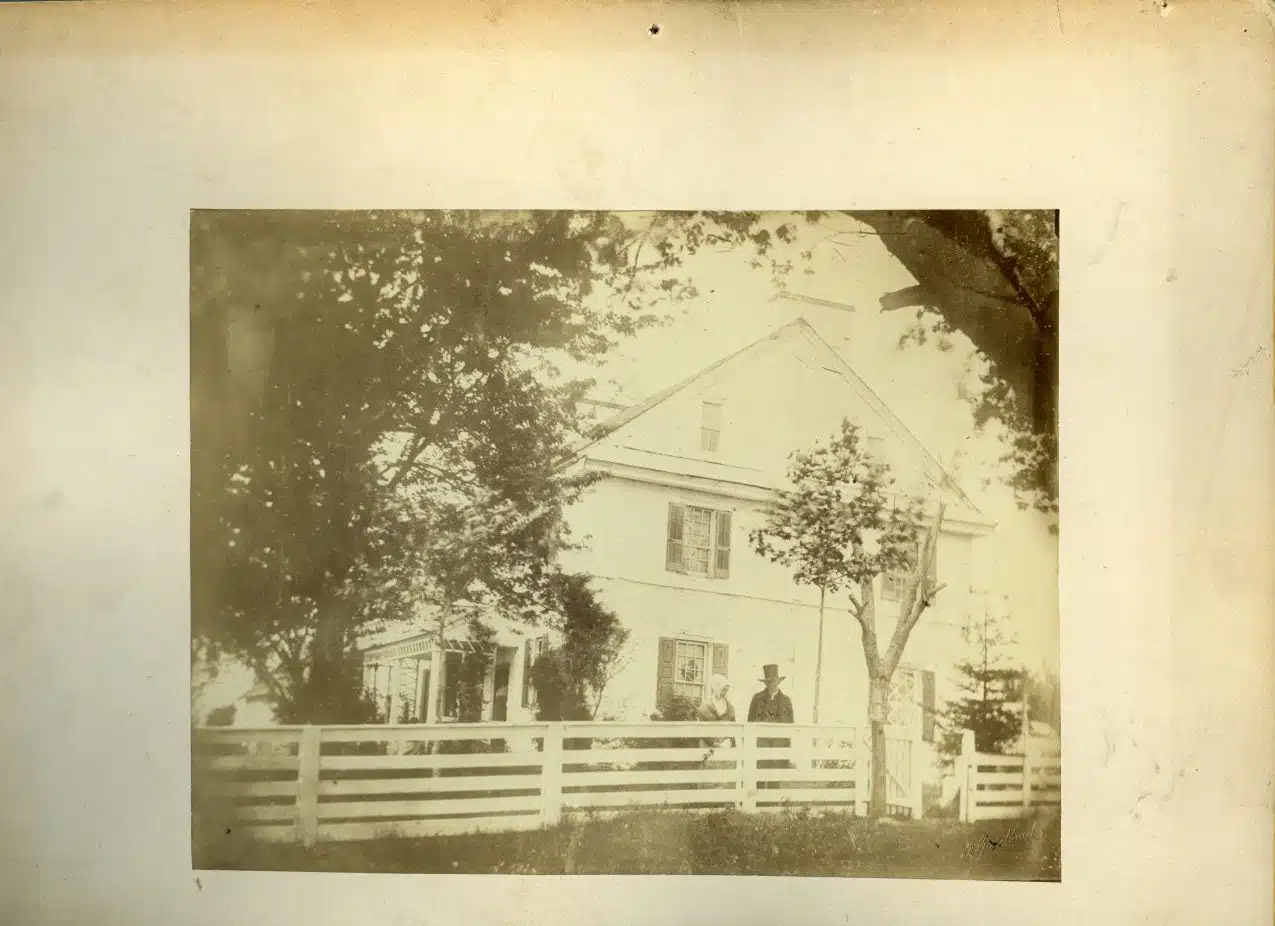
The only example of her ambrotypes can be found in the Albert Cook Myers Collection at the Chester County History Center, West Chester, PA.[1] The albumen photograph shows a nicely framed view of a house with a porch and a gentleman with a top hat and a woman in Quaker plain dress standing beside it. We must thank Myers for annotating the photograph on the back with the following: “Pennock Homestead, East Marlborough Twp., Chester County, Penna., showing Moses Pennock and wife. Photographed by Gutekunst from an ambrotype in size about 4 x 5 inches made about 1855 by Ann P. Baily of Marlborough, Chester County, Pennsylvania.” The back of the photograph bears the imprint of F. Gutekunst, 712 Arch St., Philadelphia, Negative #63663, printed 1895. Myers includes a further annotation: “Presented to Albert Cook Myers November 28, 1905, by Edith Pennock of Kennett Square, Penna., daughter of Moses Pennock.” Albert Cook Myers was a very meticulous historian, and one can assume that the daughter of the man shown in the photograph would be a reliable source of information.
Let us reflect for a moment on what impact the location had on the making of this ambrotype. East Marlborough Township in 1855 was a rural area, composed of acres farmed largely by a Quaker population. Nearby are numerous Friends Meetings, namely Marlborough, Old Kennett, Kennett (in Kennett Square), New Garden, London Grove, Parkersville as well as Longwood Progressive Friends Meeting. Founded in 1853 the Longwood Progressive Meeting was a hotbed of reform activity supporting the causes of abolition, temperance, woman’s rights and others.
Today, this area still has a rural look dotted with horse farms and is home to hunter trials and three-day-eventing as well as popular tourist destination Longwood Gardens. In Ann Baily’s time she would have needed a horse-drawn vehicle to traverse the rural roads; she needed a wagon for more than transportation. She needed a traveling dark room set up to make the wet-plate collodion negative for the Moses Pennock ambrotype.
Her equipment would have included the camera and tripod as well as a darkroom set up complete with chemicals and trays either under a tent or inside a light-proof wagon. Baily’s outdoor view ambrotype for the Pennock’s took several hours to create, counting travel to the location, set up and finishing the plate. Since a half-plate is a large size, Baily may have charged them upwards of $5.00 or more.
The most likely person who I can identify as Ann P. Baily is listed in The Genealogy of the Baily Family by Gilbert Cope. Ann Pennock Baily was born 1 mo. 12, 1817 to Jeremiah Baily and second wife Elizabeth Pennock.[2] She was the last of Jeremiah’s eight children and in the years ahead never married.
Jeremiah’s life would have had a big impact on his daughter Ann and how she lived her life. Jeremiah was the son of Levi Baily who married out of meeting and was disowned. This means that although Levi had been a birthright Quaker, his children were not. Jeremiah became a convinced Friend and was accepted into membership at Marlborough Meeting. Here he and Elizabeth Pennock were married in 1811. When the family moved to the Red Clay Creek area, they removed their membership to Kennett Monthly Meeting.[3]
Jeremiah was the type of person who had an inventive mind and big dreams. He invented the Baily mowing machine for cutting hay, it was the first invention of its kind to replace the hand powered scythe. His machine could cut an acre in 36 minutes. Jeremiah demonstrated his invention before the Chester County Agricultural Society in August of 1821 and secured a patent in February 1822.[4] His plan was to manufacture and sell his invention.
Unfortunately, Jeremiah also dabbled in land speculation and lost everything he had when prices fell. He became an assigned estate in 1823 and moved in with his son Levi in Wilmington, who along with Thomas Ward of Newlin Township, worked to pay his creditors.
Jeremiah made a good effort to get back on his feet and capitalize on his invention. He moved to Philadelphia and between 1829 and 1833 engaged in manufacturing agricultural equipment.[5] But the Baily Mowing Machine was soon eclipsed by improved inventions by other manufacturers.
Jeremiah and his family moved to the region known as Brandywine Hundred in New Castle County, Delaware. His family is recorded on the 1840 Census for this region.[6] Unfortunately, Ann’s mother Elizabeth died in 1841. When Jeremiah Baily died in 1847 in Wilmington, his children were not expecting any inheritance. His daughter Ann (age30) knew she had to be self-supporting.
She did get a windfall in 1850, when her Aunt Alice Saunders died and divided her property between all her nieces and nephews. Ann received $65.54 – a healthy sum in 1850.[7] Could this have been the seed money that Ann used to get into photography? We cannot know how that came about. Photography would have been an attractive career, enabling her to make a better income than being a school teacher, dressmaker or housekeeper. Those were the options available to women at the time.
But we do know that it was most likely that she stayed within the Quaker sphere to learn the trade. Several names come to mind. Reese Pugh, an itinerant of E. Nottingham would have been active during this time and could have given her lessons. Or she could have gone to Wilmington to study under Elwood Garrett[8]. There is no manuscript material to let us know how it all came about. Nor do we know if she made daguerreotypes as well.
The United States Census gives us glimpses into Ann P. Baily’s life and how she was supporting herself. The 1860 Census records her as living with Phebe Paxson, a dressmaker in Kennett Square.[9] It even reports that the value of Ann’s estate is $300, a tidy sum in 1860. It does not report an occupation, so we do not know if she was doing photography or dressmaking.
An 1870 Census records an Ann Baily as a domestic servant in the home of Joshua Wickersham, a farmer living near Unionville in E. Marlborough Township.[10] She was keeping house for the family of four plus several field hands.[11]
In the 1880 Census, Ann is recorded as the head of a household in Willowdale, W. Marlborough Township.[12] She has her cousin, Emogene Hodgson age 27 and Emogene’s daughter Mary, age 6 living with her. It does not record any type of occupation.
Exploring the Chester County Tax Lists for the period, I could not find any data for her. Women were usually only taxed if they owned property or had loaned money at interest. It seems unlikely that she owed her own horse, but she could have rented one or borrowed one from a friend.
Ann Pennock Baily died on April 7th of 1890 at the home of her cousin James T. Pyle in Willowdale, West Marlborough Twp., at age 73 after a long illness.[13] She was buried in the family plot at Marlborough Friends Meeting[14] and her death was recorded in the minutes of Marlborough Preparative Meeting.[15]
Ann Baily’s time as an ambrotypist remains a mystery. Hopefully, more examples of her work will come to light, giving us more clues as to the details of her career in photography.
© Pamela C. Powell, 2024
-
Moses Pennock Homestead, Albert Cook Myers Photograph Collection, Box 21 File 610, Photo Archives, Chester County History Center, West Chester, PA. ↑
-
Gilbert Cope, Genealogy of the Baily family of Bromham, Wiltshire, England, and more Particularly of the Descendants of Joel Baily, who came from Bromham about 1682 and settled in Chester County, Pa. , (Lancaster, Pa.: Wickersham Printing Co., 1912), p. 221-222. ↑
-
Daily Local News, (West Chester: PA) 1 September 1892, p. 2. ↑
-
W.W. Thompson, Chester County and Its People, (Chicago & New York: The Union History Company, 1898), p. 960-961. ↑
-
DeSilver’s Philadelphia Directory & Stranger’s Guide 1829-1833, (Philadelphia: Robert DeSilver), 1829-1833. ↑
-
Census Year: 1840; Census Place: Brandywine Hundred, New Castle, Delaware; Roll:33; Page: 148; Family History Library Film 0006434. ↑
-
Alice Saunders Estate File, Will #11688, Chester County Archives and Records Services, West Chester, PA. ↑
-
Ellwood Garrett was the son of Thomas Garrett, well known for participation in the Underground Railroad. The Garrett family embraced photography, Ellwood’s three sons, C. Alfred, Maurice and Warren were photographers also, as well as his sister, Sarah Garrett Hewes. ↑
-
Census Year: 1860; Census Place: Kennett, Chester, Pennsylvania; Roll: M653-1091; Page 338; Family History Library Film: 805091. ↑
-
Census Year: 1870; Census Place: East Marlborough, Chester, Pennsylvania: Roll: M593_1323; Page: 133A. ↑
-
However, this since this family is not Quaker, I am not positive that this is Ann P. Baily. ↑
-
Census Year: 1880; Census Place: East Marlborough, Chester, Pennsylvania; Roll: 1114; page 211A; Enumeration District: 050. ↑
-
Daily Local News, (West Chester, PA) 8 April 1890. ↑
-
Findagrave.com Ann P Baily (1818-1890) – Find a Grave Memorial ↑
-
Ancestry.com. US Quaker Meeting Records, 1681-1935. ↑