Edward S. Marshall
( 1853 – 1916 )
Portrait Artist
Edward S. Marshall operated a prolific studio in West Chester between 1876 and 1887. After learning the trade from C. Alfred Garrett, he worked in partnership with Henry Paxson between July 1876 – May 1877. He specialized in portrait photography, but hand-colored crayon portraits, outdoor photographs and stereographs were a large part of his business. His wife, Abby Hicks Marshall played a significant role also. He competed with other photographers by keeping himself in the news and specializing in large negative work.
Edward S. Marshall was born September 27, 1853, to Philena Cranston and Ezra Marshall[1], a drover and farmer in E. Marlborough Township[2]. Their family is well documented in the records of Kennett Monthly Meeting of the Society of Friends. In 1860, tragedy struck the family when Ezra died of bronchitis on March 7th. Philena Marshall was left with the puzzle of how to support and educate her four children, the youngest just two years old. Through Meeting records and the Federal Census, we can see how the family was divided. Philena, her daughter Mary and the baby Joshua went to live with farmer William and Sarah Johnson (possible relative on mother’s side) in New Garden Township[3], she transferred her membership to London Grove Meeting. Meanwhile her two boys, Ezra Jr. and Edward transferred to Wilmington Monthly Meeting. It is presently unknown who they were living with.
By the time the 1870 Federal Census was taken, Edward attended school in the borough of West Chester, living with his two relatives Mary A. Marshall, age 55 and Rachel Marshall age 42[4].
The next mention found of Marshall was an 1875 notice that he performed in an amateur theatrical production given at Wood’s Museum, Philadelphia in support of Miss Annie Ward Tiffany[5]. Edward Marshall is listed as being “formerly of Chester County.”
A significant document in Chester County History Center (CCHC) ephemera collection is a business card for Edward S. Marshall[6] stating: “Seven years with the popular artist C. Alfred Garrett.”
E. S. Marshall Business Card. Courtesy of Chester County History Center, West Chester, PA.

But exactly which seven years was Marshall with Garrett? Garrett was in West Chester between December of 1864 and fall of 1871. In the mid-1860s Marshall may have been living in Wilmington. Perhaps he worked with Garrett as a teenager in West Chester and followed him to Philadelphia in 1871? That could be why he was living in Philadelphia in 1875. In that case, Marshall may have started working with Garrett as a teenager in about 1869. But this brings up another mystery, did Marshall manage the studio for Garrett while he travelled to Yosemite in spring of 1871 or did Marshall travel with Garrett? If so, it gave him a taste of the West that played a significant role in his decision making as we will see later on.
Garrett had a strong influence on Marshall as can be seen both in his photographic work and in his engagement in social issues of the day. Marshall advertised the same services that were Garrett’s strong suits: hand-colored portrait photographs and outdoor photography. Marshall also supported temperance activities: he took on the role of William J. Mullin in the temperance drama titled “Three Years a Man Trap” which ran in Dover Delaware in December 1876. It was reported to be the “most popular temperance drama ever written[7].”
In 1876 Marshall returned to West Chester to open his own studio with partner Henry Paxson. Their advertisement in the July 17th edition of the Daily Local News listed them as “artists in photography” who could create hand-colored photographs in watercolors, oil or ink. They took a prominent location in the borough opposite the Turk’s Head Hotel for their studio. They also let the public know that they are not confined to the studio portrait trade and also did out-door photography.
Examples of their outdoor work during their partnership include a series of stereographs, which can be found in CCHC collection of the McFarlan-Stern family reunion[8], taken August 8, 1876, at Longwood[9]. They also advertised photographs of Longwood Friends Meeting and cemetery for sale in their gallery in the August 16, 1876, edition of the Daily Local News.
The partnership of Paxson and Marshall did not last for long. Henry Paxson withdrew from the business and an official dissolution of partnership notice was published in the May 28, 1877, edition of the Daily Local News. Marshall promised to continue the business stating: “having several years’ experience with C. Alfred Garrett, I feel confident that I can satisfy the most fastidious.” His studio remained at the prominent location of High and Market Streets.
Marshall was noted in the press for a well-executed ink portrait of Samuel E. Way which was exhibited in the window of Hammond & Kervey’s Drug Store[10]. A review of his work appeared in The Village Record of January 19, 1878 praising his crayon portraits especially. The writer further commented that Marshall “took the old establishment known as Beecher’s opposite the Turk’s Head Hotel, and is building up a good business.[11]”
The Chester County Agricultural Society’s Fair in the fall of 1878 provided Marshall with an opportunity to show his best work. He exhibited 21 photographs in large frames featuring portraits of local notables, including social activist Charles C. Burleigh, “General” Jackson who escaped from slavery, Miss Mattie England an attractive postal clerk, as well as a self-portrait[12].
Marshall’s main competition in West Chester was Thomas W. Taylor. So Marshall had to do newsworthy things in order to compete with this well-established photographer. In the May 27, 1879, edition of the Daily Local News, Marshall was reported as taking a photo of the crowd rushing for “U.S. Certificates” at the old West Chester Post Office at the SW corner of High and Market Streets. The Local comments: “It shows the money excitement at its zenith, and may be regarded as an historical picture. Anyone desiring a copy can be accommodated by calling Mr. Marshall at his gallery.” A copy of this photo is in the collection of CCHC[13].
Marshall also advertised his skills in hand-coloring portraits in the program brochure for the Chester County Teacher’s Institute in 1879[14]. The Institute brought over a hundred teachers from all over the county into the borough for a week of workshops and lectures as well as the chance to shop in downtown West Chester. He also received the contract to photograph the graduating class of the West Chester State Normal School (today known as West Chester University)[15].
The most ingenious method of photographing a group of unruly newsboys was undertaken by Marshall and reported by the Daily Local News on July 17, 1879.
–“Look out now” Fifty-one youthful heads of all sizes, shapes and colors suddenly looked skyward. They are standing promiscuously in the sunlight fronting the News office on High Street yesterday afternoon. They had been waiting for their armfuls of this issue of the paper, and the congregation of the faces was incentive for Photographer E.S. Marshall to come over and take a picture of them. Perfect pandemonium reigned among them because of the delay of their not getting their papers as soon as desired. The only way they could be coerced into any group or quieted was by the promise of “scrambling” of a handful of pennies. This acted like a magician’s wand upon the boys and soon they were grouped together in hurly-burly style.
“Look out!” cried Mr. Marshall, and at once the pennies were flung high into the air. All looked upward for their descent. That instant their pictures were taken by the instantaneous process. Then the pennies fell among them and the scene which followed beggar’s description. People on the sidewalk laughed convulsively, carriages were stopped, the hand organ was for the moment stilled and the monkey hid under his master’s coat with fear. Even good-natured Officer Finn enjoyed the scene, for the boys tumbled over each other in reckless profusion, eagerly snatching at scattered nickels. Nearly all succeeding in enriching themselves. After a while they received their supplies of the paper and never did they extol its qualities in louder tones than they did that afternoon through the streets of West Chester.”
Marshall never missed an opportunity to travel. In the summer of 1879 he visited the New England states[16]. He embarked with friends James Monaghan, Esq. and Dr. M.M. Worrall by sea to Boston[17]. It is not known if he took any views on this voyage.
Marshall’s studio was on the third floor of the Darlington Building on the south east corner of Market and High Streets. The building was named for its owner, Franklin Darlington. Marshall used the display window on the street level of the Darlington Building to showcase examples of his work. On September 4, 1879, the Daily Local News noted a fine portrait finished in ink of Rev. John Bolton, Rector of the Church of the Holy Trinity, as well as several outdoor views including the home of Thomas Marshall on Virginia Ave and Aaron Sharpless in Birmingham Township[18].
The Borough was abuzz when it was learned in September of 1879 that The Daily Graphic of New York was organizing a feature on West Chester. It was announced that it would include photographs of prominent buildings together with a history of the borough written by members of the Chester County Bar[19]. The Daily Graphic, which began publication out of New York in 1873, was the first illustrated daily newspaper featuring cartoons, engravings of photographs and works of art, illustrations of news events and personalities[20]. For most people at this time, this newspaper was one of a few ways to see what celebrities looked like, or to view famous works of art from around the world.
The September 26, 1879, Daily Local News reported on Marshall’s Daily Graphic assignment. Marshall was busy photographing the Chester County Courthouse, West Chester Normal School, Horticultural Hall, the Mansion House Hotel, as well as public schools, churches, homes of prominent citizens and businesses such as Hoopes, Bros. & Thomas Nurseries and the McLear Carriage Factory. He was assisted in his work by former partner, Henry Paxson[21]. When the Graphic ran the feature, the reproductions of a handful of the views were of poor quality, leaving Marshall open to public ridicule[22]. A reporter for the Daily Local News on November 11, 1879, contested the local hash proclaiming the original views to be beautifully done examples of the photographic art.
In 1879, Edward Marshall was living at 210 W. Barnard St. with his widowed mother Philena and brother Ezra[23]. On September 17, 1879, Edward married Abbie Hicks in the manner of Friends in Wilmington, Delaware[24]. She was the daughter of John and Elizabeth Pusey Hicks[25]. The young couple took up residence at 206 W. Barnard St.[26] Their happiness was soon broken by the death of their infant son in August of 1880[27]. Hereafter they remained childless throughout their marriage. In the 1880 West Chester Tax list, Ezra’s occupation was recorded as photographer only for that one year. No doubt he was helping his brother during that difficult time.
Marshall continued to promote his photographic work by creating a collage of portrait photographs mounted in a large gilt frame which was exhibited in the ladies’ room of the West Chester Post Office. The Daily Local News of April 23, 1880, commented: “altogether the display is one of artistic merit and taste.”
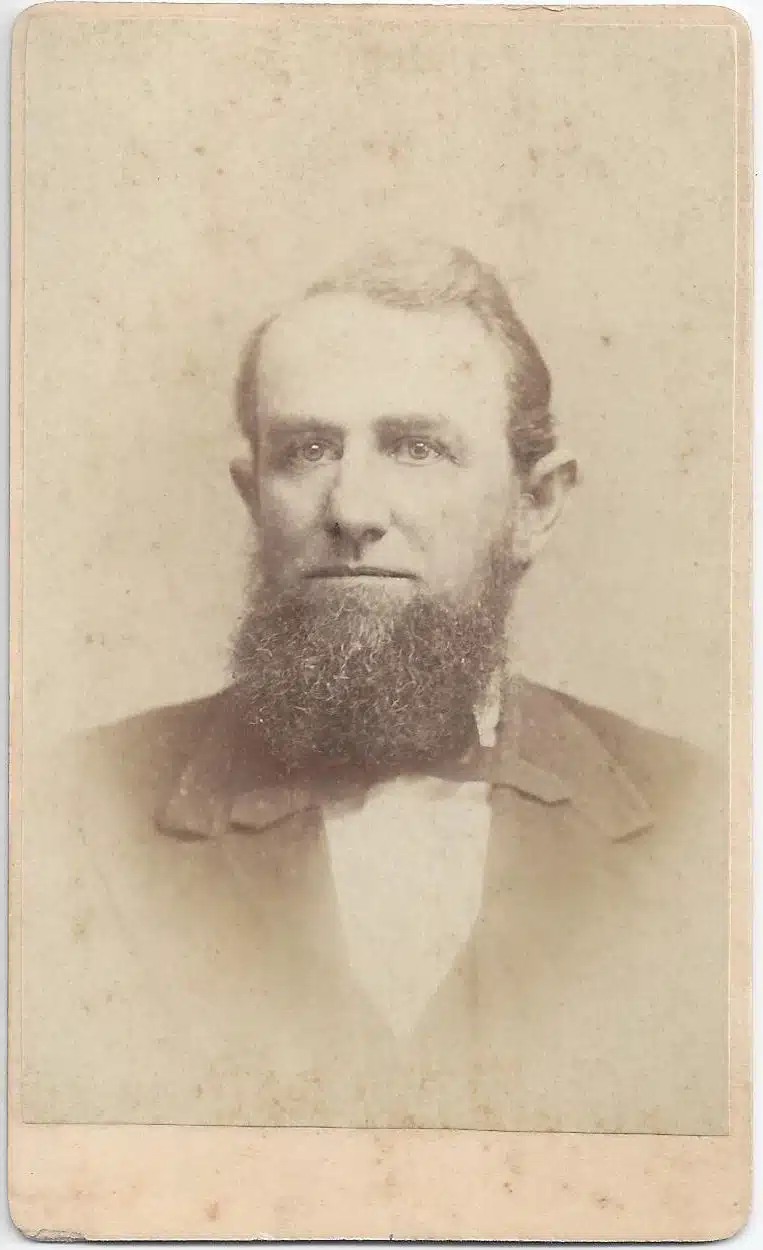
E. S. Marshall, Unidentified man with whiskers, mid 1880s, albumen carte-de-visite, Collection of Pamela C. Powell. [photo 121 front & verso] The vignette was Marshall’s predominant CDV portrait style.

Abby Marshall was also an artist in her own right. After the death of the child she pursued art forsaking the typical role of housewife. The Daily Local News praised life-sized photograph enhanced in watercolors she had made of recently deceased Eva J. Pierce, daughter of Joshua N. Pierce[28].
Abby frequently displayed her artwork in her husband’s gallery window. The November 6, 1880, issue of the Daily Local News described a lady’s belt and handkerchief bag she created: “Both articles are made of black satin, while painted on one side in water colors are pansies, and on the other side the figure “1880”. The work shows rare taste and skill.”
Edward and Abby Marshall were a popular couple in West Chester, with a busy social life. They were active in a Whist Club[29]. Edward started a Shakespearean Club[30] in their home and joined the Chester County Philosophical Society[31].
The September 25, 1880, edition of the Daily Local News advertised a clearance sale of all picture frames at Marshall’s gallery. It was followed by this notice: “Will Go to Zanesville, Ohio – We made mention of the fact that Mr. E.S. Marshall, photographer, of this Borough, intended selling out his stock of goods, etc., and removing from our midst. We have since learned that Mr. M. will take up his abode in Zanesville, Ohio, and will engage in the same business. He will have a sale of household furniture and everything in his line of business, wishing to start afresh in new quarters. We wish him success in his new home.”
But it seems, the Local’s announcement was premature, in the March 16th issue in 1881 it was revealed that Marshall would not be leaving West Chester after all. “Will not go West – we mentioned some time ago that E. S. Marshall, photographer, of this borough, intended moving to the West. This we learn is not the case as he has since changed his mind, and will remain in West Chester. He will, however, dispose of his household goods in a short time, as Mrs. M. is compelled to devote her time and attention to art work.”[32] Indeed on March 29, 1881, the Marshall’s home furnishings and household goods right down to the dishes and quilts were sold at auction[33].
This calls into question the wording of an advertisement from the Daily Local News in the April 29th edition in 1881. It read, “Your Photograph taken any size at suitable prices in crayon, ink or otherwise, by Marshalls, Artists.” With the additional “s” on the name Marshall and the plural of Artists – signals that Abby Marshall was playing a major role in her husband’s business, doing hand-coloring on crayon portraits.
Since Marshall chose to stay in West Chester, he decided to invest in some rather expensive improvements in his gallery, with a new skylight and backgrounded painted by scenic artist, Seavey of New York[34]. The West Chester Opera House also had stage scenery painted by Seavy.
Marshall, Hannie M. Woodward [born 1867], ca. 1885, albumen cabinet card. Collection of Pamela C. Powell. [photo 7 front] Note the painted background scenery and papier mâché rock.

The Local reported on August 16th, 1881: “In addition to his improved facilities for light, he has added a rustic arrangement representing a woodland scene. There is a stile with a fence, some trees, a path among the leaves and grasses, etc., making a beautiful rustic view. It is from the hands of Seavey, the New York specialist in this line. We shall watch the show frames on market Street until we see who of our romantic young people are photographed “sitting on the stile”.”[35] This new scenery would assist Marshall in competing against Thomas W. Taylor, who had extensive scenery and props in his gallery.
Marshall, Judges Bench, 1881, albumen carte-de-visite, CDV#2311. Courtesy of Chester County History Center, West Chester, PA


The Chester County History Center has a unique carte-de-visite of the original judge’s bench from the old Courthouse in Chester[36]. Marshall was engaged in 1881 by Judge J. Smith Futhey to photograph the historic 150-year-old bench to be reproduced in his forthcoming book The History of Chester County.
The Marshalls did enjoy traveling; in July of 1882 they went to Bushkill in Pike County[37]. Edward returned to Pike and Monroe Counties in 1883 to take views of this popular tourist destination, while former partner, Henry Paxson kept his gallery open[38].
In 1883 Marshall was recognized by the Daily Local News for taking a finely executed 11 x 14 photograph of Rev. John Wall’s monument in Oaklands Cemetery; Walls was the Priest of St. Agnes Church[39]. Such photographs were highly saleable to local parishioners and were sometimes used as church fund raisers. Another popular outdoor view was a photograph of West Chester Normal School’s building known as “Old Main.” It was available in 11 x 14 inch and carte-de-visite sizes[40].
E. S. Marshall, Old Main, West Chester State Normal School, [between 1877 – 1885], albumen photograph, 25.5 cm x 34 cm, OV/B37. Courtesy of Chester County History Center, West Chester, PA. This oversized photograph gives the viewer the sense of the massiveness of Old Main, the largest serpentine building in the state.

Marshall excelled at working with large negatives. In May of 1883 he photographed Pennsylvania Railroad Engine #505 when it came into the Gay Street station in West Chester. It was well known as the engine used to transport soldiers to Pittsburg during the Railroad War of 1877. The Village Record reported that the engineer bought six copies of the 14 x 17 photograph[41].
Marshall performed a feat when he photographed 200 people attending the Maris family Bicentennial on one 11 x 14-inch glass plate negative[42]. The event was held at the family homestead known as “Home House” on August 25, 1883. Marshall sold copies of the large albumen photographs and mounted them on a specially designed mount with gold print. A copy of this photograph is in the collection of the Chester County History Center.
Marshall’s camera was again employed by the Children’s Country Week Association. He was asked to photograph 300 inner city children as they arrived home to West Philadelphia after spending a week on area farms. The job was paid for by a “philanthropic lady in the city”[43]. Marshall’s talents were becoming well known beyond the borders of Chester County.
Photographers had to constantly work to promote their work at every opportunity. Marshall exhibited his portrait work at the Chester County Fair held in the fall[44] as well as the fair at the Delaware County Agricultural Society[45]. He also looked for other ways to enhance the business for customers. In 1883 he added an additional room to his gallery in the Darlington Building to offer picture framing for customers[46]. He also sold engravings of popular art reproductions[47].
In 1884 the Marshalls took the month of July to make a summer tour with a group of friends by carriages to Pike County[48]. Along the way they stopped to see and photograph the sites such as the Ringing Rocks, industrial works in Pottstown, Allentown, Bethlehem, Easton and others. In August of that year, Marshall also spent three weeks at Dingman’s Ferry photographing[49].
Photographs in CCHC collection demonstrate how Marshall began to make inroads on T.W. Taylor’s former steady accounts. Marshall was invited to photograph Uriah Hunt Painter’s ice being harvested and stored in his West Chester ice house on January 24, 1885[50].
Business was going well for Edward Marshall until Thursday evening, March 19, 1885, when a fire broke out in his dark room. The Daily Local News commented in the March 20th edition that “the origin of the fire is a mystery.” Some boys in the street were the first to see the smoke coming out of the third floor of the Darlington Building on the south east corner of Market and High Streets. At that time, Fame Fire Company was located on the north side of Market Street in that same block. They were the first to respond, followed by First West Chester and Good Will Fire Companies.
The fire could be seen at the peak of the roof and the firemen had some difficulty getting their hoses to the right location. One Fame firefighter climbed onto the roof of an adjacent building and with the aid of a ladder tried to douse the blaze. The force of the water knocked him off the ladder sending him sliding down the roof. Still other firefighters attempted to take their hoses up the smoke-filled stairway.
Casper Darlington, son of the building’s owner, was familiar with the building. He climbed into a loft above the dark room and started a bucket brigade to extinguish the blaze. So much water had been directed on the fire that the building was soaked from the third floor down to the cellar. Other businesses housed on the first and second floors were also damaged, as well as Franklin Darlington’s parlor. A Local reporter described the scene in the gallery with windows broken, furniture wrecked: “The photographic instruments were more or less broken and many valuable negatives and other useful material in the dark room destroyed.”
Marshall said to the reporter, “It is the devastation of the result of years of toil, but the exact amount I am at present time unable to state; but it will be considerably over the amount of the insurance ($1000). Four lenses valued at from $40 to $200 were destroyed, together with two camera boxes, a large stock of mount, dry plates, and all valuable chemicals used in the conducting of my photography business. But the greatest loss of all is the large number of negatives – the accumulation of twenty years – which become more valuable every year. I would not have taken $1000 for them.”
The morning after the fire, debris was piled in the street for removal. Passersby commented on the burned heap of photographs of many familiar sites and people. But the damage to his stock of negatives was an irreplaceable loss.
The March 21, 1885 Local reported that work had already begun on the building, replacing windows and water-soaked ceilings. It announced: “E. S. Marshall will shortly make extensive and handsome improvements to his photographic rooms, which were damaged by fire.”[51] However, the Penn Mutual Insurance Company, granted Marshall only $800 for his loss[52].
Marshall finally reopened his gallery as was reported in the November 6, 1885, Daily Local News. It featured: “Newer attractions and better facilities for photography. Instantaneous pictures of children a specialty.”[53] Marshall ordered a new sign for the business with hand-carved raised letters inscribed: “Marshall, Artist”[54]. After losing months of work, as well as the loss of equipment, which was not recovered through insurance, Marshall was working hard to recoup his losses.
On April 22, 1886, E. S. Marshall was served a summons alerting him that the photographic supply company of Buchanan, Smedley and Bromley of 25 N. Seventh Street Philadelphia were filing a suit for a debt of $161.20[55].
In the lawsuit is an inventory of purchases Marshall selected to refurbish his gallery after the fire in March of 1885. This gives us a fascinating inside look at Marshall’s studio, since it shows us rich detail of the demand for specific photographic products he provided his customers. It includes a beech tree background with rustic seat, papier Mache log and five yards of English Ivy used as a studio background and props. More importantly are the listings of equipment such as a rectilinear view Dallenmayer lens, DeVoe shutter, plate holders, focusing cloth, developing tray and print clips, ruby gas burner. It is interesting to review the sizes of glass plate negatives used – he bought 2 ½ dozen 11 x 14 plates and a lot of salted paper – indicating that he made a lot of crayon portraits which were so popular at the time. There were also good quantities of plates to make cabinet cards – 6 x 4 inches, many plates for 8 x 10 and 5 x 7s, but few at the 3 x 5 size, since cartes-de-visite were waning in favor. He also bought the necessary paper and chemistry.
The Marshall’s personal property was in jeopardy of being sold at sheriff’s sale to settle the debt. On April 30, 1886, Abby Marshall entered a counter suit that certain articles were her personal property. Abby Marshall’s suit claimed that certain property was purchased with monies before her marriage. These included one horse, carriage, sleigh, set of sleigh bells, harness, horse blankets, 2 photographic Euryscope lenses and one camera, the later were purchased at Thomas McCollin’s in Philadelphia.
Here again, with the mention of two lenses and a camera she purchased, indicates that
Abby Marshall herself was a photographer who played a significant role in the business. The counter suit even refers to possible earnings after marriage with the statement “nor acquired by her as her earnings since marriage…”[56]
Under the Married Women’s Property Act of 1848, women were able to control or dispose of any property they held separately. This was true for any earned income, inherited property or gifts. Furthermore, their property could not be tapped for their husband’s debts[57].
In the counter suit Abby Marshall claimed that she had loaned $700 to her husband, undoubtedly to get the photo gallery refurbished after the fire.
Buchanan, Smedley and Bromley contested that claim of the $700 loan was fraudulent on the grounds that “the said Abbie G. Marshall has declared that said judgement, was created for the purpose of compelling her husband’s creditors to compromise their claims against him, and not in good faith for the recovery of the sum appearing due to her thereby.”
The Court of Common Pleas ruled that Abby Marshall’s claim to her property was legitimate, and the cases moved forward for resolution. The June 1st edition of the 1886 Daily Local News reported that the Sherriff has seized the property of E.S. Marshall, photographer of West Chester.”[58]
On June 8, 1886, the property of Edward S. Marshall was sold by Sherriff’s sale. The distributions were made and are recorded in the August term of the Court of Common Pleas of Chester County[59]. Buchanan, Smedley and Bromley received $161.20 they were owed, and Abby Marshall received the residual of the sale of goods less court costs which amounted to $235.73. At least the couple had some resources to live on.
Edward S. Marshall is not even listed in the West Chester Tax List for 1886 or 1887, even though he was a resident there. This was most likely because his income fell beneath the taxable level. It was reported in the Daily Local News that Edward was quite ill with pulmonary troubles in December of 1886[60].
Having sold their household goods, the Marshalls boarded with Mrs. Hannah Hoskins on East Gay Street, beginning in March of 1887[61].
The following year, Edward and Abby Marshall, now in their mid-thirties, made the decision to move to Denver, Colorado and begin anew. The Daily Local News reported on June 10, 1887, that all their possessions were loaded into a railroad car, along with their horse, sleigh and carriage to be shipped to the West. Accompanying them was Henry Smith, an African American groom, to care for the horse on the journey.
Edward S. Marshall opened a studio at 1367 Larimer St. in Denver, Colorado and operated it between 1888 and 1891[62]. We find the couple in the 1900 Federal Census for Denver, Colorado as living on Cook Street. Edward Marshall is listed as an insurance agent[63].
A note in the Birmingham Monthly Meeting membership register from brother Ezra Marshall reported that Edward S. Marshall died in a hospital in Kansas City in 1916. Abby Marshall’s place and date of death is not known.
© Pamela C. Powell, 2025
-
Hinshaw Index, 1853; Friends Historical Library, Swarthmore College, Swarthmore, PA. ↑
-
Year: 1850; Census Place: East Marlborough, Chester, Pennsylvania; Roll 764; Page 171b. ↑
-
Year: 1860; Census Place: New Garden Township, Chester, Pennsylvania: Page 449; FHL Microfilm: 805091. ↑
-
Year: 1870; Census Place: West Chester, Chester, Pennsylvania; Roll: M593_1325; Page 158B; FHL Microfilm: 552824. ↑
-
Daily Local News, (West Chester, PA), 7 April 1875. ↑
-
. Marshall folder, Ephemera Collection: West Chester Business Houses, Chester County History Center, West Chester, PA ↑
-
Daily Local News, (West Chester, PA), 18 December 1876. ↑
-
Paxson & Marshall, McFarlan- Stern Reunion, Stereographs, Photo Archives Collection, Chester County History Center, West Chester, PA. ↑
-
Daily Local News, (West Chester, PA), 8 August 1876. ↑
-
Daily Local News, (West Chester, PA), 30 October 1877, p.3. ↑
-
Village Record, (West Chester, PA), 19 January 1878, p.2. ↑
-
The Jeffersonian, (West Chester, PA) 21 September 1878, p.3. ↑
-
General Collection: Post Offices-West Chester, Photo Archives Collection, Chester County History Center, West Chester, PA. ↑
-
Chester County Schools Collection: Chester County Teacher’s Institute, Chester County History Center, West Chester, PA. ↑
-
Daily Local News, (West Chester, PA), 18 June 1879, p.3. ↑
-
Village Record, (West Chester, PA), 19 July 1879, p.2. ↑
-
Daily Local News, (West Chester, PA), 23 July 1879, p.3. ↑
-
Daily Local News, (West Chester, PA), 4 November 1879. ↑
-
Daily Local News, (West Chester, PA), 12 September 1879. ↑
-
The Daily Graphic entry in Wikipedia https://en.wikipedia.org/wiki/the_Daily_Graphic ↑
-
Daily Village Record,(West Chester, PA), 22 April 1880, p.3 and Daily Village Record, (West Chester, PA), 24 September 1879, p.3. ↑
-
Daily Local News, (West Chester, PA), 11 November 1879. ↑
-
S. Fred Boyd, compiler and publisher. Boyd’s West Chester Directory for 1879-80. (Wilmington, Delaware: James & Webb, 1879). ↑
-
Daily Local News, (West Chester, PA), 18 September 1879. ↑
-
Hinshaw Index, 1879; Friends Historical Library, Swarthmore College, Swarthmore, PA. ↑
-
S. Fred Boyd, compiler and publisher. Boyd’s West Chester Directory for 1879-80. (Wilmington, Delaware: James & Webb, 1879). ↑
-
Daily Local News, (West Chester, PA), 21 August 1880. ↑
-
Daily Local News, (West Chester, PA), 7 October 1880, p. 3. ↑
-
Daily Local News, (West Chester, PA), 22 April 1881, p.3. ↑
-
Daily Local News, (West Chester, PA), 18 December 1880, p.3. ↑
-
Village Record, (West Chester, PA), 25 March 1881, p.3. ↑
-
Daily Local News, (West Chester, PA), 16 March 1881. ↑
-
Village Record, (West Chester, PA) 2 April 1881, p.4. ↑
-
Daily Local News, (West Chester, PA), 8 August 1881. ↑
-
Daily Local News, (West Chester, PA), 16 August 1881. ↑
-
E. S. Marshall, Judge’s Bench, albumen carte-de-visite, 1881, Chester County History Center Photo Archives CDV#2311. ↑
-
Daily Local News, (West Chester, PA), 31 July 1882. ↑
-
Daily Local News, (West Chester, PA) 13 August 1883. ↑
-
Daily Local News, (West Chester, PA), 1 July 1883. ↑
-
E.S. Marshall, Old Main, undated, OV/B37 and CDV#2435, Photo Archives, Chester County History Center, West Chester, PA. ↑
-
Village Record, (West Chester, PA), 4 May 1883, p.3. ↑
-
E. S. Marshall, Maris Bi-Centennial at “Home House” 8 mo. 25 1883, OVB53, Photo Archives, Chester County History Center, West Chester, PA. ↑
-
Daily Local News, (West Chester, PA), 30 August 1883, p.3. ↑
-
The Jeffersonian, (West Chester, PA) 29 September 1883, p.4. ↑
-
Daily Local News, (West Chester, PA) 12 October 1882, p. 3. ↑
-
Daily Local News, (West Chester, PA), 16 June 1883, p.3. ↑
-
Daily Local News, (West Chester, PA), 28 November 1881, p.3. ↑
-
Daily Local News, (West Chester, PA), 15 July 1884, p.3. ↑
-
Daily Local News, (West Chester, PA), 8 August 1884, p.3. ↑
-
E.S. Marshall, Preparing for Summer, 24 January 1885, DN40/OVA51 Uriah Hunt Painter Collection, Photo Archives, Chester County History Center, West Chester, PA. ↑
-
Daily Local News, (West Chester, PA) 21 March 1885. ↑
-
Daily Local News, (West Chester, PA), 25 March 1885. ↑
-
Daily Local News, (West Chester, PA), 6 November 1885. ↑
-
Daily Local News, (West Chester, PA), 27 May 1885. ↑
-
Court of Common Pleas Appearance Papers, County of Chester, Pennsylvania, April Term 1886, case #109, Chester County Archives & Records Services, West Chester, PA. ↑
-
Abby G. Marshall vs. E.S. Marshall, Court of Common Pleas, County of Chester, Pennsylvania, August term 1886, Chester County Archives & Records Services, West Chester, PA. ↑
-
Married Women’s Property Act of 1848, Married Women’s Property Act of 1848 | Encyclopedia.com ↑
-
Daily Local News, (West Chester, PA), 1 June 1886. ↑
-
Court of Common Pleas, County of Chester, Pennsylvania, Execution Docket P, Page 516, Chester County Archives & Records Services, West Chester, PA. ↑
-
Daily Local News, (West Chester, PA), 3 December 1886, p.1. ↑
-
Daily Local News, (West Chester, PA), 30 March 1887, p. 3. ↑
-
Carl Mautz, Biographies of Western Photographers, revised and expanded ed., (Nevada City, California: Carl Mautz Publishing, 2018), 201. ↑
-
Year: 1900; Census Place: Denver, Arapahoe, Colorado; Page 16; Enumeration District:0064; FHL Microfilm: 1240118. ↑