Charles Alfred Garrett – Part 1
( 1840 – 1891 )
Garrett & Nickerson
C. Alfred Garrett came from a family of Wilmington, Delaware photographers that included his father, aunt, and two younger brothers. After learning the art from his father, he struck out on his own, operating studios in Louisville, Kentucky (1860-1861), Salem, New Jersey (1863-64), West Chester, Pennsylvania (1864-1871) and Philadelphia (1871-1881). He also traveled to Yosemite California with his brother Maurice to make views. This biography is presented in two chapters.
C. Alfred Garrett came from a Quaker family with extraordinary convictions and achievements. His grandfather was Thomas Garrett the renowned stationmaster on the Underground Railroad who aided 2700 enslaved people to gain their freedom. His grandfather became a household name in 1848 when he went on trial for aiding a family of freedom seekers. After facing a stiff fine and an admonition from the judge to desist, Thomas Garrett proclaimed that he would not give up his work on the Underground Railroad, instead he invited more freedom seekers to come to him for aid. This dynamic man left a profound impression on everyone who knew him.
C. Alfred Garret’s father Ellwood was noteworthy as an early pioneer of photography in the state of Delaware. Ellwood Garrett was cited in the book, Wilmington, Delaware: Three Centuries Under Four Flags, 1609-1937, as having made the earliest daguerreotype in the state and possibly the nation. The book provides the following detail: “Perhaps the earliest daguerreotype [sic] machine in the United States was the one sent to Elwood Garrett by English Friends. A silver plate containing the name of M. Daguerre and the number eight showed it to be one the first made by the inventor. Mr. Garrett had read of this invention and had made for himself a crude camera from a cigar box, and the copper plate was sensitized by flattening out a silver quarter dollar and then fumed with the proper chemicals. His first “shot” was directed toward a silver door knob on a house opposite his own. This the first sun-made picture in Wilmington and possibly in the United States, was the fore-runner of the now common-place and innumerable artistic and valuable snap-shots by amateurs and professionals.[1]” These claims, however, cannot be verified beyond this source. The whereabouts of the daguerreotype camera #8 and the experimental plate is not known, but it demonstrates that Elwood Garrett took an early interest in the art long before he entered into the business.
Born in 1840, Charles Alfred Garrett was the eldest son of Ellwood and Catherine Garrett of Wilmington, Delaware[2]. A machinist by trade, Ellwood’s health and financial fortunes had its ups and downs. In 1842 he moved out of Wilmington to a farm in Herford, Maryland on account of “ill health.[3]” Once his health was improved, he advertised the farm for sale in 1847 and returned to Wilmington opening a machine shop that produced sash, shutters and washstands.
Tragedy struck in 1849 when his shop was burned to the ground by an arsonist[4]. Unfortunately, his shop was located so far from the available public water system that the building was uninsurable.
Ellwood Garrett needed to feed his growing family with only a small investment. After studying daguerreotypy with Samuel Broadbent, he opened his own studio at 66 Market Street in Wilmington in 1850[5]. Ellwood’s sister Sarah Hewes, recently widowed with three small children, also learned the art. Partnered with Broadbent, she became the operator of a studio in West Chester, on the upper floor of what is today known as the Lincoln Building[6].
Garrett-Cremer, Garrett Family, ca. 1857, whole plate daguerreotype. Courtesy of Historical Society of Delaware, Wilmington, DE. C. Alfred Garrett is pictured standing on the far left.
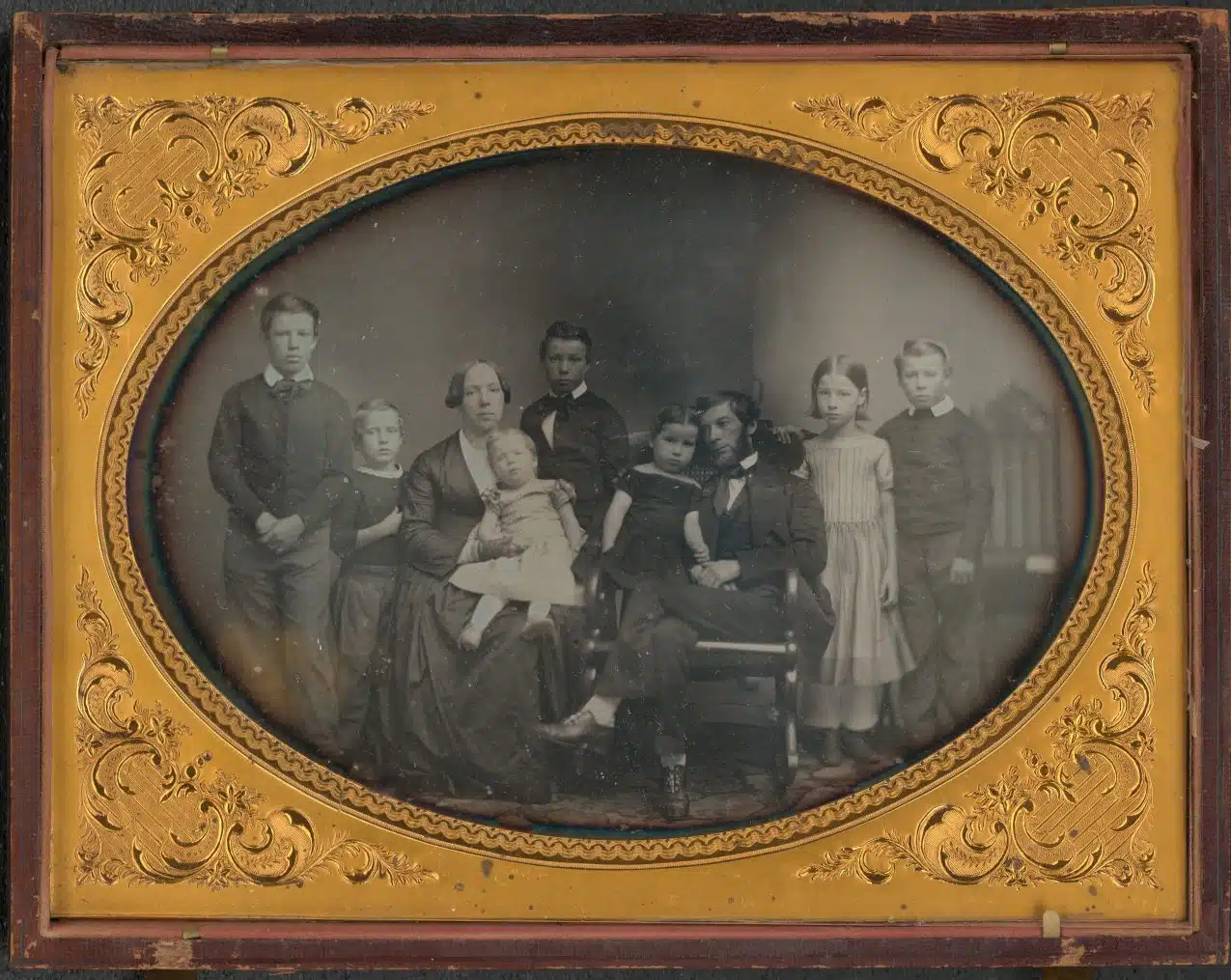
Ever since he was a young teenager, Alfred helped his father in his studio. He would have learned the daguerreotype and ambrotype processes as well as photography on paper from his father. Ellwood’s studio in Wilmington was taken over by sons Maurice and Warren in 1870 which they continued until 1888[7].
In 1860, when C. Alfred Garrett became 20 years old, he was eager to go out on his own and open his own gallery. That first gallery was not located where you might expect. The opening was announced by the Louisville Courier-Journal in Kentucky.
“NOTICE: THE PHOTOGRAPHIC GALLERY formerly occupied by G. T. Shaw, is being thoroughly refitted by Messrs. GARRETT & NICKERSON. It will be reopened to the public on Monday, 7th May, under the name of the “TELEGRAPH GALLERY.[8]”
The gallery received its moniker from its prime location above two telegraph offices belonging to Western Union and South Western[9]. An expanded advertisement appeared on May 11, 1860:
“NEW PHOTOGRAPH GALLERY. Messers. GARRETT & NICKERSON have purchased the GALLERY on Main Street, between Second and Third, Louisville, Ky., formerly occupied by Mr. G. T. Shaw, in which they have gone to considerable expenses in refitting. The Gallery is now certainly the very finest in the West. We are prepared to furnish all styles of pictures known in the art. Photographs in oil, water colors, and India Ink. Satisfaction given to all. Give us a call C. ALFRED GARRETT. GEO. H. NICKERSON. This Gallery is closed on Sundays.[10]”
Identical advertisements next appeared June 10 and October 27, 1860 and then frequently between January and June 1861. The text of the advertisements was always the same.
We may never know the events that brought the two men together to go into business so far from their home states. Nickerson hailed from Massachusetts, Garrett from Delaware. Why would they choose Kentucky? In 1860 Louisville was the 12th largest city in the nation. It was known as a major hub for transportation of goods via steamboats on the Ohio River. In 1830 a canal was built circumventing the Falls of the Ohio at Louisville, this created a direct route from Pittsburgh to New Orleans[11]. Goods such as cotton, sugar cane and wheat were major commodities.
Louisville also had a reputation as a major slave auction city. Here enslaved people were sold south, separating them from family with little hope of ever seeing them again. Louisville offered the last chance to “cross over the Jordan” to freedom in the north.
George H. Nickerson was born in Centreville, Massachusetts in 1835 and studied photography with James Wallace Black a well-known Boston photographer. Nickerson is listed in the U.S. Census for Louisville in 1860 as a twenty-seven-year-old photographer[12]. He was boarding at 408 E. Walnut St. in the household of twenty-nine-year-old seamstress named Elizabeth Baxter, who had three small children. Garrett’s only address in the 1860 Louisville city directory was that of the studio at 213 W. Main St[13]. If he was living in the studio this would account for why he was not recorded in the 1860 census.
We can document that Garrett and Nickerson were in Louisville from May 1860 through June 1861, but evidence suggests that by 1862 both had returned to their home states.
They advertised a variety of services, including photographs finished in water colors for five dollars[14] and life-sized portraits for twenty dollars[15]. In a wise public relations move, Nickerson photographed the local newspaper’s new building and received the following glowing review:
“A FINE PICTURE. – We are indebted to Mr. G.H. NICKERSON, of the Telegraph Gallery, Main street, between Second and Third, for a large and very handsomely executed photographic view of the new COURIER BUILDING and the block in which it is located. The style and execution of the picture shows that MR. NICKERSON is well skilled in the art to which his time and attention are devoted.[16]”
Another interesting job they had was reported in the expense claims for the local police department. Nickerson was paid $12 for taking “daguerreotypes of thieves” [17].
While in Louisville the duo created a noteworthy body of work that is the legacy of their time there. Garrett and Nickerson went on location with the Kentucky State Guard when they assembled on August 23, 1860 for a week of training at Camp Boone. They produced salted paper prints showing views of camp life, parading and drilling as well as portraits of the commanding officers. The original prints were tipped into a book titled “Sketches of Camp Boone” and was published by G. T. Shaw, the daguerreotypist whose gallery they had purchased. The work included the history of the unit. Only five copies of the work are known to exist[18].
The State Guard was established March 5, 1860 by the Kentucky State Legislature in response to the events at Harper’s Ferry in 1859. Being a border state, the Legislature took a neutral position establishing the State Guard for home defense. However it was not long before they had to make a choice, while the legislature sided with the Union, many of the guardsmen left to join the Confederacy.
Garrett and Nickerson brought a portable dark tent into the field with them for their work. They made 6 x 8 collodion glass plate negatives, producing eleven outdoor views for the album. The enterprising pair captured views of the encampment populated by 3,000 troops, their dress parade, and street scenes after the parade. They also took views of important dignitaries reviewing the troops, including the Governor of Kentucky, Major Hunt, Captain Hayes and Col. Frank Tryon. One of the scenes of a group of officers included Mary Todd Lincoln’s brother. The book opened with portraits of Major General Simon Bolivar Bruckner and eight officers in his staff. The partners produced all the salted paper prints for the sketchbook, which would have been a significant undertaking, since all the papers used were hand sensitized[19].
While in Kentucky, Nickerson was also involved in raising a company of Union Men for a Home Guard militia, according to an advertisement placed in the Courier Journal May 25, 1861[20].
We can’t be sure if business was not going well or it was a smart April Fool’s ploy for the Telegraph Gallery when this advertisement appeared in the April 1, 1861: “Nickerson says he will take pictures of everybody free of charge. Go and try him at the Telegraph Gallery.[21]” Note that there is no mention of Garrett here.
Second Lieutenant, Company E 43rd Massachusetts Volunteer Militia, George H. Nickerson , [1861-1865] albumen carte-de-visite, Courtesy of Medford Historical Society & Museum, Civil War Photographs Collection. Imprint on verso: G. H. Nickerson, photographist, Orleans, Mass[achusetts].

By 1862 Both Garrett and Nickerson had returned to their home states. Nickerson was back in Orleans, Massachusetts where he married Mary Young on June 4, 1862[22]. He then joined Company E., 43rd Massachusetts Volunteer Militia that September with the rank of Second Lieutenant[23]. He did for his own unit what he did for the Kentucky State Guard, producing views of the company in the field in New Bern, North Carolina. The Center for Civil War Photography quotes a letter written by Private Colman Tilden to his parents March 30, 1863 when he described the event: “Friday morning we had some photographs taken of the camp and the regiment. We were taken three times, the first time the regiment were on the march, marching in column by companies, guns at the right shoulder shift. The second we were formed in a hollow square at “charge bayonets” the third was at dress parade standing at “parade rest”. I understand they take a great many to be stuck off, and sold to the regiment. If they do and they are good ones I sill send home some.”[24] The resulting views were dramatic and are now incredibly rare.
When Nickerson mustered out on July 30, 1863, he had attained the rank of First Lieutenant. In 1865 he established a photographic gallery in Orleans, MA and by 1872 moved to Provincetown on the Cape. Here he partnered with William May Smith producing portraits as well as stereographs of local scenery[25]. Nickerson died in 1890 at the age of 53. He had been a commander of J. C. Freeman Post 55 G.A.R. His obituary noted that he was a man of “unswerving integrity, pleasing address and made friends everywhere.[26]” These skills aided him in building a successful business.
A birthright member of the Society of Friends, C. Alfred Garrett made a difficult choice when he enlisted in the 5th Delaware Infantry in fall of 1862[27]. His desire to fight for the end of slavery cost him membership in the Society of Friends. He served for nine months in Co. E. His service may have included duty as garrison at Fort Delaware and guard duty on the line of the Philadelphia, Wilmington & Baltimore Railroad[28]. An unfortunate accident brought tragedy, when Garrett attempted to repair fellow soldier John Crisfield’s gun. It discharged prematurely, shooting Crisfield in the face and killing him[29]. The newspaper accounts noted that the accident occurred even though every safety precaution had been taken.
Garrett definitely drifted away from the testimony of Friends, meeting minutes cite that he was listening to hireling ministers, music and engaging in war[30]. He was read out of Wilmington Monthly Meeting on 5 mo. 29th 1863. He then joined the Presbyterian Church in Wilmington that year[31].
See Part 2 to discover the history of Garrett’s studios in New Jersey and Pennsylvania.
©Pamela C. Powell, 2025
-
Anna T. Lincoln, Wilmington Delaware: Three Centuries Under Four Flags, 1609-2937, (Rutland, VT: Tuttle Pub. Co., 1937), p. 316. ↑
-
Births and Deaths, 1740-1851; Quaker Meeting Records; Collection #: MR Ph:647. Swarthmore College, Swarthmore, PA. ↑
-
Wilmington 1833-1858; Quaker Meeting Records; Call #MR Ph651, Swarthmore College, Swarthmore, PA. ↑
-
Blue Hen’s Chicken (Wilmington, Delaware), 25 May 1849, p. 2 col 5. ↑
-
William McKay, Directory of Delaware Photographers 1839-1900 and Beyond, (New Castle, Delaware: Oak Knoll Press, 2018), 92. ↑
-
Sarah J. Weatherwax, “More Than an Elegant Accomplishment,” Pennsylvania History, Vol 81, No. 4, Special Issue: Photography in Pennsylvania (Autumn 2014), 432-450. ↑
-
William A. McKay, A Directory of Delaware Photographers 1839-1900 and Beyond, (Delaware: Oak Knoll Press, 2018), p. 96-97. ↑
-
Louisville Courier-Journal, 2 May 1860, p.2. ↑
-
Henry Tanner, comp., Tanner’s Business Directory and Business Advertiser for 1861, (Louisville, 1861), p. 316. ↑
-
Louisville Courier-Journal, (Louisville, KY), 11 May 1860, p. 1. ↑
-
Steamboats on the Ohio River, Filson Historical Society digital project Steamboats on the Ohio River · The Filson Historical Society Digital Projects ↑
-
Year: 1860; Census Place: Louisville Ward 2, Jefferson, Kentucky; Roll: M653-375; page: 183; Family History Library Film: 803375. ↑
-
Correspondence, Jennie Cole, Director Collections Access, Filson Historical Society, Louisville, KY 23 February 2025. ↑
-
Louisville Courier-Journal, (Louisville, KY), 14 July 1860, p. 1. ↑
-
Louisville Courier-Journal, (Louisville, KY), 28 March 1861, p. 1. ↑
-
Louisville Daily Courier, (Louisville, KY), 9 April 1861, p. 1. ↑
-
Louisville Courier-Journal, (Louisville, KY), 3 June 1861, p. 3. ↑
-
New Acquisitions Press release, 6 February 2020, The Huntington, San Marino, CA, Site Search | The Huntington; other copies are in the collections of Stanford University, University of Wisconsin, Madison, University of Kentucky Special Collections and the Gilder Lehrman Institute of American History. ↑
-
See also for more information: Cowan’s Auctions Sketches of Camp Boone, The First Encampment of the in United States ↑
-
Courier-Journal, (Louisville, KY), 25 May 1861, p. 3. ↑
-
Louisville Courier-Journal, (Louisville, KY) 1 April 1861, p. 3. ↑
-
Marriage Record, New England Historic Genealogical Society, Boston, MA; Massachusetts Vital Records, 1911-1915. ↑
-
Historical Data Systems, Inc. Duxbury, MA 02331; American Civil War Research Database. ↑
-
Facebook, Center for Civil War Photography, February 25, 2024 NEW BERN, N.C…. – The Center for Civil War Photography | Facebook ↑
-
Amy Whorf McGuiggan, Icebound in Stereoscope: the Artic Freeze of 1875 & G. H. Nickerson’s Views, Provincetown Independent, (Provincetown, MA), 19 February 2025. Icebound, in Stereoscope – The Provincetown Independent ↑
-
Obituary, Barnstable Patriot (Provincetown, MA) 15 April 1890. ↑
-
Consolidated List of Civil War Draft Registration Records (Provost Marshal General’s Bureau; Consolidated Enrollment lists 1863-1865); Record Group 110, Records of the Provost Marshal General’s Bureau (Civil War): collection name: Consolidated Enrollment lists, 1863-1865(Civil War Draft Records); NAI 4213514; Archive Volume Number 1 of 5. National Archives and Records Administration; Washington, D.C.. ↑
-
Fifth Delaware Infantry Regiment, Wikipedia, 5th Delaware Infantry Regiment – Wikipedia ↑
-
Smyrna Times, (Smyrna, DE), 9 July 1863, p. 1. ↑
-
Entry 1863, 5 mo. 29, Minutes 1858-1878; Quaker Meeting Records; Call #: MR Ph:653. Swarthmore College, Swarthmore, PA. ↑
-
Church Membership, First Presbyterian Church Wilmington, Delaware; Historic Pennsylvania Church and Town Records; Reel: 800.Historical Society of Pennsylvania; Philadelphia, Pennsylvania. ↑