Oliver Harvey Willard
( 1829 – 1875 )
An Itinerant Stops in Oxford
O. H. Willard was a native of Vermont who left the family farm to pursue a career as a photographer. He passed through Oxford, PA as an itinerant photographer in 1850 before moving to Philadelphia where he ran a prosperous studio until his death at age 48.
Oliver H. Willard, Self-portrait, ca. 1855, salted paper print, Courtesy of Smithsonian American Art Museum, Gift of Charles Isaacs and Carol Nigro, 1999. http://americanart.si.edu/artist/oliver-h-Willard-18557
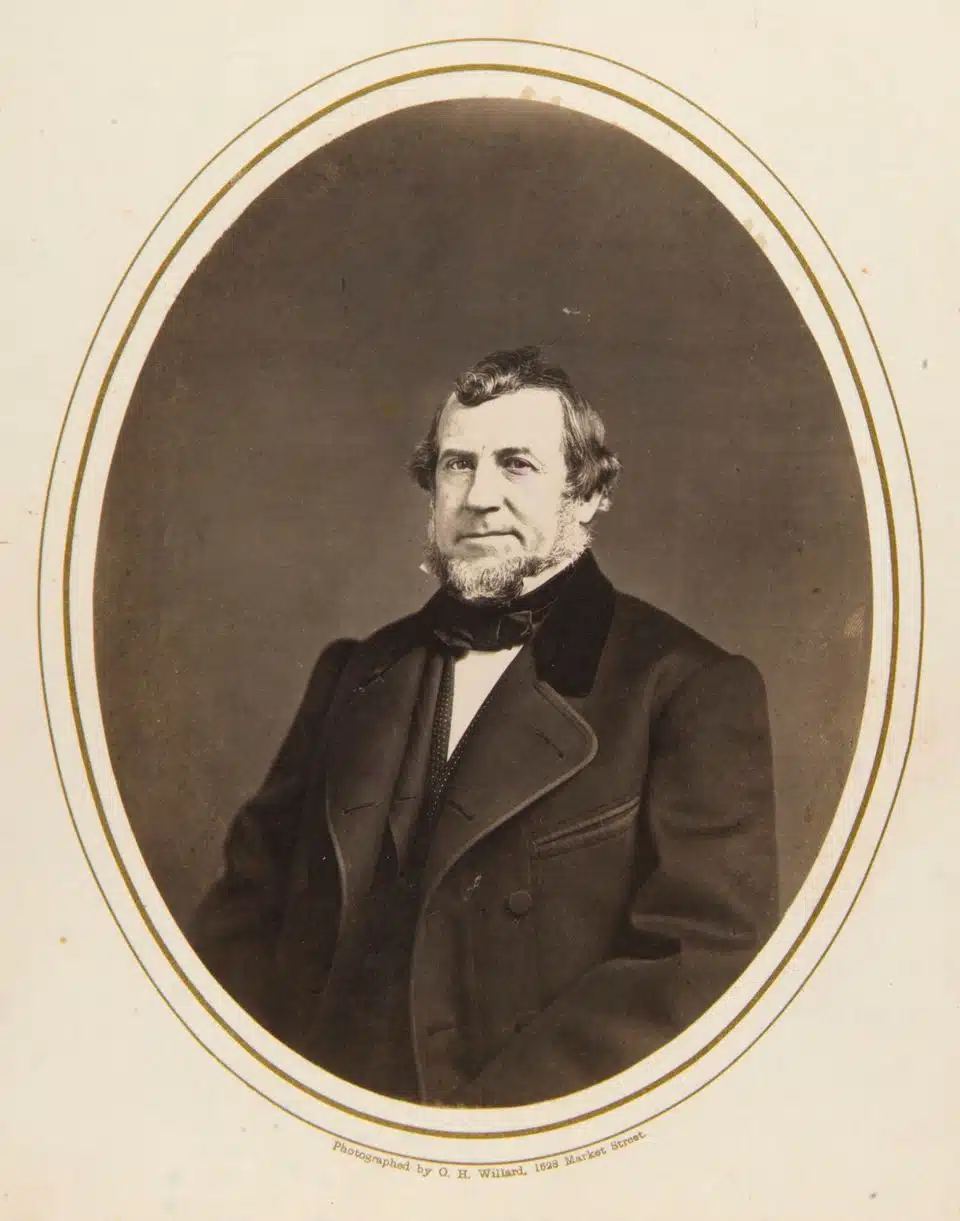
Oliver Harvey Willard was born in Wardsboro, Vermont the son of farmer Oliver Willard, Jr. (1789 -1868) and Sarah Jones Harvey (1797-1875) on December 4, 1828. His father was an industrious farmer, who also ran a seasonal saw mill and worked hauling area farmer’s produce to market in Boston. He saved enough money for the couple to have a comfortable retirement – something that was unusual during that time period.[1] O. H. Willard inherited his mother’s family name as his middle name, since his father was also named Oliver, he frequently went by Harvey.
The Harvey Book family history recorded this information about him: “In 1847 he removed from Wardsboro, Vt. To Philadelphia, Penn’a, where he carried on the business of photography with much artistic skill and financial success until his death, 19 Dec., 1875”[2]
However, Willard does not show up in Philadelphia directories until 1854. What was he doing between 1847 and 1854? We know that he does visit Oxford as an itinerant daguerreotypist. He is recorded in the United States census for 1850 as a 21-year-old daguerreotypist, born in Vermont, living in the borough of Oxford.[3] The listing is an entry for a hotel or large boarding house, recording many unrelated people rooming together.
The roads that pass through Oxford, PA could connect Willard with some towns that would be good markets for photographers, such as Rising Sun in nearby Maryland on the Baltimore Pike.
Lancaster County is also nearby.[4] Willard courted Rebecca Ann Berstler, who was from Ephrata, Lancaster County. The couple married on January 18, 1854 and settled in Philadelphia. They had five children, three of whom lived into adulthood.[5] The children were baptized at the Third Presbyterian Church in Philadelphia.[6]
Oliver H. Willard, [Portrait of an Unidentified young woman, wearing a white lace cap, her arm resting on a table], Philadelphia, ca. 1860, sixth plate hand colored daguerreotype. Courtesy of the Library Company of Philadelphia. https://www.librarycompany.org
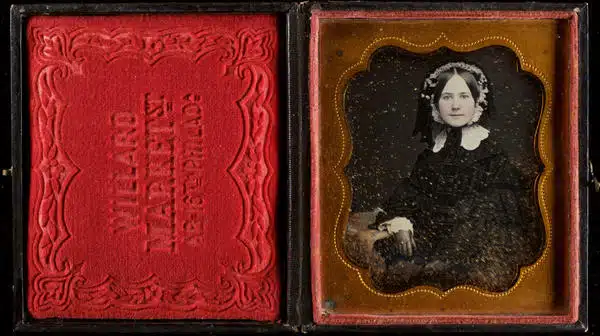
Willard established a studio at 120 W. Market Street, Philadelphia in 1854.[7] Here he made daguerreotypes and ambrotypes with his name and address impressed into the velvet lining of his cases. During the 1854 -1857 time period the imprint reads: “Willard/120 W. Market St./8 doors E. Sch & 6th St.”[8] The streets were renumbered in 1858 and his address changed to 1628 W. Market Street. During this time the case linings of his ambrotypes and daguerreotypes had two different imprints: “Willard/ Market St./AB [about] 16th Philada”[9] and “Williard, 1628 W. Market.”[10] More likely the first of these was used before the numbers were finalized. The Chester County History Center has eleven daguerreotypes and four ambrotypes by Willard which illustrates the above.
The examples in the History Center’s collection illustrates Willard’s portrait style. Most of the subjects are photographed half-length; usually the subject fills the frame with no furniture or props showing. Each individual is well posed and well lighted. The only daguerreotype showing a painted background is a portrait of a small child, Mary Norman.[11] She is seated before a background with leafy foliage, with a table beside her.
Willard, Ash Family, quarter plate daguerreotype in case, ca. 1850, DG3. Courtesy of Chester County History Center. Note Willard’s name stamped in the mat on the lower right corner.
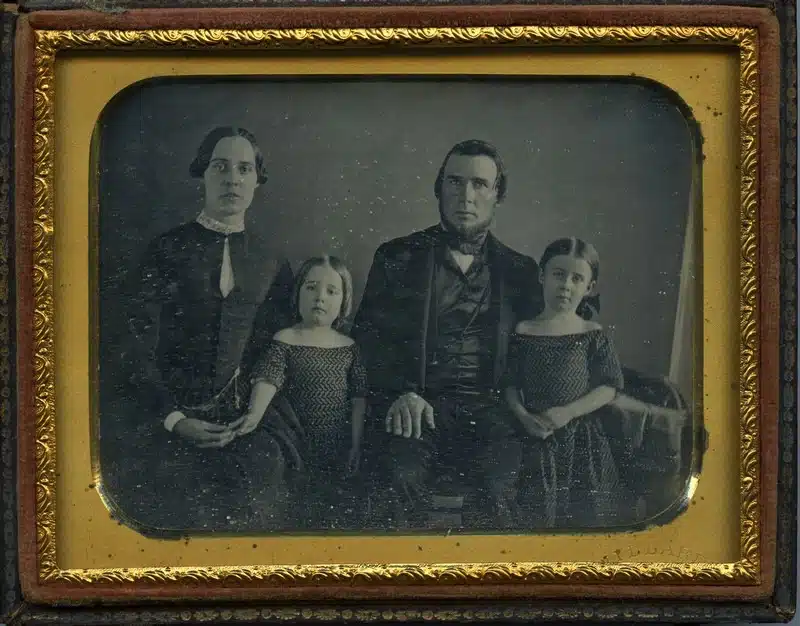
A one quarter plate daguerreotype of the Ash family in the History Center’s collection was made during Willard’s itinerant days. It shows a couple with two young daughters posed before a draped fabric background, the type that could be easily transported and hung up to create a temporary studio. The costume of the couple, as well as the off-the-shoulder necklines of the children’s dresses look like the late 1840s- early 1850s. The subjects are beautifully illuminated, with the mother holding the youngest child’s hand, and the father supporting the older girl with his arm around her shoulders. The mat of this lovely portrait is simply stamped: “Willard.”[12] The surname Ash is commonly found in the western Chester County area.
During the Civil War years, Willard paid the necessary licensing fees in order to practice his craft. He made thousands of the popular cartes-de-visite during this time.
In 1863 he moved his family to 1206 Chestnut Street for a combined family home and studio. This was to be his studio until his death in 1875. He also took on extra trade during the summers by operating a photography studio at Congress Hall in Cape May, New Jersey from about 1868 into the 1870s.[13]
The most interesting event in Willard’s photographic career was when he was a photographer for the Eclipse Expedition of 1869.[14] It was supervised by John Huntington Crane Coffin of the United States Navy who oversaw the publication of the American Ephemeris and Nautical Almanac which compiled data necessary for navigators, astronomers and surveyors.[15] Coffin received a $5,000 appropriation from Congress to study and photograph the total solar eclipse. Professor Hanry Morton PhD was to oversee the photography. Edward L. Wilson, publisher of the The Philadelphia Photographer journal recruited volunteer photographers from Philadelphia to execute the work.[16] The party included: Oliver H. Willard, Henry C. Philips, J. Mahony, John C. Browne, W. J. Baker, H. M. Clifford, James Cremer, W.V. Ranger.
The best place to view the solar eclipse in the U.S. was in Iowa. The party which included astronomers, scientific instrument makers, mathematicians and photographers embarked from Philadelphia on August 2, 1869 by train. Their first stop was at the Baldwin Locomotive Works in Altoona where a brand new specially fitted out railroad car was ready for their use. Aboard this railroad car they headed west, and stopped in Chicago, where photograph materials manufacturer, John Carbutt joined the party. Arriving in Iowa they had much to prepare.
The group was divided into three observation groups to be stationed in the towns of Burlington, Ottumwa and Mount Pleasant, Iowa. O. H. Willard and his team were in Burlington with a telescope loaned by a Philadelphia High School. It had a 6-inch aperture and 9-foot focal length. Professor A. M. Moyer PhD and O. H. Kendall were in charge of adjusting the instrument. The party constructed a temporary building around the placement of the telescope. It sheltered the telescope from the prairie wind and had a retractable roof.[17] It also included a complete darkroom. Here O. H. Willard, H. C. Philips and J. Mahony worked as a team to pour the collodion wet-plates, sensitize them, place them it in holders, expose and develop them in rapid production line fashion. Mr. Joseph Zentmayer constructed the cameras that attached to the telescopes.
When the momentous event began on August 7, 1869, the teams at each site recorded the eclipse through all its phases. The Burlington team was able to make forty negatives during the many phases of the solar eclipse; six good exposures during the totality of the eclipse which lasted for 3 minutes and 48 seconds. Each exposure took 5-7 seconds.[18] Although the photographers confined in the darkroom were not able to witness the whole event, what they did see of it, was awe inspiring and something they remembered throughout their lives. The contribution they made by recording the eclipse on collodion plates was worth it.
When the eclipse was over, the whole party was toasted by the local communities in a grand celebration. The group was so pleasantly hosted by the community that they were sorry to return home once again.
The complete story of the expedition was featured in the September 1869 Philadelphia Photographer with one of the photographs tipped into the edition. Scientists extracted much data regarding the sun spots and corona of the sun that were recorded.
Willard died on December 19, 1875, from typhoid pneumonia in Philadelphia.[19] He was buried in Woodlands Cemetery in Philadelphia.[20]
© Pamela C. Powell, 2022.
-
Oscar Jewell Harvey, The Harvey Book: giving the Genealogies of Certain Branches of the American Families of Harvey, Nesbitt, Dixon, and Jameson, and Notes on Many Other Families, Together with Numerous Biographical Sketches, (Wilkes-Barre: E. B. Yordy & Co., 1899), p.112-113. ↑
-
The Harvey Book. p. 115. ↑
-
Year: 1850; Census Place: Oxford, Chester, Pennsylvania; Roll: 764; page: 72A. ↑
-
O.H. Willard is not listed on Lancaster County Historical Society’s list of photographers. But it may be that his daguerreotypes and ambrotypes did not bear his imprint nor did he sign the image within the case. ↑
-
The Harvey Book, p. 115. ↑
-
Presbyterian Historical Society; Philadelphia, Pennsylvania: U.S. Presbyterian Church Records, 1701-1907; Book Title: Third Presbyterian Church Philadelphia Register, Baptisms, Marriages, Deaths 1794-1955: Accession Number: V M146 P54rg. ↑
-
Gary Saretzsky, List of Philadelphia Photographers, gary.saretzky.com/photohistory/philadelphiaphotographers.html ↑
-
O.H. Willard, Hannah Eachus, sixth plate daguerreotype DG243, [1855-57], Chester Couty History Center, West Chester, PA. ↑
-
O.H. Willard, Hibberd Cox, ninth plate daguerreotype DG45, [1858-1862], Chester County History Center, West Chester, PA. ↑
-
O.H. Willard, Annie Shoemaker Thompson, sixth plate ambrotype AM306, ca. 1862, Chester County History Center, West Chester, PA. ↑
-
O.H. Willard, Mary Norman, sixth plate daguerreotype DG262, Chester County History Center, West Chester, PA. ↑
-
O.H. Willard, Ash Family, quarter plate daguerreotype DG3, Chester County History Center, West Chester, PA. ↑
-
John S. Craig, Craig’s Daguerreian Registry, Daguerreian Registry Home Page (craigcamera.com) ↑
-
Wikipedia, The 1869 Eclipse Expedition, Solar eclipse of August 7, 1869 – Wikipedia ↑
-
Wikipedia, American Ephemeris and Nautical Almanac American Ephemeris and Nautical Almanac – Wikipedia ↑
-
Edward L. Wilson, “Photographing the Eclipse,” Philadelphia Photographer, Vol. VI, No. 69, September 1869, p. 285-292. ↑
-
A view taken by John C. Browne of a telescope shelter can be seen on the website of Princeton University, Firestone Library, Special Collections at 1869 Eclipse Photographed | Graphic Arts (princeton.edu). ↑
-
Prof. Henry Morton, “The Eclipse Expedition,” Philadelphia Photographer, Vol. VI, No. 69, September 1869, p.305-309. ↑
-
O.H. Willard, Death Certificate, Pennsylvania Philadelphia City Death Certificates, 1803-1915, Philadelphia City Archives, Philadelphia, PA. ↑
-
Oliver Harvey Willard, Findagrave.com Oliver Harvey Willard (1828-1875) – Find a Grave Memorial ↑