
John W. Odiorne
( 1839 – 1866 )
Odiorne & Shrieves | Business and Marital Discord in the 1860s
John W. Odiorne’s brief career in West Chester was wracked by marital discord and financial difficulties. The studio of Odiorne & Shrieves succeeded F. McCutchen at the High and Market Street address and lasted only from late July 1865 until November of 1865; John Odiorne continued on his own until October of 1866. His private life was not unlike a modern soap opera with a tragic ending.
John Wilcox Odiorne was born in Roxbury, Massachusetts on June 14, 1839 to Henry B. and Hannah M.B. Odiorne[1]. His family moved to Philadelphia[2], where John and his older brother Henry[3] worked as photographers.
Both John and Henry Odiorne served in the Civil War. John enlisted in Hummell’s Pennsylvania Cavalry on July 2, 1863 and was mustered out on September 16, 1863[4]. His brothers Henry and David enlisted as privates in Co. D. 19th Regiment of the Pennsylvania Volunteers, entering service on May 18, 1861[5]. After completing their service, both brothers enlisted in Company D of the 97th Regiment Pennsylvania Volunteers September 6, 1861[6]. Henry rose through the ranks becoming a Captain in December of 1864. He was killed in action at Fort Fisher, N.C. on January 15, 1865[7].
John Odiorne had nine years of experience as a photographer in Philadelphia before taking over the gallery of F. McCutchen in West Chester, Pennsylvania along with business partner Charles D. Shrieves[8].
In the Village Record newspaper it was announced on July 29, 1865 that John W. Odiorne and Charles D. Shrieves would take over the gallery of F. McCutchen on August the 1st. A testimonial published in the August 8th Village Record endorsed Odiorne’s skills as having been an operator at Gutekunst’s Gallery in Philadelphia. It further recommends his skills with children, “A lady friend exhibited to me a picture of her son, eighteen months old, which is very good. She had taken him to seven different establishments, and this is the only good picture she succeeded in getting.[9]” In an advertisement also placed in that same issue, Odiorne and Shrieves list among their services copying daguerreotypes, taking views of houses and stock on short notice. They also will honor McCutchen’s customers who need to pick up orders that remained at the studio.
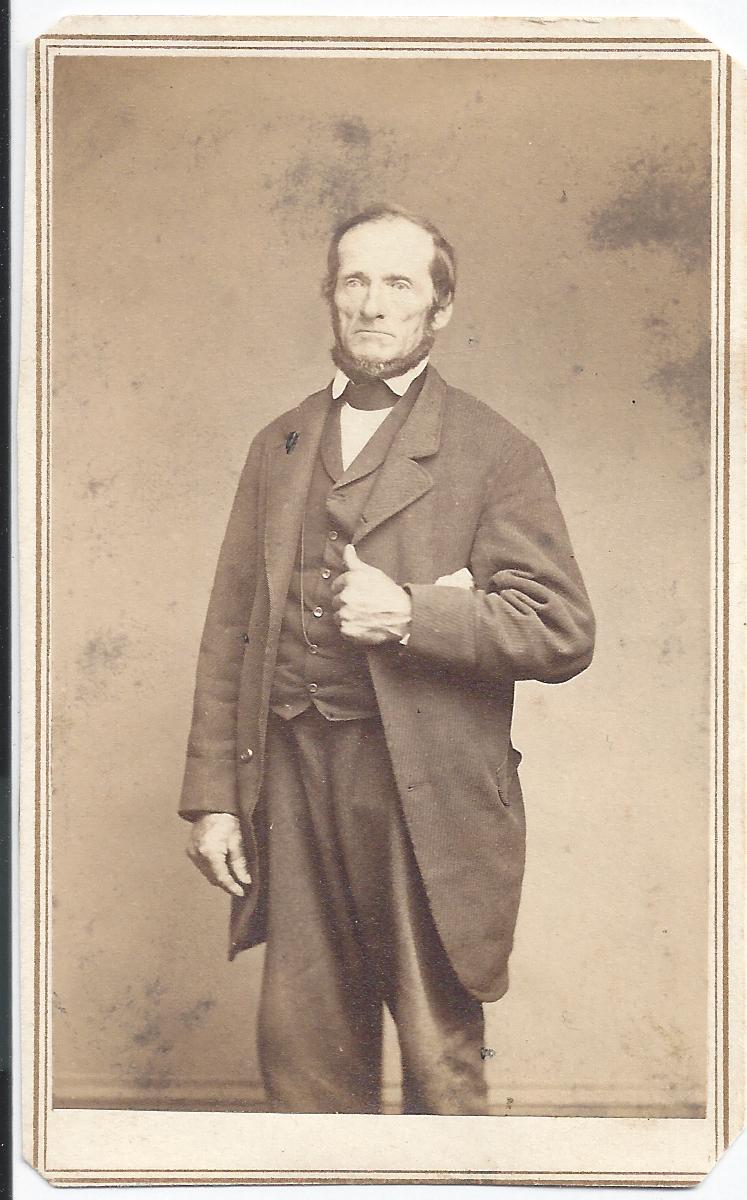
Photo 3: Odiorne & Shrieves, Unidentified gentleman with chin whiskers, albumen carte-de-visite, West Chester, PA, August 1864. Collection of the author.
Odiorne & Shrieves imprint showing label with the partners names pasted over McCutcheon’s name. Collection of the author.
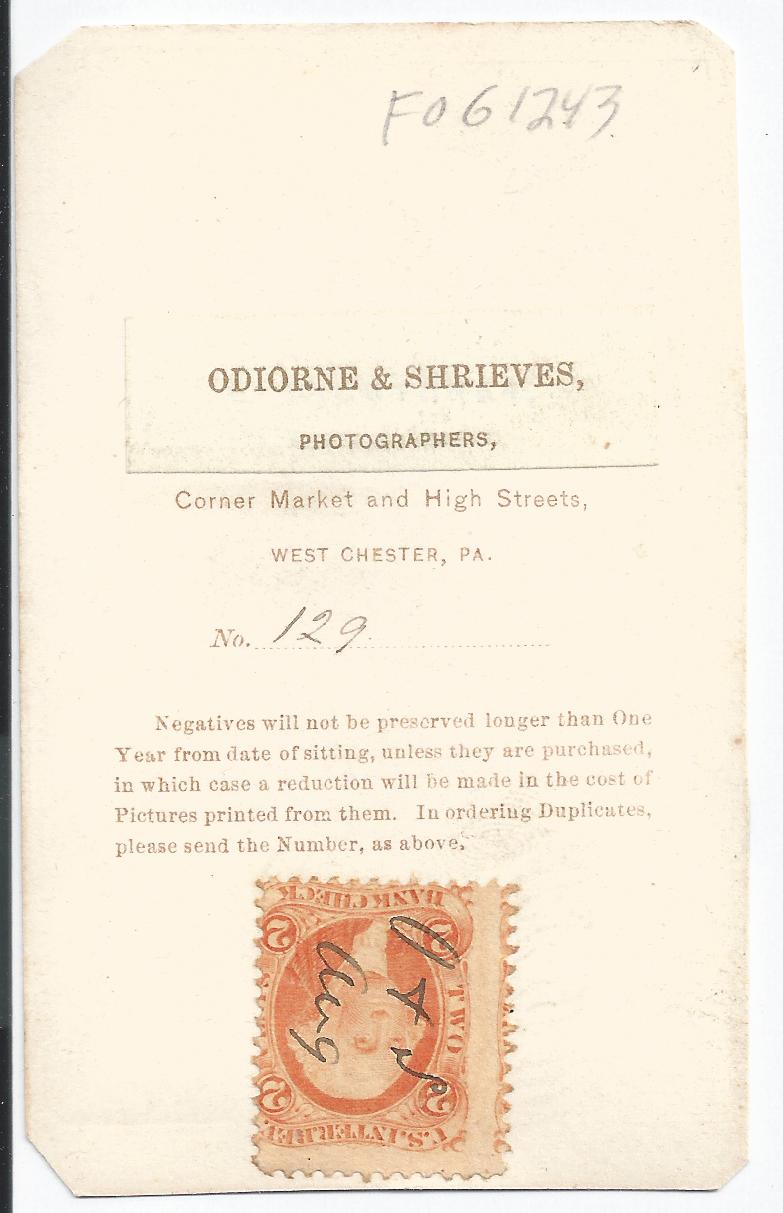
Further evidence that Odiorne & Shrieves succeeded McCutcheon are examples of cartes-de-visite in the collection of the Chester County History Center, in which Odiorne & Shrieves glued their own printed label over McCutcheon’s name on his carte-de-visite mounts[10]. When they purchased his gallery, all of the fixtures went with it.
The business relationship between Shrieves and Odiorne was short lived, since by November of 1865 Charles Shrieves moved into the studio over Worrall’s bookstore with a new partner, Marshall Battin. The November 4th issue of the Village Record summarized the rearrangement of three of the five photography studios in West Chester:
“PHOTOGRAPHING.- Messrs. Shrieves & Battin, have taken the Photograph Gallery of Mr. Garrett, over Worrall’s book store, and have spent some time in altering and improving the rooms. Mr. Garrett takes the rooms over Mr. Travilla’s dry goods store, about a square further west on the same street…Also..Mr. Odiorne, whose rooms are opposite the Turk’s Head Hotel, Market Street[11].”
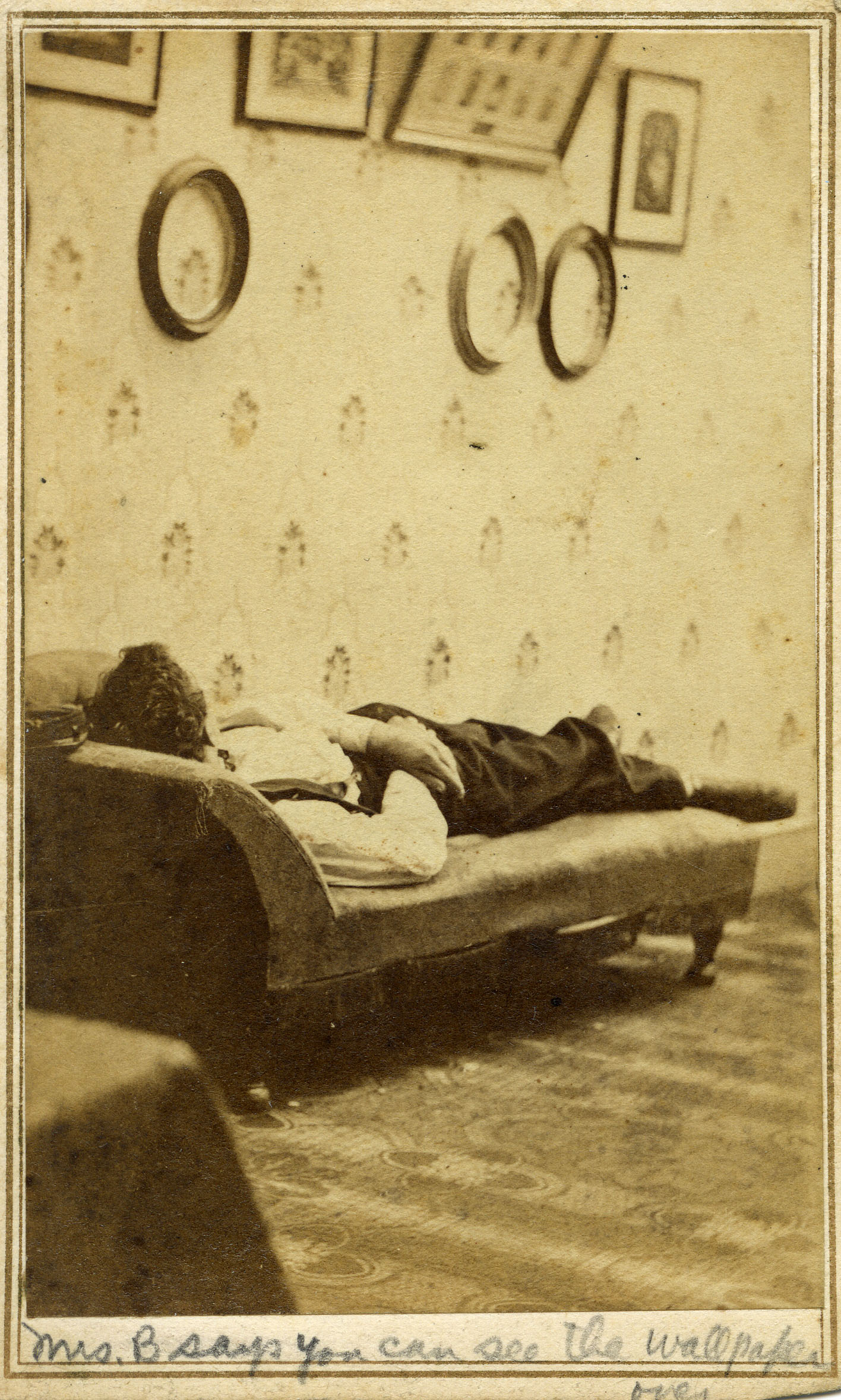
Odiorne & Shrieves, albumen carte-de-visite, Courtesy of Chester County History Center, West Chester, PA. Labeled: “Mrs. B. says you can see the wall paper through the frames,” an unusual candid carte-de-visite taken by photographers whose business was very slow.
Now that Odiorne was on his own, he needed some good publicity. A Village Record reporter visiting the gallery remarked on seeing a fine portrait of Col. Guss, the beloved Commander of the 97th Regiment there, but this writer wonders if it remained there from a previous gallery operator.
Financially, the operation of the gallery did not go smoothly. There was tough competition between the five photograph galleries in the one-mile square borough at that time including C. Alfred Garrett, Thomas W. Taylor, Eber Woodward, and Shrieves & Battin.
Odiorne’s business in West Chester came to an end by October of 1866 when suffering from illness and a broken marriage, he went to Media, Delaware County to be with relatives. While there, he died on October 20, 1866 of what was called inflammatory rheumatism. He was buried on October 29 at Monument Cemetery at Broad & Berks Street in Philadelphia[12].
It is only after his death, John Odiorne’s marital discord came to public attention through court cases decided at the Court of Common Pleas in Chester County and appealed at the Superior Court of Pennsylvania. Both his estranged wife, Annie Odiorne and John’s brother David vied to administer his estate. Since John Odiorne died intestate, Annie took out Letters of Administration in Philadelphia, since she, as widow, resided there. Meanwhile, David Odiorne took out Letters of Administration in Chester County, John’s last place of legal residence.
The couple’s unhappy story is revealed in the Appellant’s Paper Book, Supreme Court of Pennsylvania Eastern District. Annie I. Odiorne Appellant, versus David W. Odiorne, Appellee[13].
John Odiorne married Annie Isadore Robbins on August 17, 1861. For financial reasons, the young couple moved in with Annie’s adoptive father, Charles Foquet. This arrangement lasted for four years. Overstaying their welcome, Foquet offered his son-in-law some helpful advice by suggesting a business opportunity for a photographic gallery in West Chester.
In West Chester, Odiorne and his wife had to pinch pennies, they lived in the gallery rooms itself, later moved into hotels and finally into Mrs. Miller’s rooming house. In July of 1866 Annie Odiorne succeeded in getting an acting job in Detroit and left her husband for a new career. She departed with his blessing, however, what he did not know was she intended on leaving him forever.
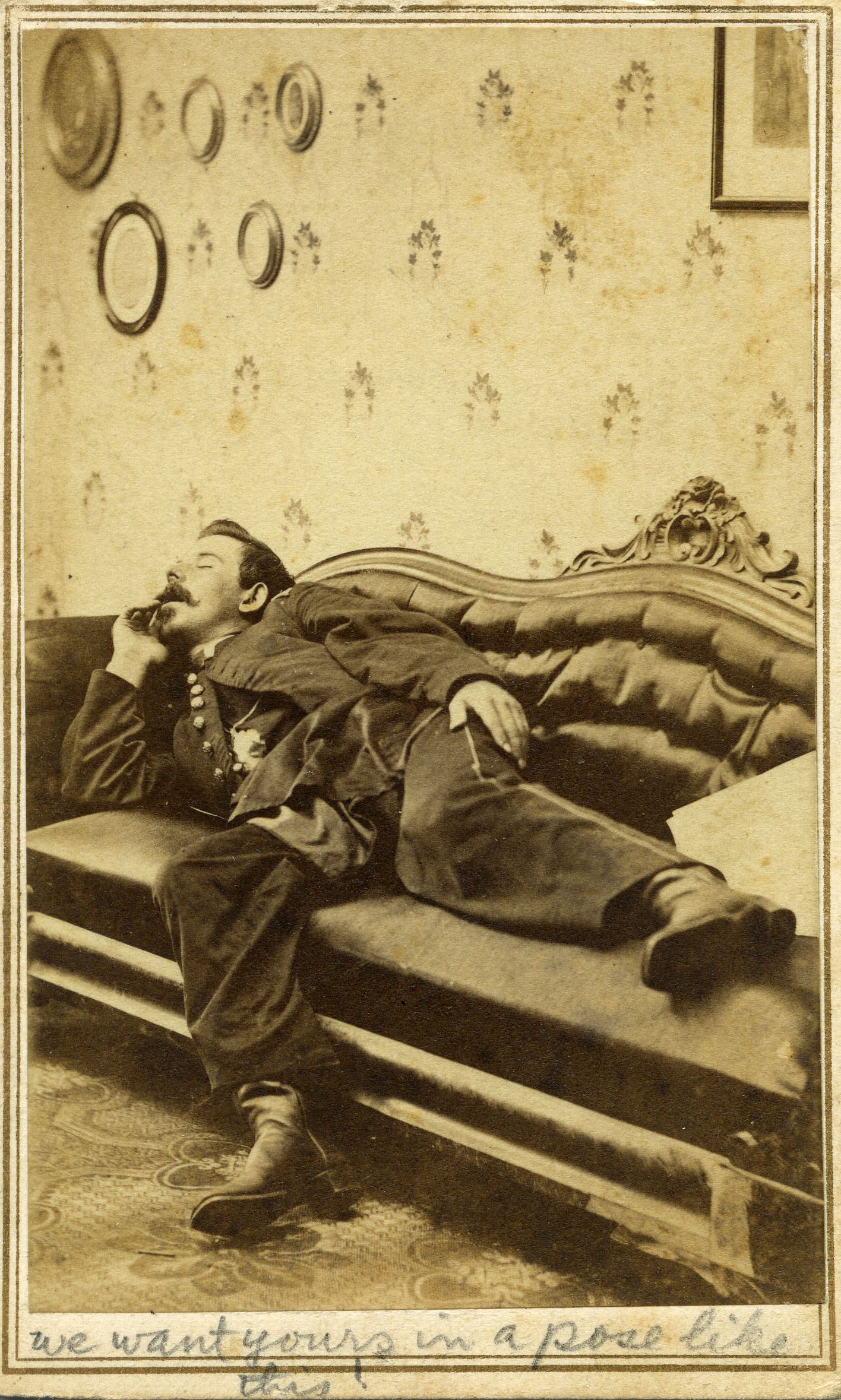
Odiorne & Shrieves, probably John Odiorne, 1866, albumen carte-de-visite, Courtesy of Chester County History Center, West Chester, PA. “We want yours in a pose like this” most likely this carte-de-visite is of John Odiorne taken to send to his wife Annie when she was in Detroit.
He wrote to her on July 17, 1866 wishing her much success and providing supportive advice. He wrote again on August the 8th, worried that he had not heard from her. But unfortunately Annie’s debut had been a disaster, her engagement did not last a week in the theatre. Heartbroken, she returned to her father’s home in Philadelphia. It is there she wrote a scathing letter to her husband on August 20, 1866 declaring that she left him and never wanted to live with him again, “I would sooner die than be forced to do so.”
Odiorne visited her to make amends but discovered Annie had found a new love. Odiorne wrote on August 22, 1866 to Annie expressing his heartbreak, “what troubles I have had, first to lose my father, my best brother and lastly and hardestly my wife.” She replies on August 24, 1866, “I am no slave but a free born woman with a will that she has both the right and determination to exercise.” He replies to her on August 26th, “I have loved but once and will never love again.” He advises her to stay away from the stage which is a career “full of vice and wickedness.”
After writing a series of soul baring letters back and forth, the couple agreed to separate. It was shortly thereafter that John Odiorne died.
Annie Odiorne made the case that she was the rightful administrator of the estate since she was the legal widow. She claimed that David Odiorne could not properly administer the case since he lived out-of-state in New York.
David Odiorne argued that since Annie declared her love for another man, she had violated her marriage vows and was morally unfit for any office of trust. She had treated her husband deceitfully and had deserted him. Furthermore, he claimed his brother’s death was hastened by Annie’s “unnatural conduct” as wife. David argued that he was not incompetent as administrator simply because he lived in New York. He also made the case that his brother’s last residence was in Chester County, since all of his property including the fixtures in his business and personal effects were at the boarding house of Mrs. Miller in West Chester. To further establish his residency there was the record that he voted there in 1865.
Judge William Butler, President Judge of the Register’s Court in Chester County issued an opinion, that the letters of administration were appropriately filed by David Odiorne in that county. He based his opinion on the grounds that Annie had deserted her husband without reasonable cause and was persisting in desertion at the time of his death. Since Annie Odiorne had lost her suit, she was responsible for the court costs of $100.
Odiorne’s personal property was inventoried and appraised in October 1866 by Franklin Darlington (the owner of the building where the studio was located) and Edward J. Willcox. Among the items inventoried were: 1 stereoscopic instrument & bath $15, lot of chemicals $5, one opal print frame $1, two bass violins @ $8 each, 1 violin & case $5, pair of skates $2, lot of books $5, etc.
Annie Odiorne appealed her case to the Superior Court of Pennsylvania. Her attorneys, James W. Latta and John H. Brinton argued that since Annie Odiorne was not well provided for by her husband, she turned to the stage to earn her bread. They also argued that since the separation of the couple was only a two-month period, it was not grounds for desertion. They claimed that Annie welcomed his visits to her adopted father’s home in Philadelphia and also mourned at his grave after John Odiorne’s sudden and unexpected death. The attorneys also reinforced the policy that non-residents are discouraged as executors in the Commonwealth of Pennsylvania.
However, the decision of the Court of Common Pleas of Chester County was upheld in the decision recorded January 1867 by the Superior Court.
David Odiorne proceeded with settling the estate, filing the final account on February 28, 1867. All John Odiorne’s debts were paid, including $19 he owed West Chester photographer C. Alfred Garrett, and $550 to his wife Annie Odiorne.
©Pamela Powell, 2019
-
Ancestry.com. Massachusetts, Town and Vital Records, 1620-1988 [database on-line]. Provo, UT, USA; Ancestry Operations, Inc. 2011. https://search.ancestry.com/cgi-bin/sse.dll?indiv=try&db=MATownVital&h=80842213 ↑
-
Ancestry.com. Pennsylvania and New Jersey, Church and Town Records, 1669-2013 [online database]. Lehi, UT, USA: Ancestry.com Operations, Inc., 2011. https://search.ancestry.com/cgi-bin/sse.dll?dbid=2451&h=2022334919&indiv=try&o_vc=Record:OtherRecord&rhSource=2495 ↑
-
William and Marie Brey. Philadelphia Photographers 1840-1900.(Cherry Hill, New Jersey, Willowdale Press), Unpaged. ↑
-
Samuel P. Bates. History of the Pennsylvania Volunteers, 1861-1865. Harrisburg, PA: B. Singerly, State Printer, 1871. 5: 1329. ↑
-
Ibid, 1: 180. ↑
-
Ibid, 3, 435. ↑
-
Isaiah Price, DDS. History of the Ninety-Seventh Regiment, Pennsylvania Volunteer Infantry during the War of the Rebellion, 1861-1865. (Philadelphia: Isaiah Price, 1875), page 496. ↑
-
Village Record, (West Chester, PA), 29 July 1865. ↑
-
Village Record, (West Chester, PA), 22 August 1865. ↑
-
Odiorne & Shrieves, unidentified sitters 1865, photograph collection : Photographer’s CDVs. Chester County History Center, West Chester, PA. ↑
-
Village Record, West Chester, PA, 4 November 1865. ↑
-
Death certificate, John W. Odiorne, Philadelphia, PA, 25 October 1866, Commonwealth of Pennsylvania Department of Health, Bureau of Vital Statistics. ↑
-
Appellant’s Paper Book, Supreme court of Pennsylvania, Eastern District. Annie J. Odiorne Appellant, vs. David W. Odiorne, Appellee, Court of Common Pleas File #15453, Chester County Archives and Records Services, West Chester, PA. ↑
