John T. Wiley
( 1853 – 1926 )
Photographer on Wheels
J.T. Wiley is one of the colorful characters of Oxford, beginning his photographic career in a mobile photograph studio on wheels in the 1880s. His wagon became a fixture parked in Oxford, PA until he rented a studio in 1896. His photographic career lasted into the 1920s.
John Thomas Wiley was born to farmer John Wiley and Matilda Bess Williams, in February of 1853 in Lower Oxford Township, Chester County, PA.[1] He was a fraternal twin, sharing his birth with his sister Rachel. The family was typical of the Scots-Irish Presbyterians that settled southwestern Chester County. J.T. had another sister, Anne and a brother, Isaac.
J.T. Wiley married Rebecca Ella Pass at the Fagg’s Manor Presbyterian Church on June 12, 1879.[2] The couple settled in East Nottingham Township were J.T. found employment as a tinner according to the 1880 Census.[3] But tin smithing turned into tintype making by 1884. Wiley outfitted a large wagon with a complete studio set up inside. The wagon afforded him the mobility the country people appreciated in the rural area around Oxford. He could easily travel to take photographs of livestock, inventions and homes. Of course, customers could have their portraits made right in that mobile studio.
Beginning in 1884, Wiley parked his wagon at Third Street near Locust in Oxford to secure some of the trade in the borough. He is listed at that location in Boyd’s Chester County Directories from 1884 through 1895. Genealogist and local historian Thomas Urbine recounts a story about Wiley’s wagon:
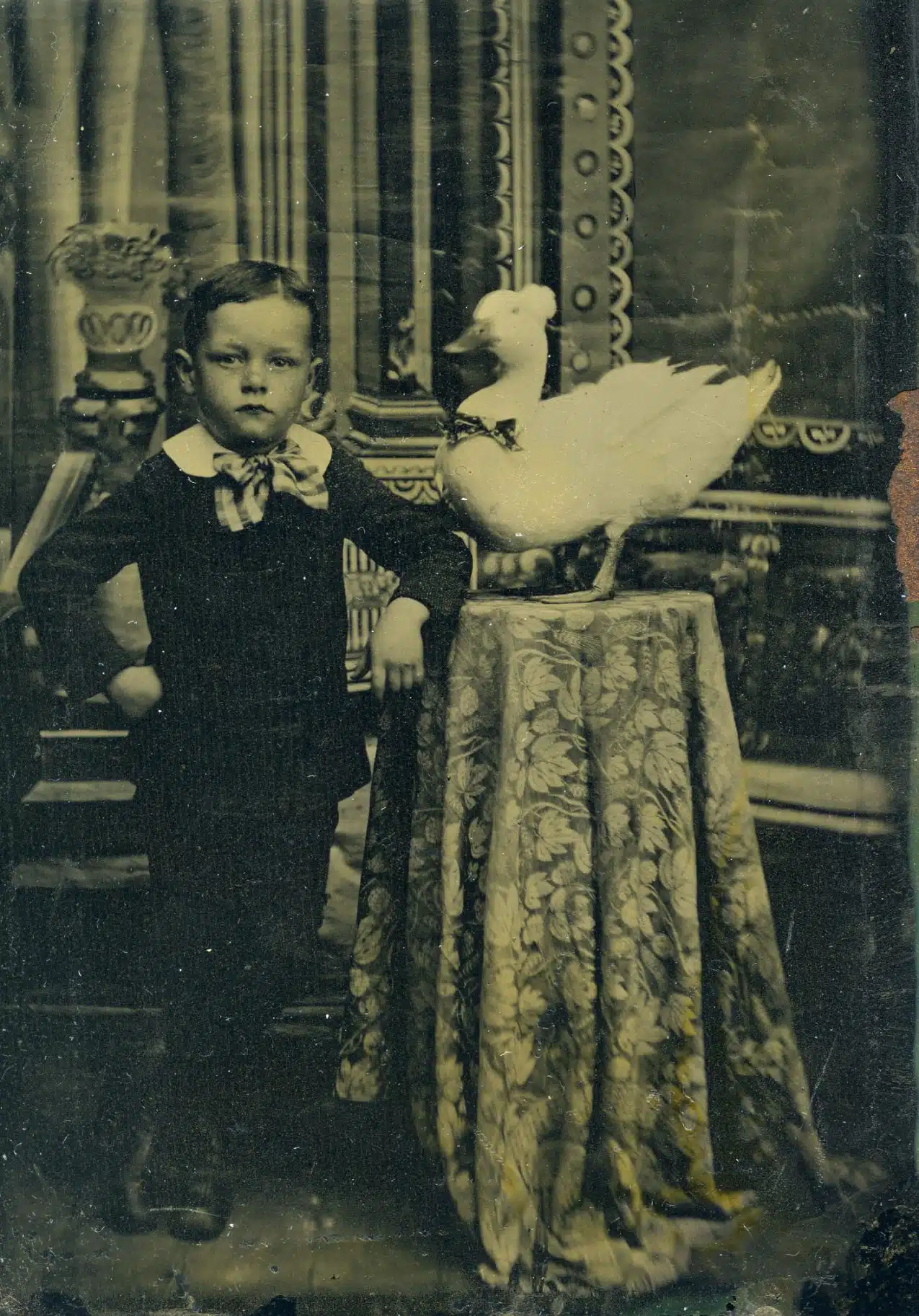
“The Wiley’s who lived on the New London Road in my gr.gr. grandparents house, quite near the McCormick lands, also had a photography business in Oxford in the 1880s. It was in a large moveable wagon at Third and Broad and Al Kirk had his picture taken there with a white duck that was his pet, in 1887. He told me that they had trouble with the duck as it wanted to get in the water tub that Wiley used in the picture-taking process.[4]”
The tintype of Al Kirk and his duck are now in the collection of the Chester County History Center.
J.T. Wiley, Al Kirk and pet duck, tintype, 1887. Thomas Urbine Collection, TIN#139. Courtesy of Chester County History Center.
In 1885 tragedy struck the photographer, his wife Ella died at the young age of 25, leaving him with the care of two small children, Guy age 5 and Theresa age 2. Wiley’s twin sister Rachel and also his sister Anne, moved in to take care of the children and household. They would remain with their brother throughout his life.
Wiley offered a variety of services from his traveling wagon. An advertisement from The Oxford Press on December 5, 1895 gives the range of his services:
J.T. Wiley, Photographer, Third and Broad Streets, Oxford, PA. Price List: Little Queen, Diamond or Long size 12 for $1.50, 6 for $1.00 Mantello: 12 for $2.00, 6 for $1.25. Cabinet: 12 for $2.50; 7 for $1.50; 4 for $1.00. 8 x 10 for frame $1.00 All the smaller and larger sizes at reasonable rates. WE MAKE A SPECIALTY OF GROUPS Either at our studio or at your own home. Out-door views of buildings, animals, etc. If you have a social gathering send us word and we will come and Photograph you. Try us for your Holiday trade. Tintypes in their different sizes. Crayons, Pastels, Copying, Enlarging, etc. We can please you. We can save you money. Very Truly, J. T. Wiley”[5]
Little Queen, Mantello and Cabinet refer to the size of the photograph’s mount. All were used for portrait photography.
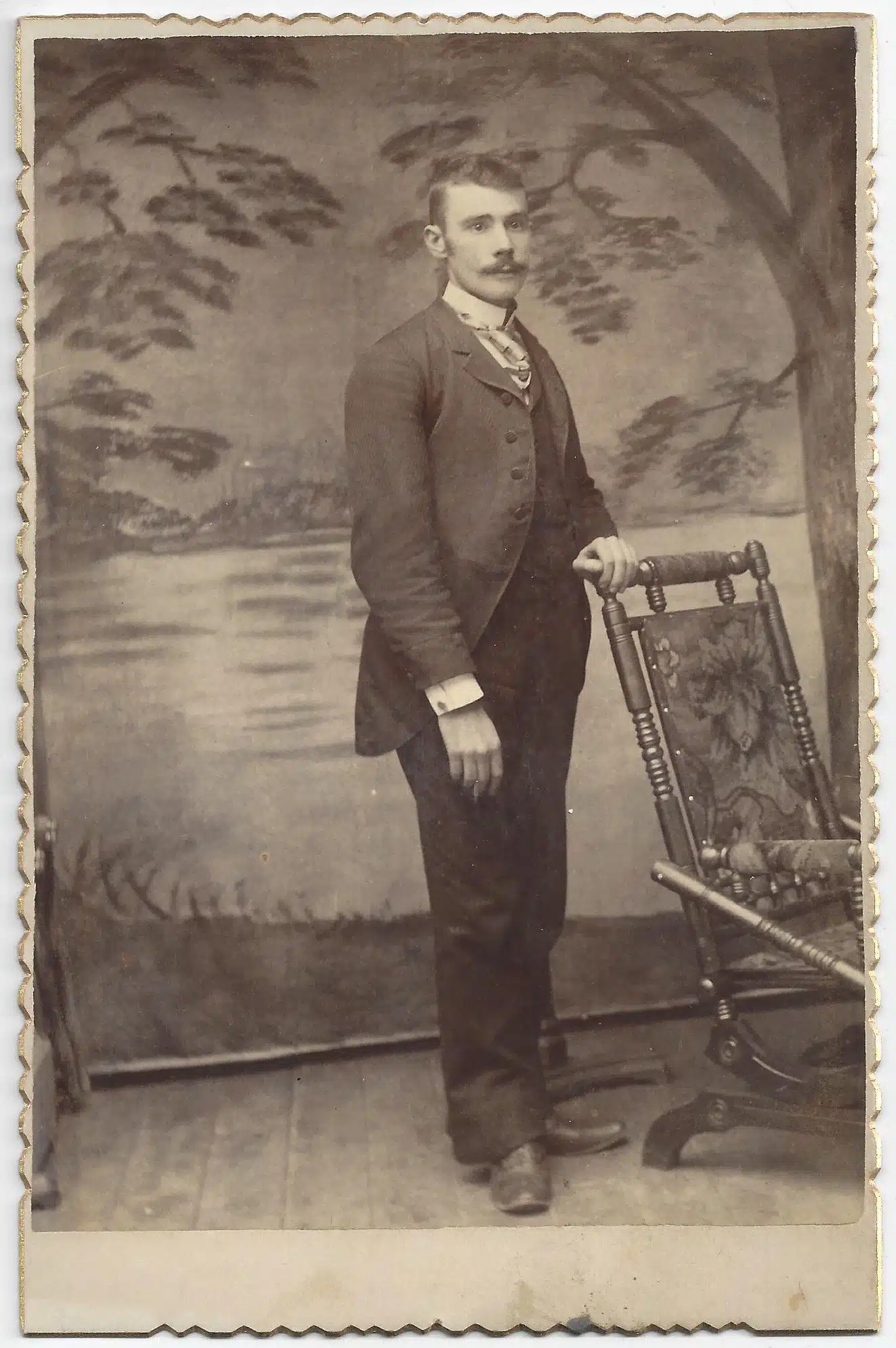
J. T. Wiley, Full-length portrait of a gentleman wearing a cut-away coat, ca. 1899, albumen photograph on cabinet card. From the collection of Pamela C. Powell. Note the use of the blank mount with gilded beveled edge and the photographer’s hand stamp on the back.

In 1896 a Frenchman named Louis Prevaust visited Wiley’s photography wagon in what proved to be a pivotal moment. Prevaust had come to New York about a year ago looking for work in designing and decorating. The competition proving too brisk, he decided to travel to smaller towns looking for work. Dapper, with a small mustache, Prevaust was charming and knew how to talk to people and gain their confidence.
The Oxford Press story explains: “It was early in April that the Frenchman appeared at Wiley’s photographic car in Oxford and asked the proprietor if he wanted any backgrounds painted. Mr. Wiley was informed by Prevaust that he too was a photographer and an artist of general ability and experience. The fellow was taken in and soon convinced Wiley he could handle a pencil and brush…”[6]
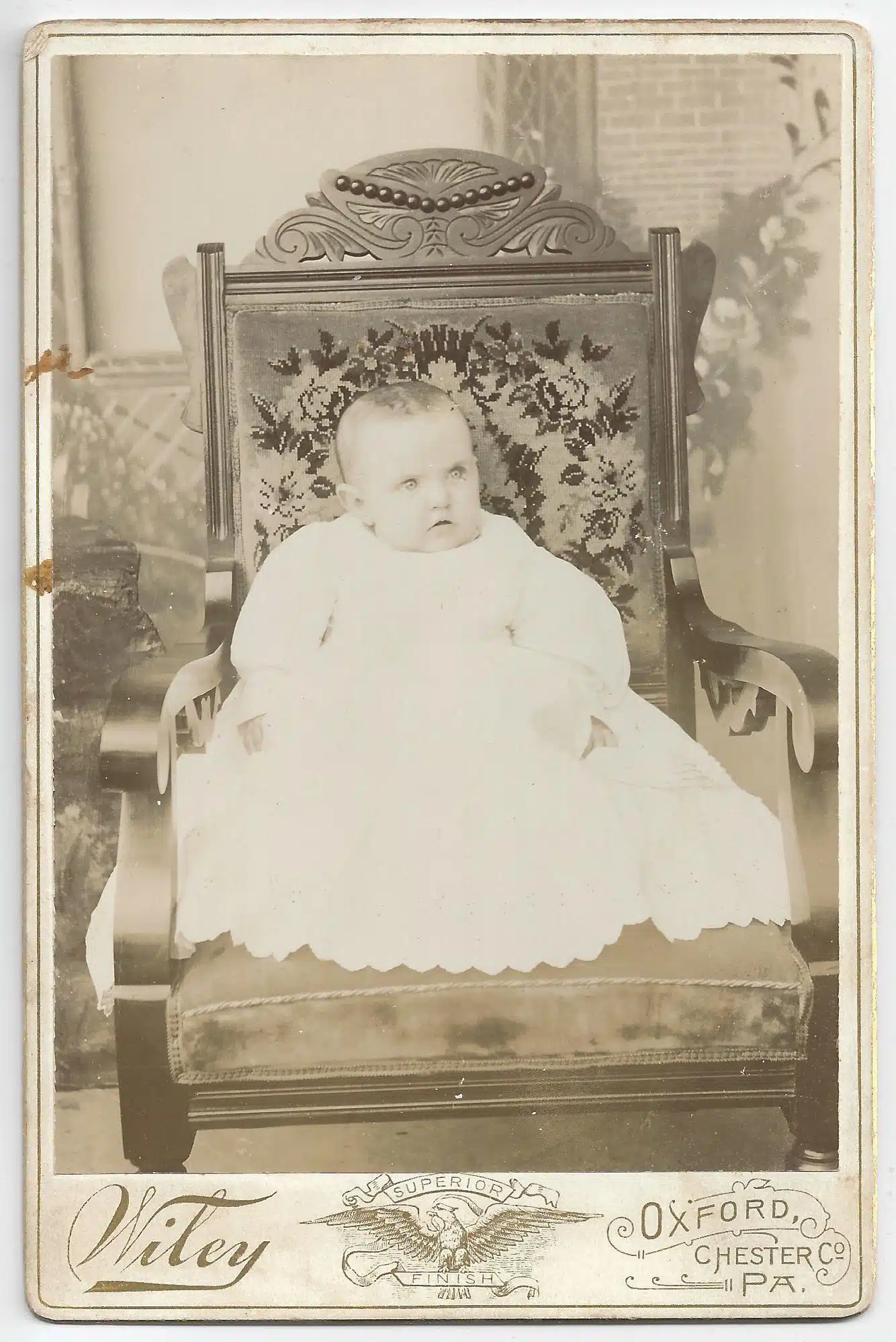
J. T. Wiley, Unidentified Infant, 1896-1898, cabinet card. From the collection of Pamela C. Powell. Note the proud address handsomely printed on the back of the card identifying the studio at the “Electric Block” in Oxford.
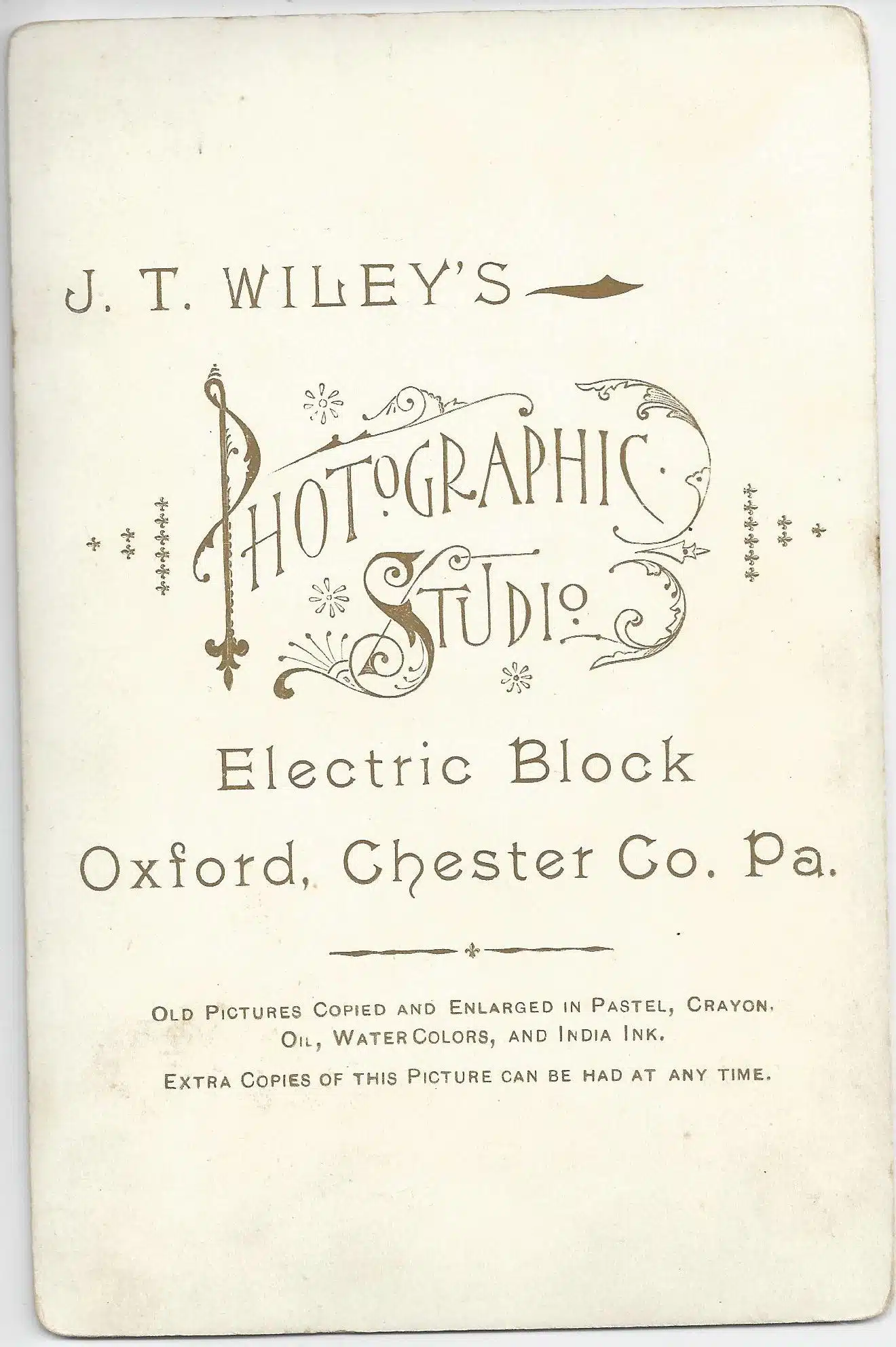
After years of working out of the mobile wagon, J.T. Wiley with the artist Prevaust moved into a studio in the Electric Block at South Third Street in Oxford in April of 1896. His advertisement appearing in the Oxford Press on April 16, 1896 paints a fabulous image of his new studio:
“Wiley’s New Photographic Studio Electric Block, South Third Street, Oxford, PA. Our Parlor and Atelier are handsomely furnished with new Scenery, Backgrounds and Instruments. We have introduced Paris and London positions, Posing, Lighting Effects and many new kinds of Pictures. Our French Artist, Mr. Prevaust, gives painting lessons in Oil, Water Colors, Crayon, Ink and Photographic Work. Hours – Tuesdays, 2 to 3 p.m.; Fridays 7 to 8 p.m. Terms very reasonable. A SPECIAL OFFER -To all my patrons living along the Central Division of L.O.& S. Railroads, I will for the month of April allow 50 cents for car fare on all orders for one dozen cabinet Photographs, We welcome to our new Studio our friends and patrons. Thanking one and all for past favors, we ask a continuance of same, Very Truly, LOUIS PREVAUST, Artist, Late of Paris, France, & J. T. WILEY, Photographer and Proprietor. Notice: Mr. William W. Daughty of Elsmere, Delaware, having completed his engagementas agent to collect pictures for enlarging at my Studio, is no longer in my employ. Mr. William Alexander of Oxford is engaged in his place.”[7]
Prevaust worked with Wiley for a few weeks, but left him, saying he was going to open his own studio. The Frenchman, who was a regular at George P. Wright’s restaurant in Rising Sun Maryland, managed to negotiate a loan from Wright amounting to $70.00. It came in the form of four checks, which Prevaust then passed off on a series of Oxford businesses which provided him with goods and cash. He then claimed that he was going on the road to canvass for orders, so he purchased a horse and wagon from Samuel Winchester of East Nottingham, but left without paying for it. Along the way he borrowed $10 from D. M. Taylor. The rig was later left at Mendenhall’s livery stable. Meanwhile, Prevaust skipped town taking the train to Baltimore leaving the local justice to sort out the claims for damages.
J. T. Wiley now had the new problem of paying for his overhead. He advertised a dozen cabinet cards for $1.50 if you paid in advance.[8] His prices were very competitive, hoping to draw some business away from his competitor, John Barry. The Oxford Press reported that he installed a new skylight in the north end of the building and was “entering into the artistic business on an enlarged scale”[9].
But according to Boyd’s Chester County Directories, it appears that Wiley was back in his mobile studio on Third and Broad Streets by 1898.[10]
Recounted through letters in the Thomas A. Urbine collection, Wiley bought a house on the Oxford-New London Road in 1900. The house had been built by the Collins family in 1856 and was torn down in 1972. According to the 1900 Census, Wiley was living there with his two sisters and daughter Theresa. Urbine noted in letters that Theresa had an impressive flower garden “which was enjoyed by the people who traveled the route from Oxford to New London crossroads.”[11]
It is unclear how long into the twentieth century Wiley actively was in business as a photographer. When he was called to serve on the Grand Jury in the term of January 1914, he lists his occupation as photographer.[12]
At the time of his death, J. T. Wiley was living at home with his daughter Theresa and two sisters.[13] He died on November 1, 1926 at age 73 and was buried in the Oxford Cemetery.[14] He was survived by his son, Guy Edgar Wiley (1880-1964), daughter Theresa B. Wiley (1883-1974) and sisters Rachel (1853-1929) and Anna Wiley (1852-1957).
©Pamela C. Powell, 2021.
-
Year: 1860; Census Place: Lower Oxford, Chester, Pennsylvania; Page: 453; Family History Library Film: 805093. ↑
-
U.S. Presbyterian Church Records, 1701-1907; Accession Number: VAULT BX9211.P4933 F32 v.2, Presbyterian Historical Society, Philadelphia, PA. ↑
-
Year: 1880; Census Place: East Nottingham, Chester, Pennsylvania; Roll: 1114; page 428B; Enumeration District: 066. ↑
-
Letter from Thomas A. Urbine, Jr. to Mr. F. McCormick Moore, 9 November 1978. Thomas A. Urbine Collection Box 9 File 153, Library, Chester County History Center, West Chester, PA. ↑
-
The Oxford press, (Oxford, PA, 5 December 1895. ↑
-
The Oxford Press, (Oxford, PA), 4 June 1896. ↑
-
The Oxford Press (Oxford, PA), 16 April 1896. ↑
-
Morning Republican, (West Chester, PA), 7 June 1896. ↑
-
Oxford Press, (Oxford, PA), 2 November 1896. ↑
-
C. E. Boyd, Boyd’s Chester County, Pennsylvania, Directory 1898-1899, (Philadelphia: C. E. Howe Company, 1898). ↑
-
Thomas A. Urbine Jr., Wiley family notes, Thomas A. Urbine Collection Box 14 File 248, Library, Chester County History Center, West Chester, PA. ↑
-
Grand Jury Records, Book #12, microfilm frame 26, 1914, Chester County Archives & Records Services, West Chester, PA ↑
-
Year: 1920; Census Place: East Nottingham, Chester, Pennsylvania; Roll: T625_1550; Page 3B; Enumeration District 34. ↑
-
Findagrave, https://www.findagrave.com/memorial/91482342/john-thomas-wiley ↑