John M. Branson
( 1822 – 1876 )
Coatesville Photographer and Real Estate Speculator
John Branson was Coatesville’s photographer from about 1860 until 1874, producing daguerreotypes, ambrotypes, tintypes and cartes-de-visite. It is uncertain that he partnered briefly with William Hannum of Kennett Square sometime during the mid to late 1860s. While information about Branson’s photographic career is lacking in detail, his sideline as a real estate speculator is well documented. A downturn in his fortunes collided with the Financial Panic of 1873, forcing the close of his studio.

John Malin Branson was born in Chester County to James G. and Elizabeth Branson on February 28, 1822.[1] John was the eldest son in the family of five children. Their father was a farmer in West Brandywine Township in Chester County, PA who also did some carpentry and carriage building.[2] The 1850 census records John as working on their farm in West Brandywine Township.[3]
On December 7, 1854, he married Annie M. Morgan. The couple is described as being of residents of Coatesville in their marriage announcement.[4] According to the 1856 Septennial Census of Pennsylvania, he was a “store tender” in Valley Township.[5] It may be that he worked in his brother Owen Branson’s store. It was in the fall of 1857 that Branson & his wife moved into a rental property owned by H.G. Thomas in the growing village of Coatesville in Valley Township.[6]
But sometime between 1856 and 1860 John Branson learned the daguerreotype process and his life was set on a new path. According to the 1860 Census, Branson described himself as a “Daguerreian.”[7] He is recorded with his wife Annie and their two children Henry (age 4) and Laura (age1).
Jno. M. Branson, Unidentified Quaker woman, early 1860s, carte-de-visite. Collection of the author.

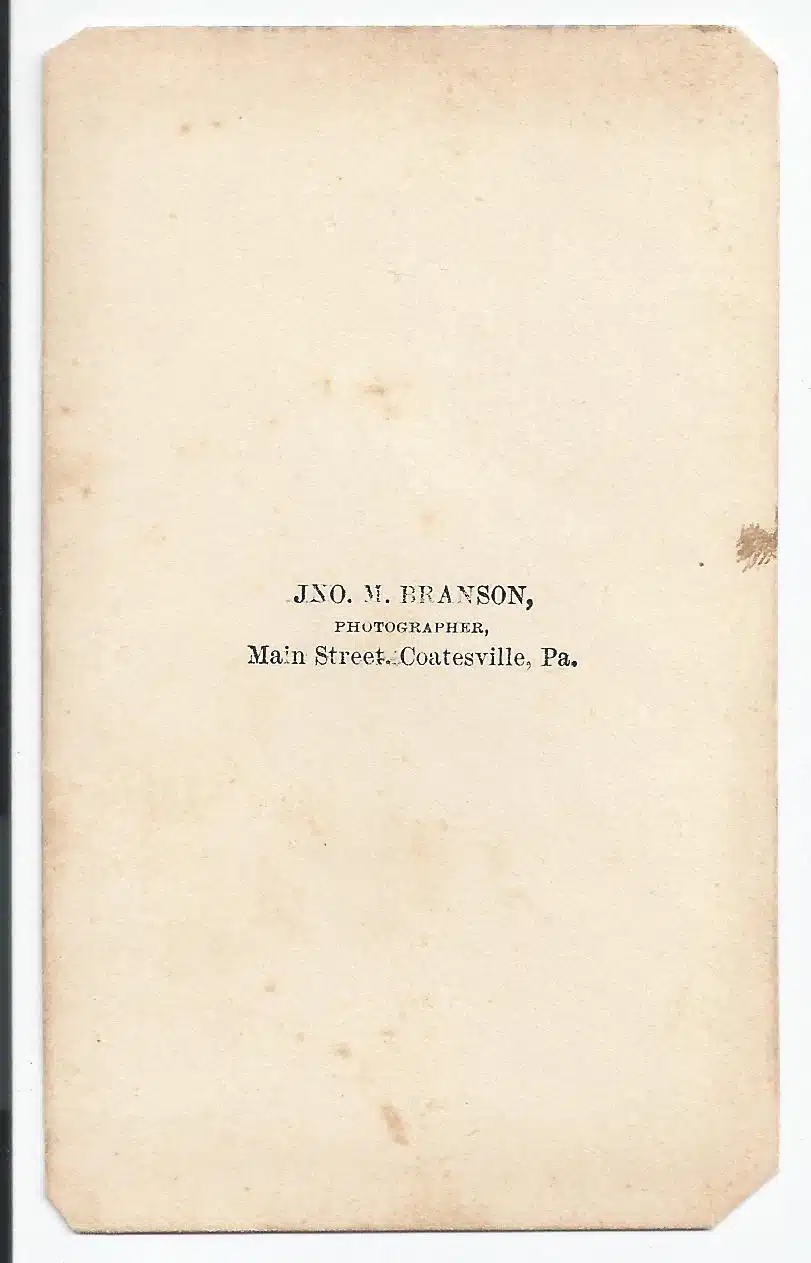
On April 1, 1858, Branson purchased a lot next to the Stephenson Hotel, a prime location on the Philadelphia and Lancaster Turnpike in Coatesville.[8] Finally in April of 1863 he engaged Robert I. Russell to build a two-story brick building to be used as a photograph gallery. It measured 31 feet by 16 feet with a skylight. The work was completed, but as of November of that year, Branson had only paid $100 of the $525 job, Russell placed a mechanic’s lien on the property.[9] Branson may have had the vision, but his cash flow didn’t always follow his plans.
Jno. M. Branson, Unidentified toddler boy, 1860s, tintype. Collection of the author.


His gallery location on Main Street, Coatesville is documented through a tintype in a carte-de-visite window mount in the collection of the Chester County History Center with this advertisement: “J.M. Branson, Photographs, Ambrotypes and Card Ferrotypes of all sizes, East of Stephenson House, Main Street, Coatesville, Pa.”[10] Another carte-de-visite gave his gallery the prestigious sounding name of the “Centre Square Gallery.” It is unfortunate that since there is no Coatesville newspaper available on microfilm before 1908 we have few details of his career.
When Branson registered for the Civil War draft in 1863, the Valley Township resident’s occupation is recorded as “ambrotypist.”[11] Branson is recorded as paying the IRS license for photographers in Valley township from 1862-1865.[12] His son, Henry J. Branson, later recounted in a biography: “His father was a photographer for many years in Coatesville. He conducted a studio there during the Civil War times and made many photographs of Union soldiers while they were encamped in that vicinity.”[13]
Jno. M. Branson, Unidentified woman, [1866-1868], albumen carte-de-visite. Collection of the author.
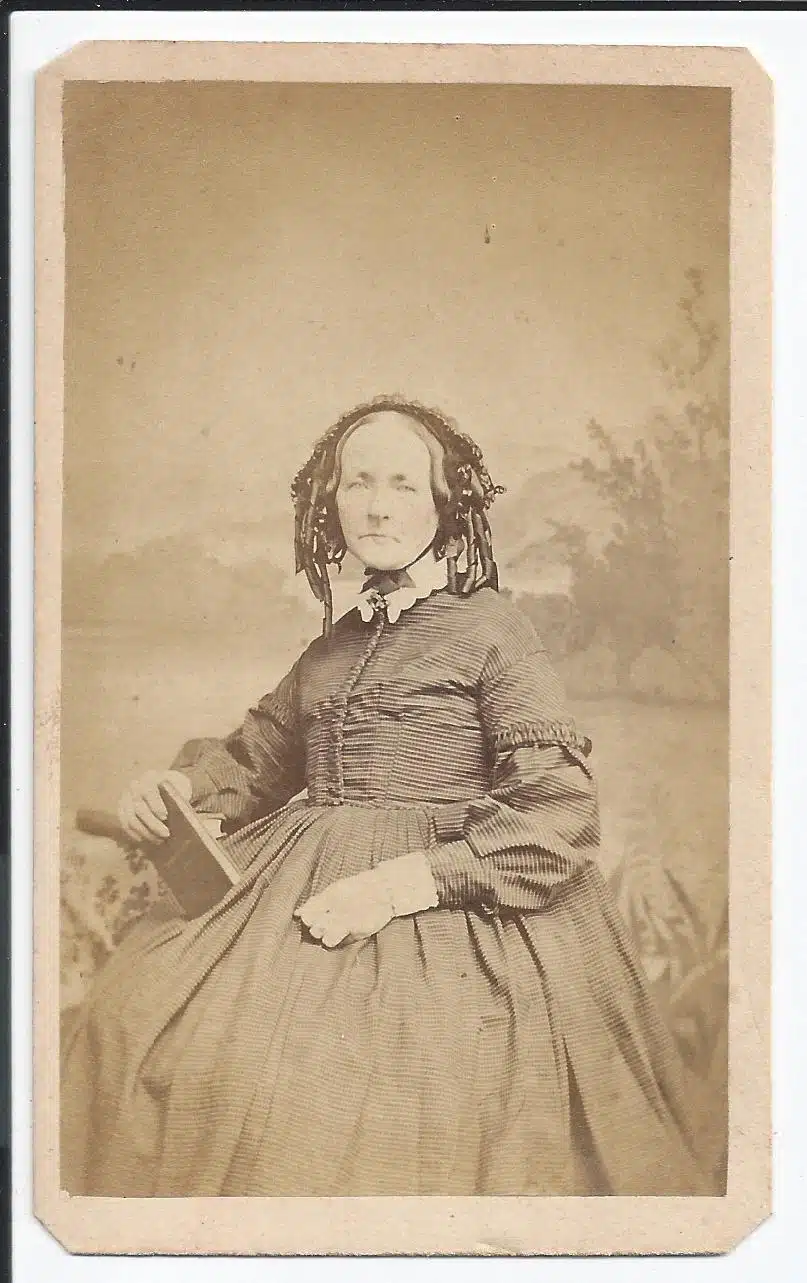

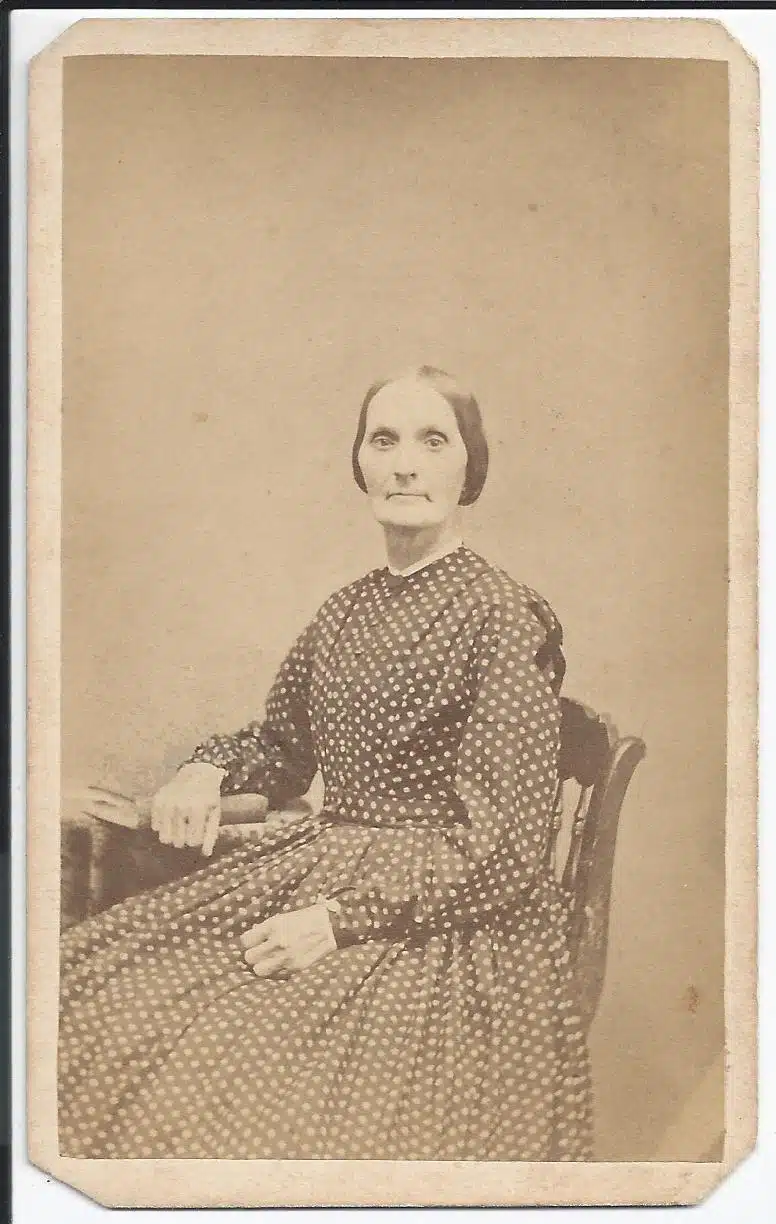
The collection of the Chester County History Center provides many examples of John Branson’s carte-de-visite portrait work during the 1860s. Most subjects are shown photographed before a plain background with simple furniture and a jacquard weave drape held back with a tasseled cord. In the mid-1860s a painted background is added that features indistinct trees and foliage. One full length portrait includes a 3-foot-high Greek column, probably left over from the Daguerreian era. A few of the portraits are hand colored. The vignetted bust portrait was always a popular style.
Jno. M. Branson, Unidentified lady wearing polka-dot dress, [1866-1868], albumen carte-de-visite. Collection of the author.

For a short time perhaps in the later 1860s, someone named Branson (first name unknown) partnered with William Hannum of Kennett Square. The duo produced cartes-de-visite with the imprint: “Hannum & Branson, Photographers, Kennett Square, Chester Co., PA.” It seems possible but questionable that John Branson was his partner while living and operating his own studio in Coatesville. Kennett Square is 14 miles from Coatesville, connected by what is now known as Route 82.
Branson was optimistic about the potential growth in Coatesville’s steel industry brought by Steel & Worth’s Viaduct Mill as well as Brandywine Rolling Mill (later Lukens Steel). Enthusiasm was conveyed in this promotional piece sent to West Chester’s Village Record newspaper, “Coatesville, Feb. 16, 1858. Improvements are still going on in our village, and time only will develop the future greatness of the place. Several building lots have been sold recently, and the erection of a number of buildings, both as places of business and private residences, is in contemplation…”[14] More shops and housing were in demand in the growing town. Branson saw a good investment in the rising real estate values. He purchased two undeveloped adjoining lots on the north side of the Philadelphia & Lancaster Turnpike, in 1858[15] and in 1860.[16] He had the lots resurveyed and subdivided them selling both in 1860 making a quick profit of $432.[17]
Coatesville was growing rapidly, enough to become incorporated as a Borough in 1867. The Oxford Press of June 10, 1868, reported: “Coatesville is rapidly improving, and in a short time will be a large town. The new Wilmington & Reading Railroad has given a great impetus to building and business in the place, and some thirty-six new dwellings, stores, &c., will be erected the present summer.”
In 1868 Branson purchased a lot with a brick double house on Second Avenue for $7600.[18] He had become a landlord with a new income stream collecting the rents. Beginning in the spring of that year, Branson now was not the only photographer in town, John B. Gibson had opened a studio at 148 Main Street, just one block away. Gibson was skilled, having learned the art from Alexander McCormick of Oxford and would be a tough competitor.
In 1869 Branson built his own home on a lot on the north side of Main Street adjacent to his gallery building. It was a two-story brick house 39 feet by 21 feet with a porch on the east side measuring 27 x 6 feet to escape the summer heat. The house was set back from the road with a front yard and wrought iron fence surrounding it. But again, Branson failed to pay the builders Bickel and Brother on time, who placed a mechanic’s lien on the property.[19]
The 1870 Census records Branson as a 45-year-old photographer living with his family in Coatesville.[20] The couple now have four children, Harry age 15, Laura E. 11, Mary E. 8 and William Morgan Branson 3. In September that year, Branson had his gallery painted.[21] Branson is listed in county directories as a photographer with a studio at 225 Main Street, Coatesville for the years 1870-71 and 1873-74.[22]
In 1871, Branson sold the double house property he had invested in for $9,000, making a profit of $1400.[23] But the good times of growth in the real estate market in Coatesville were coming to a rocky time.
The financial panic of 1873 had its effects on a global scale. Beginning with a change in Germany from the use of silver as a monetary metal, their move to the gold standard increased the value of the deutschmark but set off deflation of silver backed currencies around the world. Many other factors played into the cascade of events that put the U.S. and Europe in what was called the Great Depression until the crash of 1929 changed history’s perspective. During this crisis private investment banks felt the brunt of the monetary change. For example, Jay Cooke & Co. was heavily invested in the Northern Pacific Railroad which was planning the construction of a northern transcontinental route. When Cooke was unable to sell investment bonds for the project, nor could they secure a government backed loan, the firm went bankrupt, sending shock waves through the banking industry, causing other banks to close. Even the New York Stock Exchange was closed to trading for two weeks. The impact on railroad industry was devastating with many lines going bankrupt, putting employees out of work. In the U.S. there was double digit unemployment, and those who were still employed saw a drop in wages. Many related businesses failed during the depression which lasted from 1873-1877.[24]
Even in Coatesville, the steel industry was impacted. The Daily Local News of West Chester reported, “The iron business remains dull, Huston and Penrose have been reducing their force. Eighteen men, we understand, will have to hunt work elsewhere in order that the remainder will have steady work. The firm has done all that they could to keep their men in work, but necessity knows no laws, and thus it is in a business point of view.”[25]
Local churches took up the challenge of providing relief for the unemployed. The Daily Local News reported, “Owing to the fact that most of our iron works are standing idle, or running only part of the time, there are quite a number of persons out of employment. Many of the workers when the times were good,..made as high as twenty, twenty-five or even thirty dollars a week, are now dependent on others to keep themselves from starvation…Each of our churches have a committee of relief, who aid not only the poor of their own particular sect, but the poor of any sect and of no sect.”[26]
It was against the backdrop of these world events that John M. Branson became an Assigned Estate in 1874.[27] Between his overly optimistic real estate purchases and a drop in demand by the public for a luxury item such as photographs, he was unable to pay his day-to-day bills. He was over $3000 in debt and his creditors had come forward to force a resolution. This included all types of merchants from coal, hardware, grocery, shoes and dry goods as well as the photographic supply house of Haworth & McCollin of Philadelphia. He had borrowed from his two brothers, David ($105) and Owen ($205) as well as $1299 from his father James. Francis F. Davis of the National Bank of Chester Valley was assigned to Branson by the court to settle all of his debts. Branson was required to deed all of his real estate and personal property to be sold in order to bring about a resolution. This included everything Branson and his wife owned, except any property solely in her name, and their “wearing apparel”.[28]
Branson’s house was sold by Sheriff sale held on January 22, 1874, at the courthouse in West Chester, PA.[29] Even some of his photographic equipment was sold. The last time his occupation is listed as photographer is on the Coatesville tax list of 1874. Clearly, the pressure of not enough business for two photographers during this difficult economy contributed to his studio’s closure.
The family desperately needed support. So 19-year-old son Henry James “Harry” Branson (1855-1943) stepped up to the challenge and secured a job as a clerk at the National Bank of the Chester Valley on May 1, 1874. In the coming years he worked his way up to President, spending his entire career at the bank.[30]
On April 1, 1875, the deeds to Branson’s properties were recorded with the County of Chester, his gallery building was sold to E.T. Harley for $1960.25 and the house to Sarah Pennock for $4830.[31] This was significantly below the $10,000 appraised value. Branson’s creditors received only 22 cents on each dollar that they were owed.
The pain of bankruptcy was not only felt by John Branson, but by two of his brothers as well. David H. Branson lost two farm properties in West Brandywine Township in 1876[32] and Owen Branson lost his home and dry goods and notions store in Coatesville in 1880.[33]
On September 24, 1876, John Bransom died of “rheumatism of the heart” in Coatesville.[34] This condition of a weakening in the heart muscles often strikes people who have had rheumatic fever. But surely his failure to manage his real estate investments and business had broken his heart. He was just 54 years old, leaving a wife and four children. He was buried in the Presbyterian Burying Ground on Harmony Street in Coatesville.[35]
Despite their difficult times during the 1870s the family prevailed and prospered in years to come. Daughter Laura Branson (1859-1922) became a school teacher,[36] son William (1867-1949) was a successful salesman of men’s clothing.[37] Widow Annie (1833-1897) lived on Third Street in Coatesville with her daughter Mary (1862-1892).[38]
©Pamela C. Powell, 2021
Jno. M. Branson, Col. Charles Ewart, 1874 . Carte-de-visite. Collection of the author.
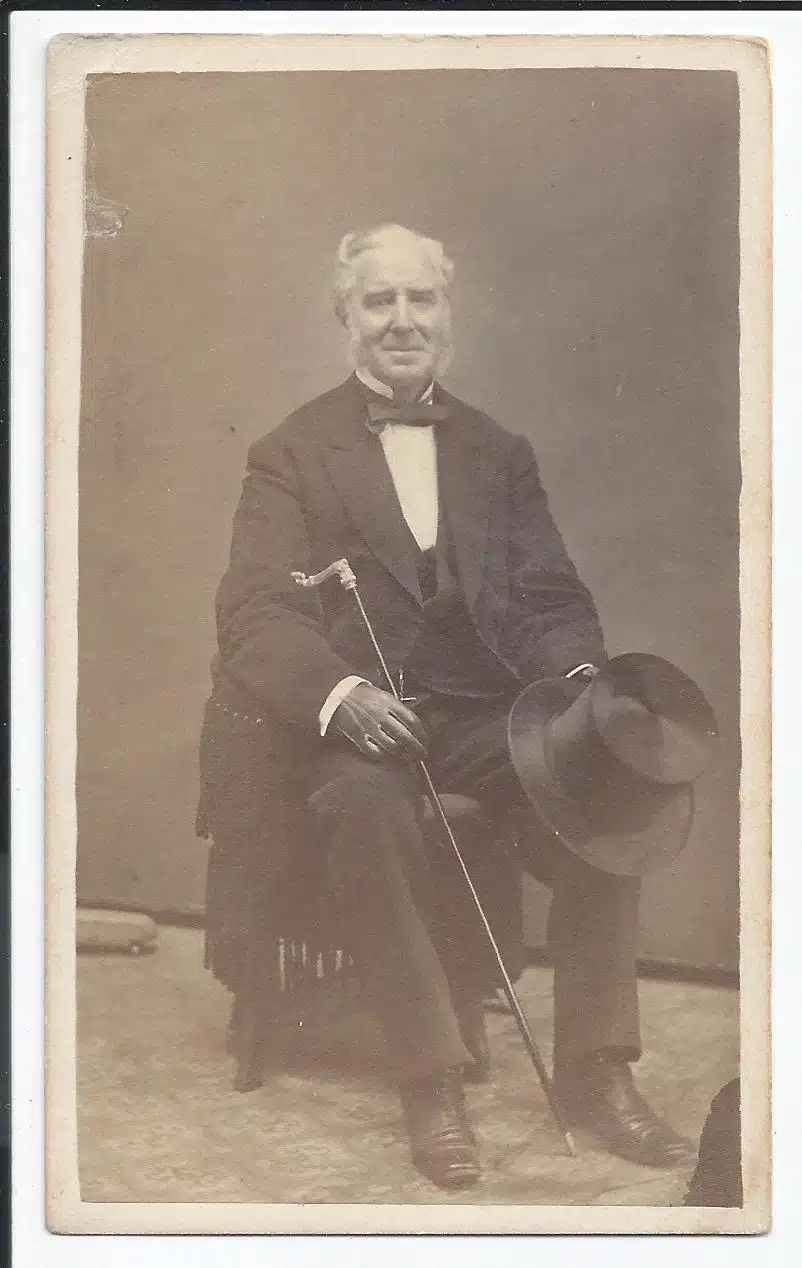

Although inscribed November 6, 1874, I believe that Branson took this photograph earlier that year, upon the occasion when Ewart was given the unusual cane with the horse’s leg handle. Ewart, an Englishman by birth, was the first librarian of the Coatesville Public Library. This institution was beset by financial problems and Ewart worked for an entire year without a salary as reported by the Daily Local News, West Chester, PA on August 27, 1874. The Daily Evening Express of Lancaster, PA January 10, 1876, reported: “Mr. Charles Ewart, of Coatesville, librarian of the library of that place, carries a unique cane presented to him by the Library Association. The handle of the cane is gold, shaped like a horse’s leg. The hoof is shod after the manner of blooded horses, four nails being on one side of the show, and three on the other. The nails are diamonds, making the cane very valuable.”
-
Cemeteries notebook, Charles Holton Collection, Coatesville ephemera collection MG2.3, Chester County History Center, West Chester, PA. ↑
-
Village Record, (West Chester, PA), 25 February 1851. ↑
-
Year: 1850; Census Place: West Brandywine, Chester, Pennsylvania; Roll: 766; Page 293b. ↑
-
Village Record, (West Chester, PA), 2 January 1855. ↑
-
Pennsylvania Septennial Census, Valley Township, Chester County, 1856. Chester County Archives & Records Services, West Chester, PA. ↑
-
Valley Township, Chester County, PA Tax List, 1857. Chester County Archives & Records Services, West Chester, PA. ↑
-
Year: 1860; Census place: Valley, Chester, Pennsylvania; Page 547. ↑
-
Chester County, Pennsylvania Deed Book H-6, Vol. 130, page 498, Chester County Archives & Records Services, West Chester, PA. ↑
-
Robert I. Russell vs. John M. Branson, November 28, 1863. Mechanic’s Lien #380, Chester County Archives & Records Services, West Chester, PA. ↑
-
J. M. Branson, “sister” Pennock Family Album, Photo Album #248, Photo Archives collection, Chester County History Center, West Chester, PA. ↑
-
National Archives and Records Administration (NARA); Washington, D.C.; Consolidated Lists of Civil War Draft Registration Records (Provost marshal General’s Bureau; Consolidated Enrollment Lists, 1863-1865); Record Group: 110, Records of the Provost Mashal General’s Bureau (Civil War); Collection name: Consolidated Enrollment Lists, 1863-1865 (Civil War Draft Records); NAI: 4213514; Archive Volume Number 1 of 3. ↑
-
Ross Kelbaugh, Directory of Civil War Photographers, (Baltimore, Maryland: Historic Graphics, 1990). ↑
-
George F. Donehoo, Pennsylvania – A History, (New York: Lewis, 1926), p. 330. ↑
-
Village Record, (West Chester, PA), 23 February 1858. ↑
-
Chester County, Pennsylvania Deed Book, I-6 Volume 131, p. 347-8. Chester County Archives & Records Services, West Chester, PA. ↑
-
Chester County, Pennsylvania Deed Book, P-6 Volume 137, p. 201, Chester County Archives & Records Services, West Chester, PA. ↑
-
Chester County, Pennsylvania Deed Book, Q-6, Volume 138, p. 75 & Deed Book N-6, Volume 135, p. 589-590, Chester County Archives & Records Services, West Chester, PA. ↑
-
Chester County, Pennsylvania Deed Book L-7, Volume 158, p. 297, Chester County Archives & Records Services, West Chester, PA. ↑
-
Frank Bickel & Benjamin Bickel a.k.a. Bickel & Bro. vs. John M. Branson, January 11, 1869, Mechanic’s Lien #552, Chester County Archives & Records Services, West Chester, PA. ↑
-
Year: 1870; Census Place: Coatesville, Chester, Pennsylvania; Roll: M593_1324; Page 548B. ↑
-
Coatesville Business Houses Notes, Louis Holton Collection, Coatesville ephemera MG2.3, Chester County History Center, West Chester, PA. ↑
-
Samuel Alexander, Samuel, comp., Chester County, PA., Business Directory containing the Names, Business and Address for the Merchants, Manufacturers and Professional Men throughout the County… 1870-1871. (Albany, New York: Andrew Boyd, 1870). And Andrew and W. Harry Boyd comps. Boyd’s Business Directory of over One Hundred Cities and Towns in Pennsylvania…1873-4. (Syracuse, New York: Andrew Boyd/ Pottsville, Pa. : W. Harry Boyd, 1873). ↑
-
Chester County, Pennsylvania Deed Book V-7, Volume 168, p. 183, Chester County Archives & Records Services, West Chester, PA. ↑
-
Panic of 1873, Teachinghistory.org ↑
-
Daily Local News, (West Chester, PA), 18 March 1875. ↑
-
Daily Local News, (West Chester, PA), 3 February 1876. ↑
-
John M. Branson & Mary M. Branson, Assigned Estate #575, Chester County Archives and Records Services, West Chester, PA. ↑
-
John M. Branson & Wife to Francis F. Davis, Miscellaneous Deed Book #15, p. 316-317. Chester County Archives and Records Services, West Chester, PA. ↑
-
American Republican, (West Chester, PA), 6 January 1874. ↑
-
“Henry James Branson”, Who’s Who in Finance, 1920-22. ↑
-
Chester County, Pennsylvania Deed Book P-8, Volume 187, p. 545 and Deed Book R-8 Vol. 189, p.122, Chester County Archives and Records Services, West Chester, PA. ↑
-
David H. Branson & Mary Branson, 1876/78, Assigned Estate #693, Chester County Archives and Records Services, West Chester, PA. ↑
-
Owen Branson & Hannah Branson, 1880/81, Assigned Estate #910, Chester County Archives and Records Services, West Chester, PA. ↑
-
Daily Local News, (West Chester, PA) 26 September 1876. ↑
-
Cemeteries notebook, Charles Holton Collection, Coatesville ephemera collection MG2.3, Chester County History Center, West Chester, PA. ↑
-
Year: 1880; Census Place: Coatesville, Chester, Pennsylvania; Roll: 1115; Page 127A; Enumeration District: 076. ↑
-
Obituary, William M. Branson, Coatesville Record, (Coatesville, PA), 19 March 1949. ↑
-
Year: 1880; Census Place: Coatesville, Chester, Pennsylvania; Roll: 1115; Page 127A; Enumeration District: 076. ↑