Eber Woodward
( 1826 – 1888 )
The Photographer Merchant
Striving for success was hard-wired in Eber Woodward’s personality. It was how he approached each new endeavor in his career. Partners Woodward & Cheyney purchased Levi Crowl’s West Chester daguerreotype studio in 1854 and Woodward assumed sole operation of the studio in 1856. His studio was one of the most productive, dominating the photography market in the Borough of West Chester until 1867. Beginning as a daguerreotypist, he kept up with each emerging trend, making ambrotypes, ivorytypes, salted paper prints, life-sized photographs colored in oils and cartes-de-visite. In 1867 he sold the studio to C. Alfred Garrett and went through a career change. He became a dry goods merchant and real estate developer.
Eber Woodward was born in West Bradford Township in 1826, the eldest of six children of Mary Price and James Woodward.[1] Eber was encouraged to follow in his father’s trade and became a carpenter. He is listed in the 1850 US Federal census as a carpenter boarding with West Chester lumber merchant Clinton Frame.[2] Woodward is recorded as a journeyman carpenter in the West Chester tax lists in 1854.[3] As we shall see, Woodward’s circle of friends in the carpentry trade stay with him throughout his business life.
E. Woodward, Self-portrait of the photographer, [1859-1865], opalotype, West Chester, PA. Courtesy of Chester County History Center, West Chester, PA.
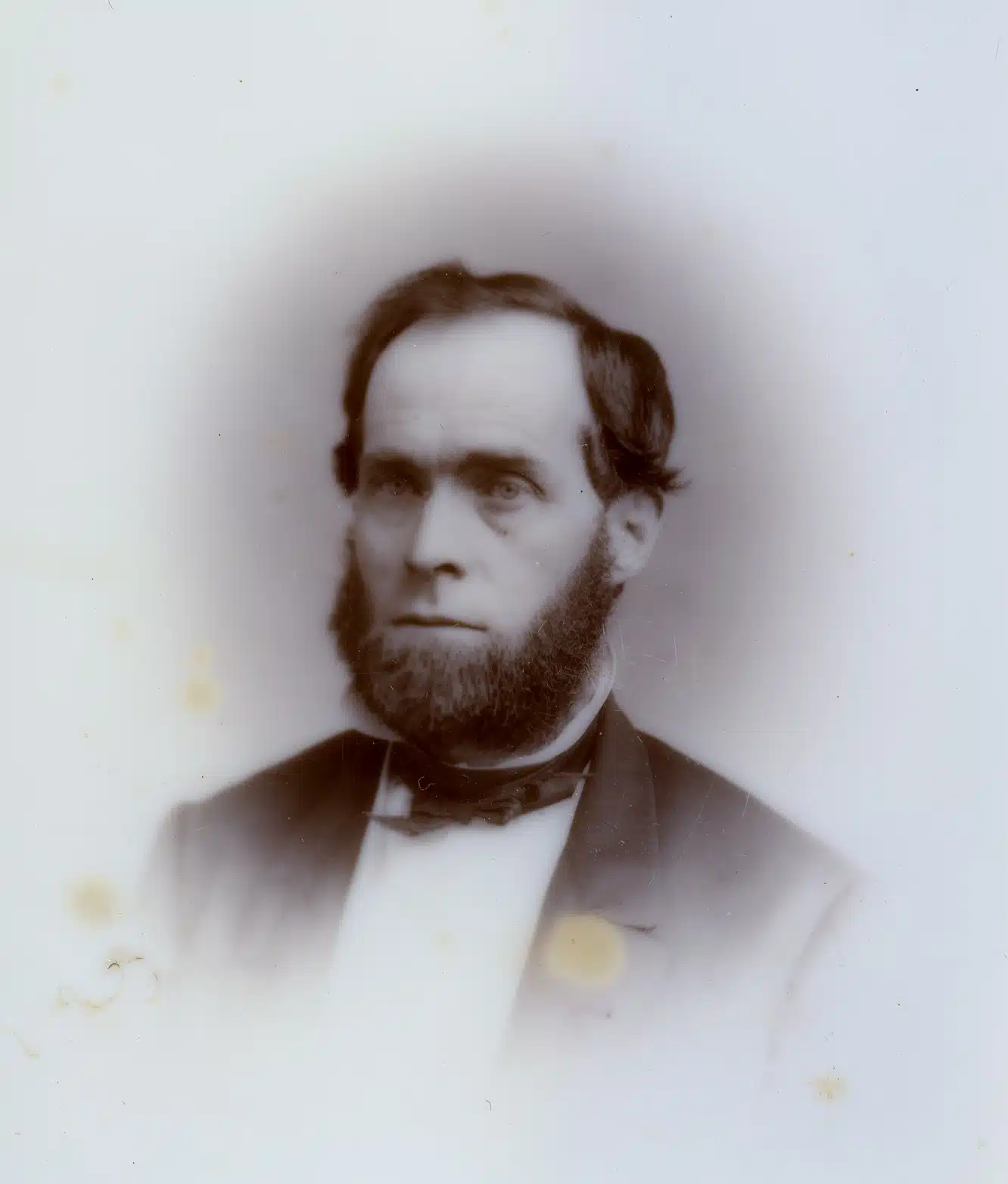
Woodward was a man who always had his eyes open for good business opportunities of any kind. When Levi Crowl’s daguerreotype studio came up for sale in 1854, he purchased it in partnership with fellow carpenter[4] William Cheyney (1832-1909).[5] The studio had a prime location on High Street in West Chester right across from the Chester County Court House in the Hemphill Building.[6]
Woodward’s success put him in the position to marry Hannah M. Long in 1855,[7] the daughter of West Chester cabinetmaker, Joseph Long. In the years ahead, the couple had six children including twins.
Woodward became sole proprietor of the gallery when his partnership with Cheyney was dissolved by mutual consent on February 15, 1856.[8] It was announced in the American Republican newspaper that Woodward would continue making daguerreotypes at the Hemphill building.
E. Woodward, Unidentified young boy wearing plaid, [1856-1860], hand-colored daguerreotype, West Chester, PA. Collection of the author.
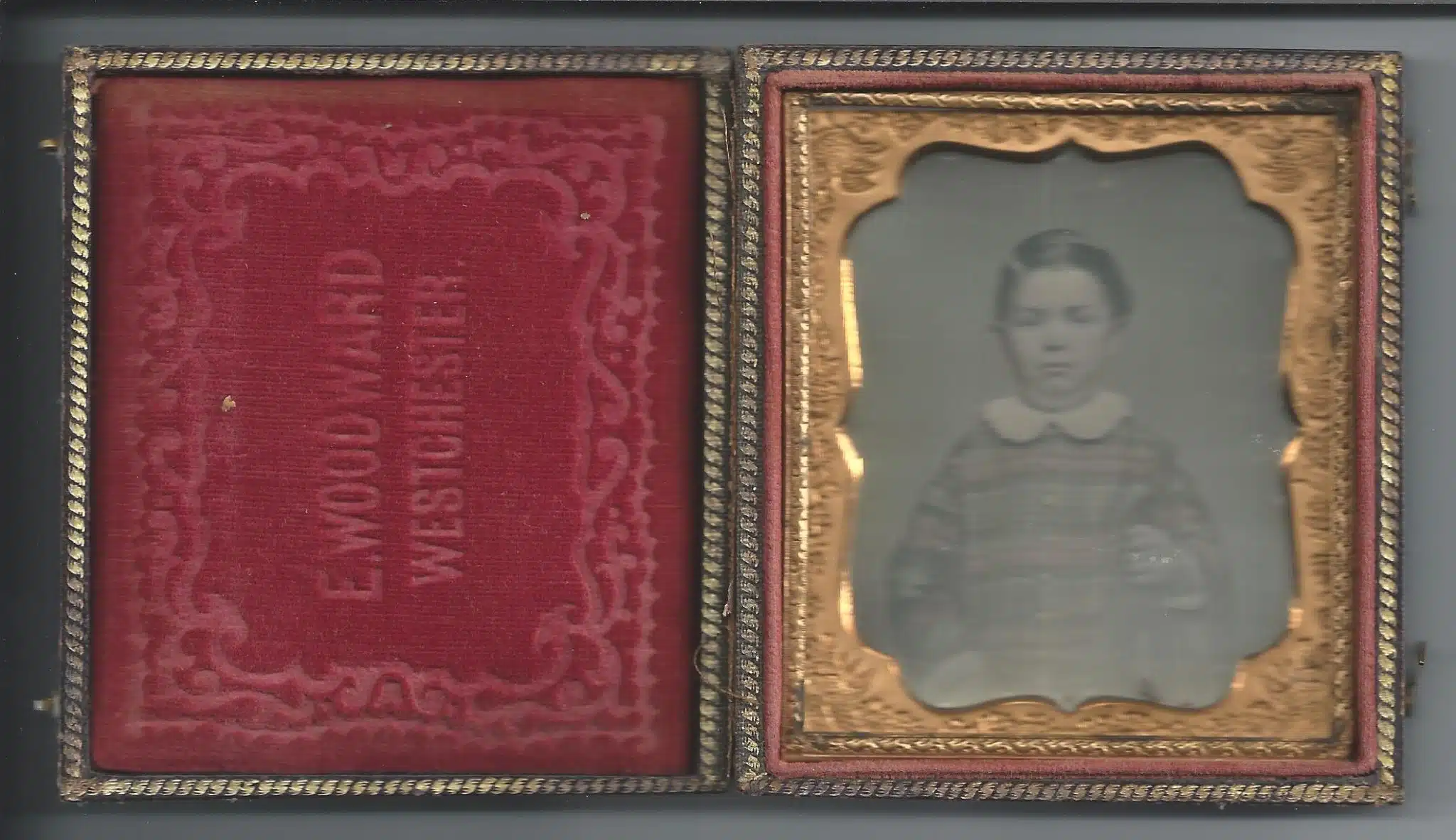
Woodward saw another good investment on August 19, 1856, when he and partner William W. Taylor purchased the livery stable of Thomas Quay.[9] They rented facilities for the business at the Washington Hotel. Perhaps the pressure of running two businesses was too much, because the partnership was dissolved on March 25, 1857 when Woodward sold his share to Jesse Cloud.[10]
Eber Woodward’s success was in keeping up with the trends of the time. The March 15, 1856 issue of the Village Record announced that he is now making ambrotypes. The March 25th issue notes that Woodward has been producing fine daguerreotypes and has “recently acquired the art of producing ambrotypes.”[11] Woodward had to keep pace with his main competitor in West Chester, photographer Nathan Parker (see the author’s article “Nathan Parker’s War of Words with Isaac Rehn” The Daguerreian Society Annual, 2019/2020.). Parker claimed that he was the only photographer in West Chester making ambrotypes and Woodward refused to be left behind.
In May 5, 1857, Woodward opened his new ambrotype rooms over James Hughes Dry Goods Store on Gay Street near the White Hall Hotel.[12] He took out a large half-page advertisement in the Directory of the Borough of West Chester for 1857 that trumpeted his services using a variety of outlandish typefaces:
Woodward had a tried and true formula for creating his ambrotype portraits. Most are bust portraits, from the waist up only. The subject is usually seated with his or her arm resting on a side table. The height of the person is accommodated by placing a number of books under their elbow to keep their shoulders erect. Woodward’s lighting was always even and his exposures are spot on. Woodward presented the ambrotypes to the customer in a case with the following mark stamped into the velvet: “E. Woodward/West Chester, PA.”
Woodward wanted to outdo his competitors by purchasing the patent rights of James Cutting of Boston and Isaac Rehn of Philadelphia’s ambrotypes hermetically sealed with Canadian balsam. In the May 9, 1857 Village Record Woodward made his announcement with the following: “AMBROTYPES – Beware of the tricks of those who make single glass pictures and call them ambrotypes. Those only are ambrotypes which are hermetically sealed, the patent for which is secured by WOODWARD.”
The ambrotype feud was heating up, evidenced by Woodward’s and Parker’s advertisements in the local papers. Woodward warned the public on May 12, 1857 with an advertisement in The American Republican: “ Beware of Counterfeit Ambrotypes made on single glass and varnished as to deceive; none genuine nor lasting but those Heretically Sealed by Woodward, for which he has the patent for this County…”
Then Woodward’s one-up-man-ship was in full gear in the June 2, 1857 Village Record when he let the public know that he was the only photographer in the borough using the licensed patent, “Woodward’s Patent Hermetically Cemented Ambrotypes and Daguerreotypes. Mr. W. would respectfully inform his customers that he has negotiated with Mr. Rehn for the Right to use his Patent for the Double Glass Hermetically Cemented Ambrotypes, which for beauty and durability is so great an improvement over the single glass varnished picture (sold by others, and erroneously called Ambrotypes,) that they need only be seen to be appreciated. Those only are Ambrotypes that are hermetically cemented by WOODWARD …”
Ironically, Woodward then sold his patent right to one of his students, who brazenly opened a studio on the same street as Woodwards! Levis H. Davis (1823-1902)[14] opened a studio at 30 East Gay Street as announced in the Village Record on June 16, 1857. He stated: “I respectfully announce that, after learning the art and purchasing the right of E. Woodward for J. A. Cutting and I. Rehn’s patent process of the Double Glass Hermetically Sealed Ambrotypes, I am now prepared to execute pictures of the latest styles and finished in the highest perfection of the art. For durability, richness of tone, beauty, clearness and life-like expression they are without rival. Outdoor views, portraits of the sick or deceased, and groups of various sizes – all taken at the shortest notice…”
What was this sudden change, when Woodward seemed proud to promote the licensing of Cutting & Rehn’s patented method to then sell it and cease using it? It is interesting to note that competitor Nathan Parker claimed that he had tried Cutting & Rehn’s method and found it to be inferior and stopped using it. Evidence shows in the collection of the Chester County History Center that Woodward changed his method over time also. In over 33 examples examined in the Chester County History Center collection, 18 are backed with a thick backing of bitumen. But there are also examples that are backed with a variety of methods, nine with black varnish or painted glass, three with violet glass.
It is my theory, based on examining the examples in the CCHC collection, that between March 15, 1856 when he first announced he was making ambrotypes it is most likely he backed them with painted glass or black varnish. On May 9, 1857 when he announced he had secured Cutting & Rehn’s patent he began sealing the ambrotypes with bitumen. After June 16, 1857, when he sold his license to Levis Davis, he went back to the varnish method and later he probably found it more convenient and cost effective to create his ambrotypes on violet glass.
The next trend that Woodward embraced was the carte-de-visite portrait. In 1858 he took a series of 43 collodion negatives of members of the Fame Fire Company. At 3 1/8 x 4 1/8 inches, they are suited to print as cartes-de visite. The negatives are in the collection of the Chester County History Center.[15]
The January 8th, 1859 edition of the Jeffersonian announced Eber Woodward’s new partnership with Wilmer Worthington.[16] Worthington (1828-1862) was a young gentleman Woodward lived next door to when he was in the carpentry business. They advertised their gallery at 13 West Gay Street opposite S.G. Snare’s clothing store.
The June 4th 1859 edition of the Jeffersonian offered a humorous story about the high quality of the partners photography. “a gentleman well known in sporting circles, had his photograph taken, and, being considered a good picture, it was put into the show case. A few days afterwards, his favorite setter-dog was seen looking wistfully at the picture, and wagging his tail joyously.” No better endorsement can be given.
Woodward got even more praise from the Philadelphia Press which he included in an advertisement in the Chester County Agricultural Society exhibition program for 1859. The quote read: “The photographs of Mr. Eber Woodward, of West Chester, are among the most successful we have ever seen. An unpretending artist, as he is, it gives us great pleasure to refer to him with commendation. If he had gallery in Philadelphia or New York he would soon be famous.”[18]
Woodward and Worthington entered a display of life-sized photographs in the exhibition, along with Shive’s patent photographic apparatus for making the enlargements. Also on display was a copy of Raphael’s Madonna, which was colored in oils by Robert Lowery.[19] Lowery was a West Chester carpenter who studied art in Philadelphia.[20] The American Republican newspaper of July 19, 1859 mentioned a noteworthy portrait of Judge Haines that Lowery had painted.
The Jeffersonian for July 16, 1859 reported “there is probably not another photographer in Pennsylvania that can produce a life-sized picture equal to Mr. Woodward of this Borough. At considerable cost he has erected instruments of a superior order, for which he holds the exclusive right for this county. Mr. W. has spent much pains and money in bringing the art to the highest perfection, and he has succeeded beyond calculation.” Furthermore, the Jeffersonian of August 6, 1859 reported that Robert Lowery was doing the oil coloring on Woodward’s life-sized photographs. In Woodward’s advertisement in that same issue he claims “..is now making the largest and best photographs ever produced in the county of Chester or even the United States..” Woodward’s advertisement was aimed at his main competition in West Chester, photographer Nathan Parker.
Woodward’s partnership with Worthington did not last long, He again advertised as sole proprietor of the gallery in the Village Record on September 20, 1859:
In 1860 Woodward exhibited samples of his photographs at the Chester County Horticultural Society annual exhibition. The Village Record of June 19, 1860 noted that “the photographs from the galleries of Messers. Parker and Woodward attracted much attention.”
The West Chester tax lists reveals three brothers: Jacob, Jesse and Alfred Taylor who are recorded as daguerreotypists, ambrotypists or “photographists” between 1860 and 1861, but are absent from the list in 1862. Woodward entered into partnership with ambrotypist Jesse Taylor in about 1860, but this partnership was dissolved October 7, 1861.[22] It is not known if the other two brothers worked for Woodward. It is possible that Woodward’s partnership with Taylor was one way to eliminate the competition of another studio in the borough.
Woodward was also starting to invest in real estate during this time. He made his first purchase in March of 1859 when he bought a house with a large lot on the north side of Chestnut Street between Darlington and New Streets.[23] He subdivided the property, selling the house as well as two building lots beginning in 1861.[24] In April of that year he purchased a lot on the northwest corner of Gay and Church Streets[25]. He tore down the old stone house and built a new three-story brick store and home. He was assessed a value of $3,000 for the building in the 1862 West Chester Tax List.
When Woodard opened his new studio on the northwest corner of Gay and Church Streets late in 1861, his studio offered a painted landscape background showing a path heading off into the distance and some trees. He offered the conventional props typical of portrait paintings of the period, a drape and a pedestal.
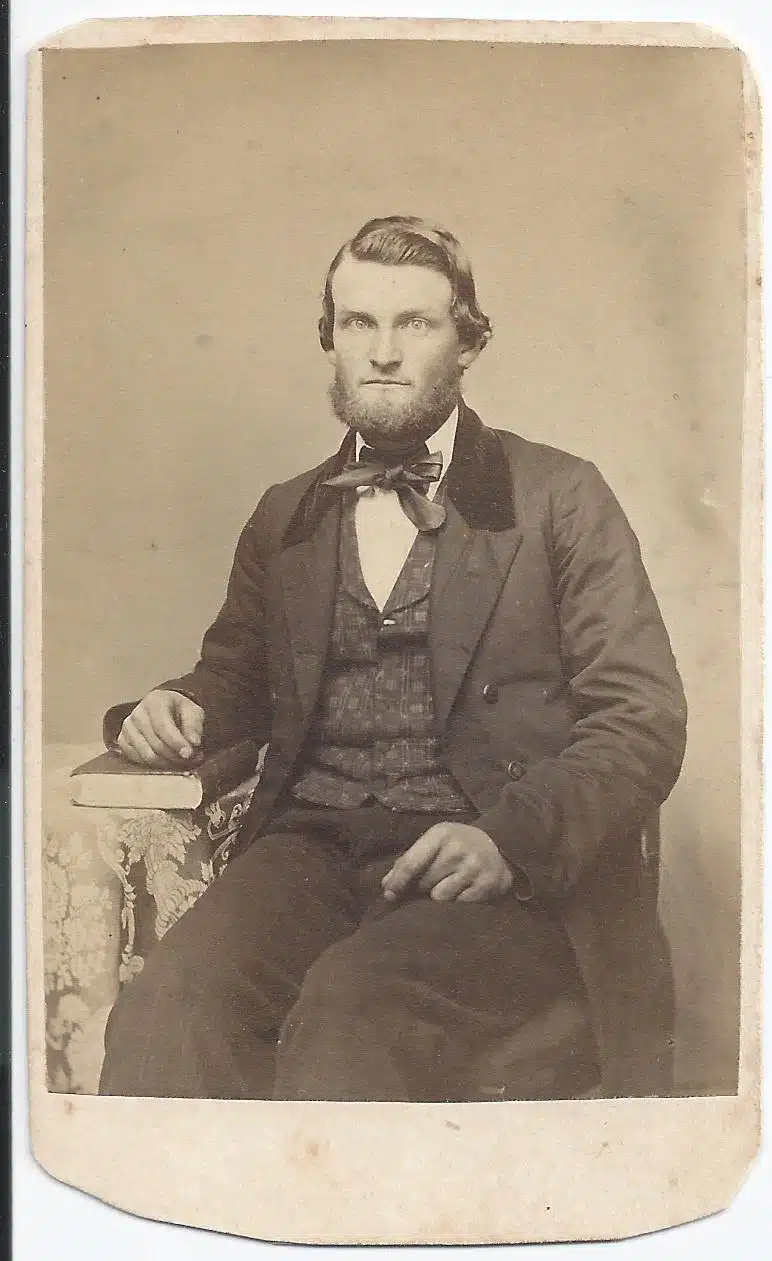
E. Woodward, Unidentified gentleman, ca. 1861-1862, albumen carte-de-visite, West Chester, PA. Collection of the author. Note the painted background, drape and pedestal, negative number 3336.

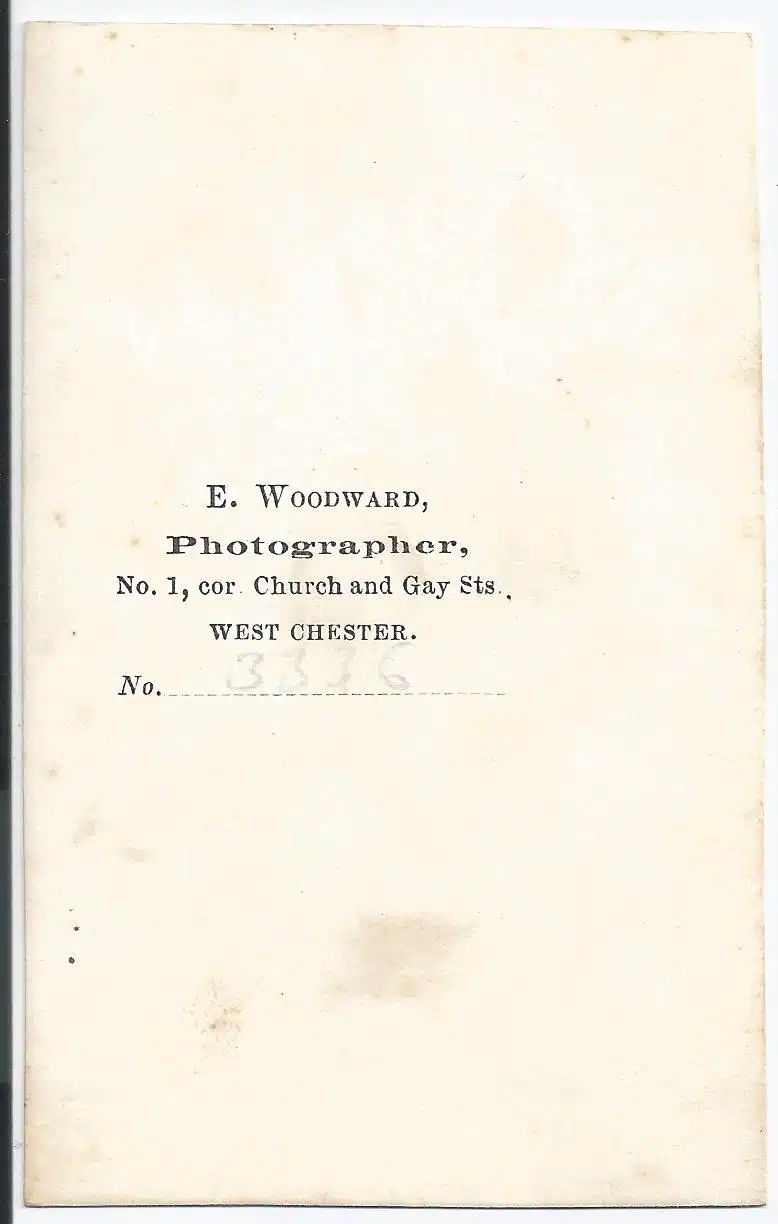
Woodward’s carte-de-visite portraits had a winning formula. The background was uncomplicated, and the poses were exactly what the Victorian public expected. Many were seated half-length or full length standing portraits. He also offered the vignette bust portrait popular in the mid-1860s. His carte-de-visite subjects were seated in one of four chairs, a standard fringed studio chair, a low backed plain chair, a high-backed chair with tall ornate spindles or a high-backed chair with less ornate spindles. A main stay prop was a table with a handsome brocade cloth.
E. Woodward, Unidentified seated man,[1863-1864] albumen carte-de-visite, West Chester, PA. Collection of the author. Note the book under his arm, negative #5863.
E. Woodward, Unidentified young boy, [1862-1863], albumen carte-de-visite, West Chester, PA. Collection of the author. Note the spindle backed chair and posing stand behind the subject.

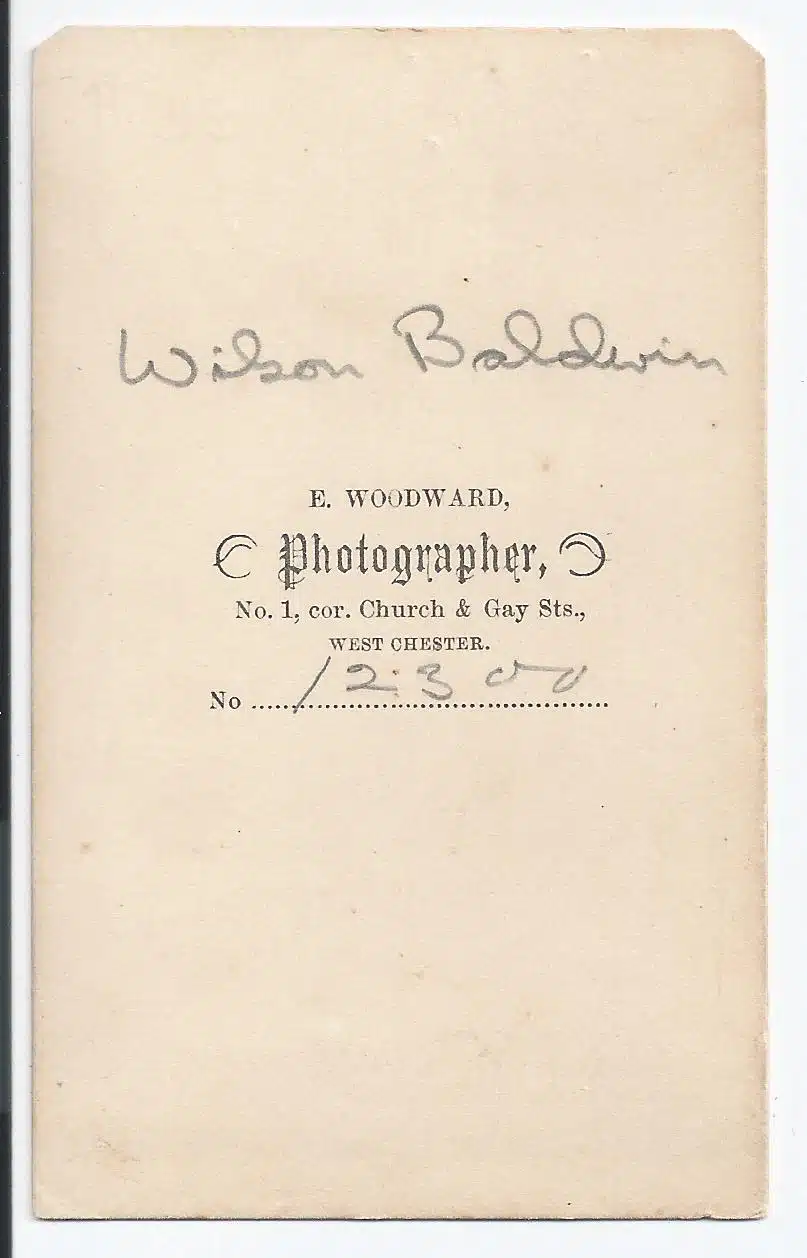
E. Woodward, Wilson Baldwin (1865-1887), 1866, albumen carte-de-visite, West Chester, PA. Collection of the author. Negative number 12,300.
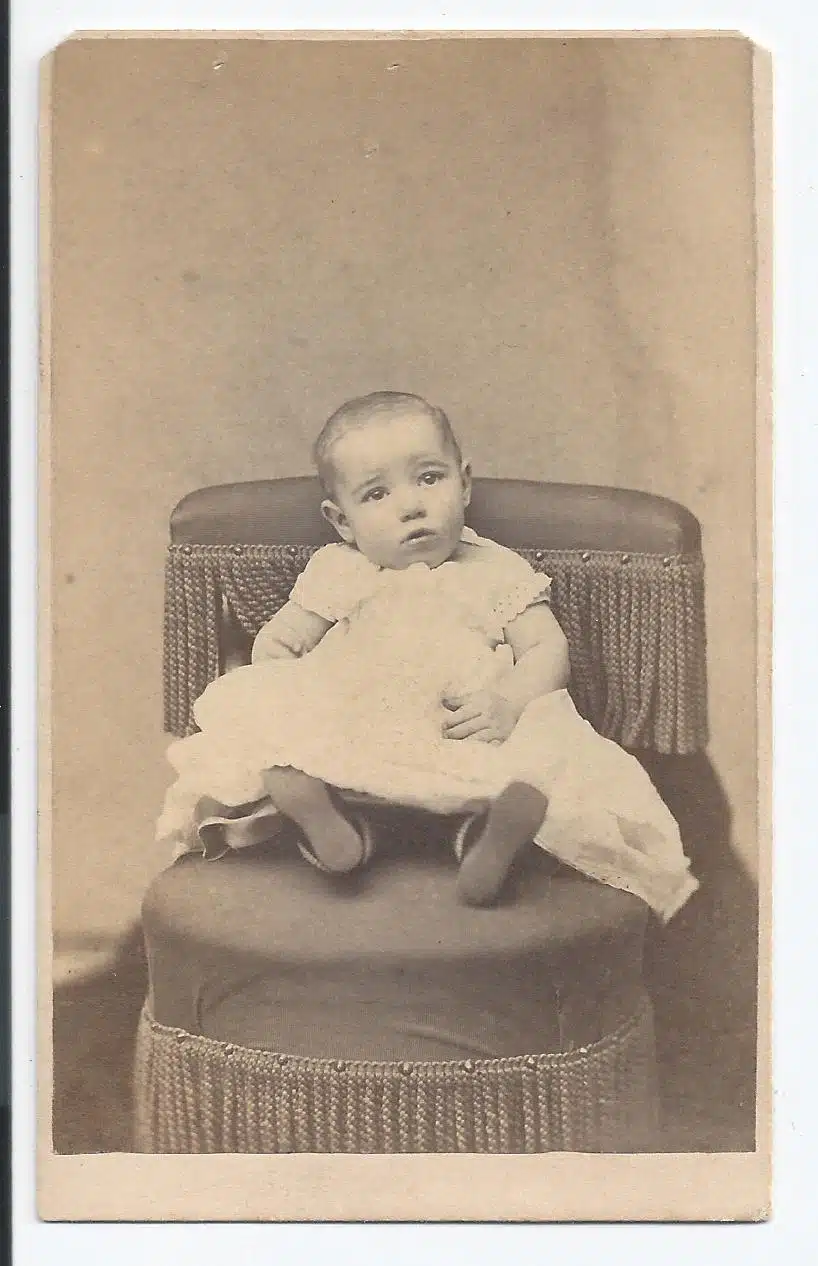
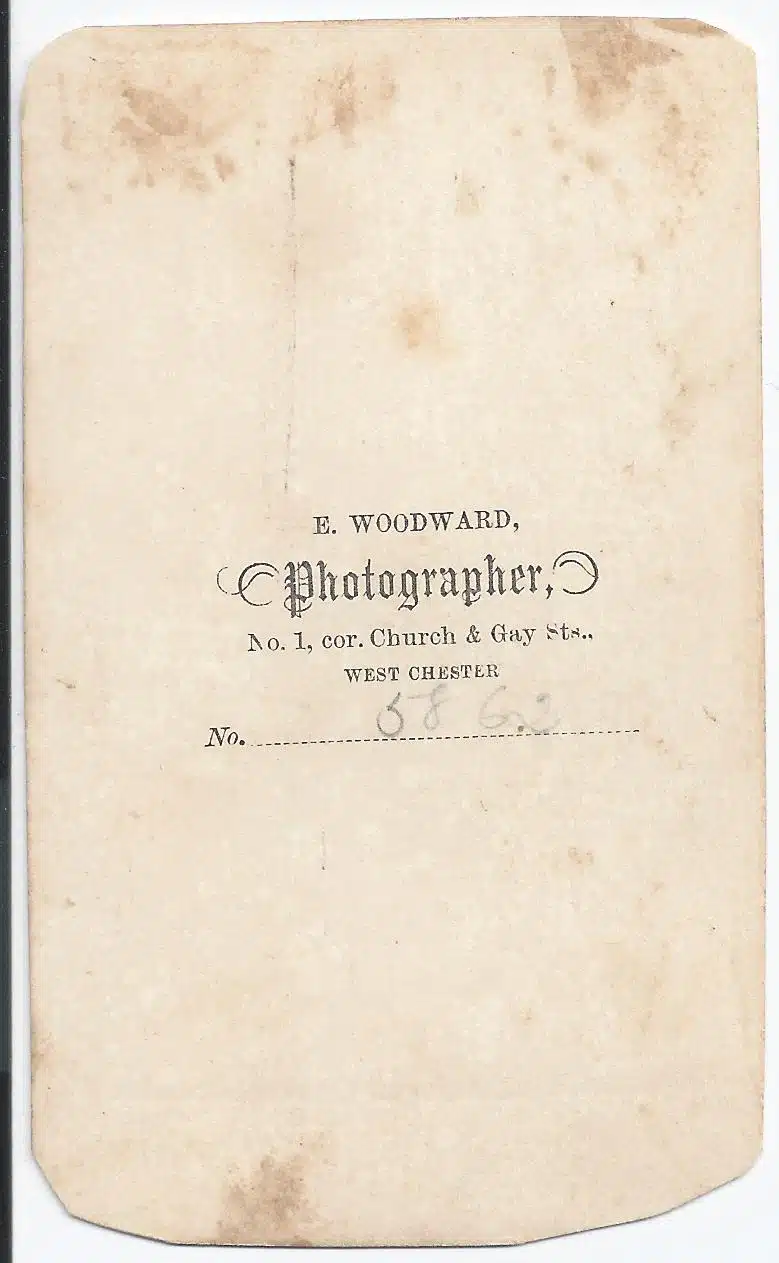
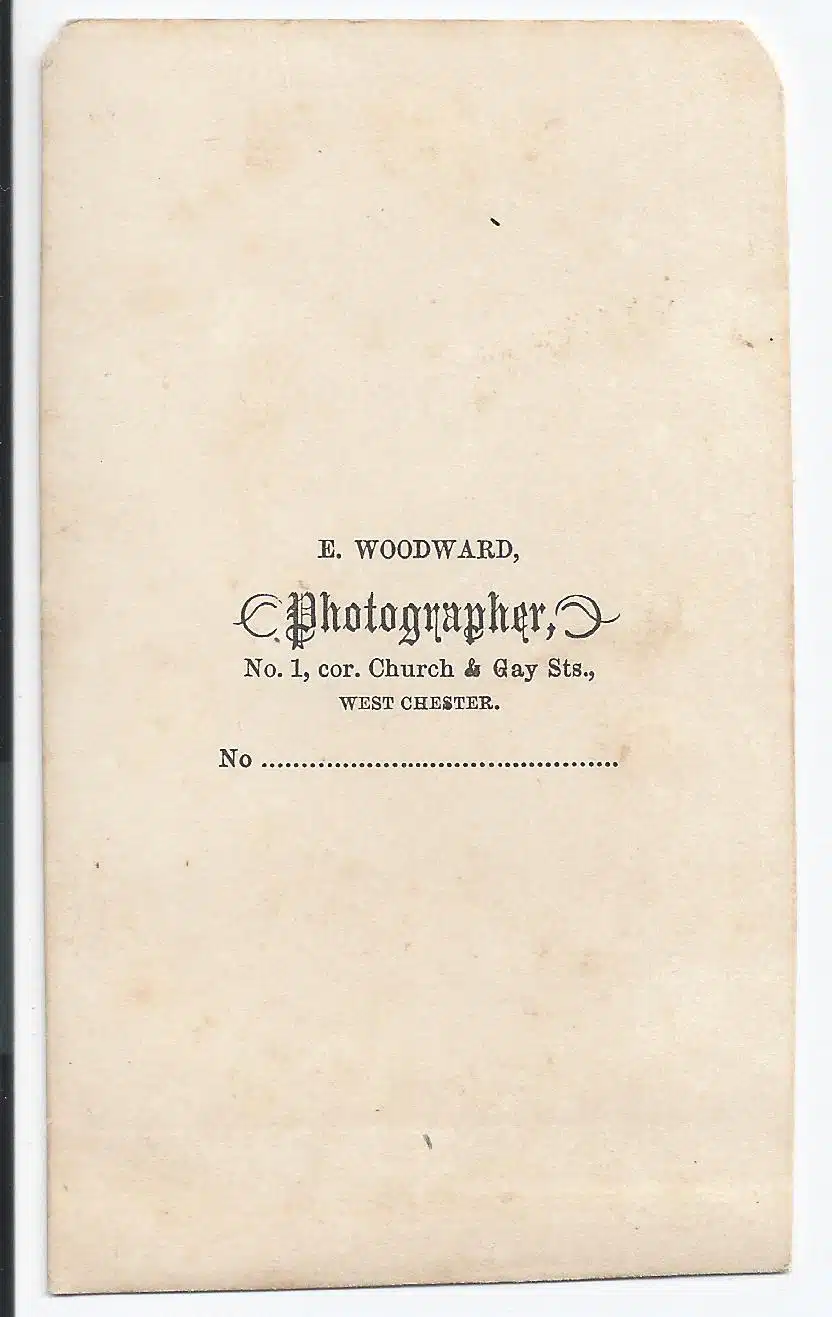
Many of Woodward’s subjects were Quakers who wanted portraits that simply showed what they looked like without any ostentatious props. Quakers lived their lives simply, excluding vanity which can be evidenced through their adherence to plain dress and speech. They favored a truthful representation of themselves through photography and shunned painted portraiture as vanity. His Quaker clients usually posed in a simple dining chair with the low back not visible in the final picture. Often ladies placed their bonnets on a table beside them. Many examples are in the collection of the Chester County History Center.
The market for cartes-de-visite exploded with the dawning of the Civil War. When the 97th regiment was recruited and trained at Camp Wayne in West Chester, every soldier, his family, and sweetheart needed photographs to exchange. Woodward worked hard to supply them. To do this he hired his brother-in-law, Edwin Long as his assistant.[26]
In order to fund the war, Abraham Lincoln established the Internal Revenue Service in 1862. Revenues were raised through taxation of luxury items such as watches, pianos, carriages, silver plate and photographs. Every photographer was required to register and pay a $25 license fee to the IRS. Between August 1, 1864 and August 1, 1866 a two-cent luxury tax was charged on all cartes-de-visite photographs.
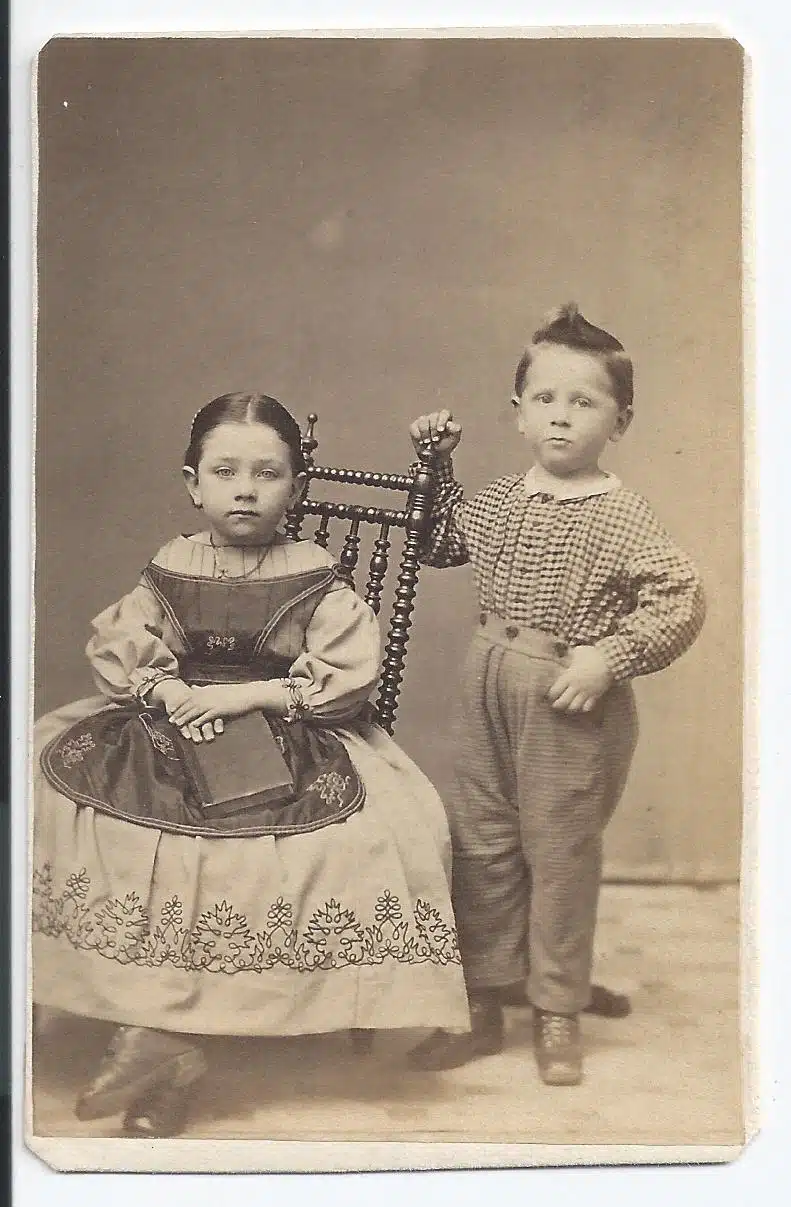
E. Woodward, Unidentified brother & sister, 1865, albumen carte-de-visite, West Chester, PA. Collection of the author. Note the tax stamp inscribed: E. W. 65, negative number 9576.
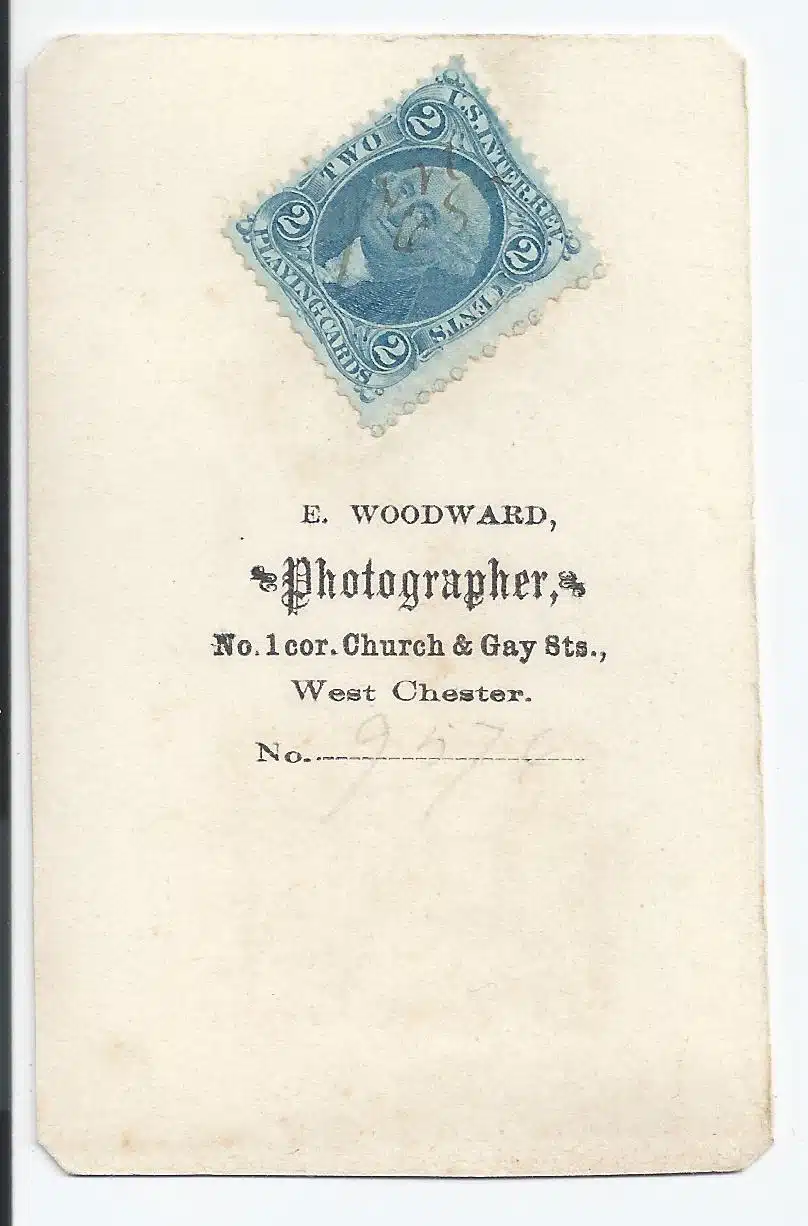
Just imagine the influx of sales for these photographers along with the time-consuming task of affixing the tax stamps to the cartes-de-visite sold by the dozen! According to the law, the photographer was supposed to initial and date each stamp thereby cancelling it. Plus, the photographer had to keep strict account of tax paid. This led Eber Woodward to join the ranks of photographers who refused to attach tax stamps to their photographs and called for a simpler system.
Postal historian Bruce Baryla has found evidence that certain studios, such as Fredericks & Co. in New York, were allowed to omit the tax stamps.[27] Baryla has found that from October 1864-April 1865 some studios omitted affixing the stamps on the photos and instead submitted a monthly report to the IRS along with the tax payment. Woodward hoped to operate on this streamlined plan. Baryla has evidence that IRS inspector Robert E. Smith visited Woodward’s studio in October of 1864 and had his photograph taken. The carte-de-visite produced reveals that the tax stamp had been soaked off and was replaced by an IRS inspector handstamp dated December 9, 1864. [28]
Abraham Lincoln appointed West Chester lawyer Joseph J. Lewis as Commissioner of the Office of Internal Revenue in the Treasury Department. Lewis wrote a letter to IRS collector William Baker dated May 11, 1865 in which he revealed that he had received photographs of the son of Thomas Spooner, IRS Collector, taken by Woodward without a tax stamp affixed.[29] In that letter Lewis noted that Woodward claimed the tax stamps injure the photographs and their presentation. Also noted was Woodward’s claim that he had destroyed the appropriate number of tax stamps before the inspector in lieu of affixing them to the photographs.
E. Woodard, Unidentified woman with a book, [1864-1865], albumen carte-de-visite, West Chester, PA. Collection of the author. Note the negative number 8484 on the back as well as a mark where an IRS tax stamp was removed.

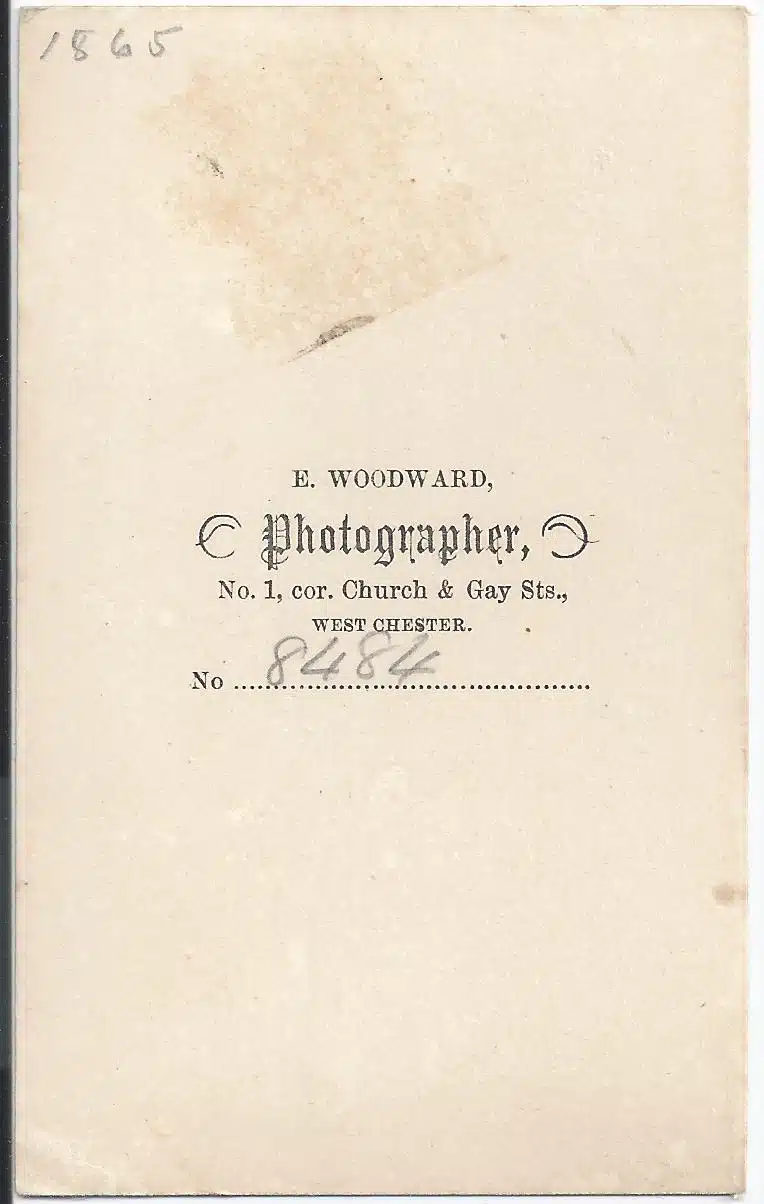
Permission to omit the tax stamps was revoked by the IRS in April of 1865, while some of the photographers continued until June. After this reprimand, Woodward had to comply.
It is interesting to trace the rise in Woodward’s income through the Civil War years by using the IRS Assessment lists. In 1863 he reports an income of $118, 1864 it rises to $538, 1865 it is $1082 and in 1866 $1680.
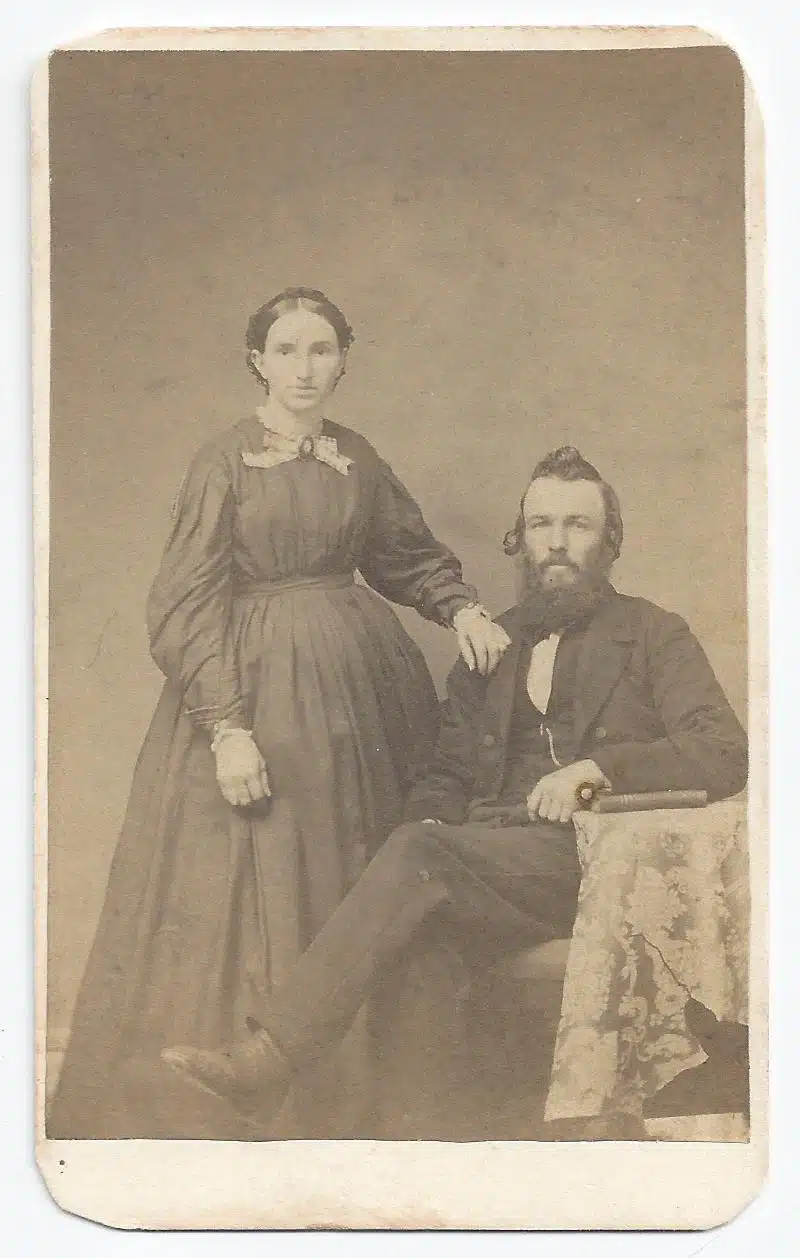
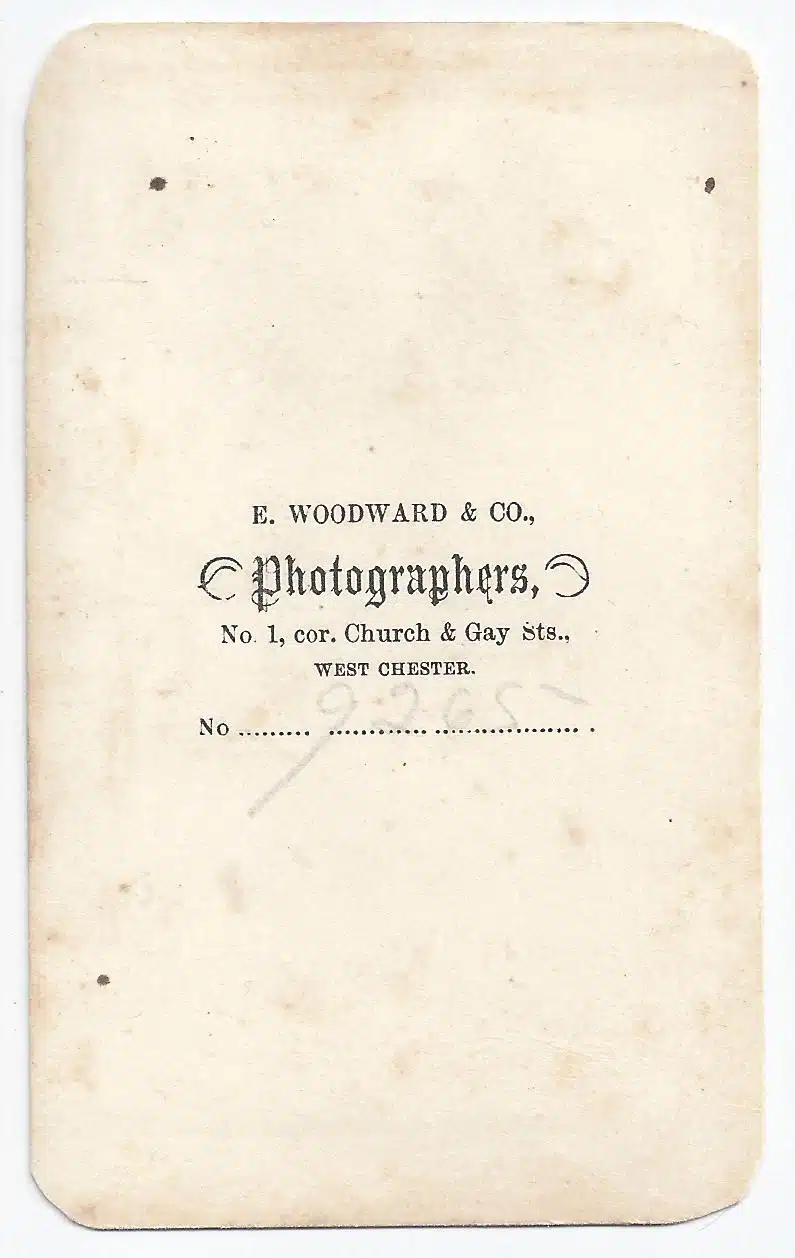
Another curious note regarding Woodward’s cartes-de-visite, in the CCHC collection are only five examples with the back mark “E. Woodward & Co., West Chester, PA”. All bear IRS tax stamps. One of Mary Buffington is labeled as taken in 1864[30]. I have never found mention of who this “and Company” may be.
Woodward & Co., Unidentified couple, [1864-65], albumen carte-de-visite, West Chester, PA. Collection of the author. Note the negative number of 9265 on the back.
We also see the “E. Woodward & Co./West Chester” stamped in the case velvet of ambrotypes. There are only two examples marked in this way in the CCHC collection. The ambrotype of Maryann Speakman and Carrie Damon would have been taken in the early to mid-1860s judging by the ages of the subjects.[31] It is not known who this “& Co.” may have been.
The years between 1863 and 1866 saw exponential growth in the cartes-de-visite market. West Chester saw at least thirteen or more different studios open in the borough. Many were short lived, but those of Thomas W. Taylor and C. Alfred Garrett were becoming well established.
In 1866, Woodward was ready for a career change. He sold the Church & Gay Street building in March of 1866 to George A. Mercer[32] and in April purchased a farm in Pocopson Township.[33] In 1867 Woodward sold his successful studio to C. Alfred Garrett complete with all equipment and massive negative file that contained as many as 25,000 negatives[34]. According to the Jeffersonian newspaper of April 13, 1867, Woodward was retiring to his farm in Pocopson Township. This move to the country may indicate a health concern that lead up to giving up photography.
But Woodward did not find farm life to his liking. He returned to West Chester as a dry goods merchant according to an announcement in the Jeffersonian on September 28, 1867. Woodward and partner Edwin Martin were the successors to William Everhart & Son’s popular store on the northwest corner of Church and Market Streets. Their inventory included carpets, Queens ware, Majolica, earthenware, table linens, cutlery, blankets, dress goods, looking glasses and many other items.
Eber Woodward sold his Pocopson farm in April of 1868.[35] On October 22, 1869 the partnership between Woodward and Martin was dissolved and Woodward continued the business on his own.[36] But the dry good business does not get all of his attention. The old White Hall Hotel property on the south east corner of Church and Gay Streets was being divided and it made a prime real estate investment. Woodward partnered with Lewis Shields, a master plasterer, to purchase a row of properties on the east side of Church Street[37].
Woodward also saw a lucrative opportunity as real estate developer. In 1873 Woodward razed the store occupied by druggist Jesse Thatcher at 21 N. Church Street, and built for him a new and larger store.[38] In 1882 he razed an old store and boarding house to “erect in its stead a handsome store building. It will be one of the finest in our borough when completed.”[39] Woodward built new brick store buildings at 20 and 22 N. Church Street.
Woodward also built an elegant home for his family at 322 W. Miner Street, West Chester in 1871. This is where Eber Woodward died of a stroke at age 62 on September 7, 1888.[40] He was survived by his wife and five children, John (who was Assistant Postmaster in West Chester), Wilmer, Frederick, Roskell and Mary. He was predeceased by a twin daughter Anna, who died in childhood. He was buried in Oaklands Cemetery north of West Chester along with many of his family members.[41]
An article in the Morning Republican memorialized him with the following: “Among the articles preserved by the family of the late Eber Woodward is a picture of Abraham Lincoln which their father had the distinction of taking a short time prior to his death.” It is possible that Woodward could have traveled to Washington, D. C. to take the photograph, since Lincoln never stopped for a visit in the county during his lifetime. There is a salted paper print of Lincoln taken shortly before his assassination in the scrapbook that A. Canova Swayne created documenting the career of his father, IRS agent and sculptor William Marshall Swayne. The sculptor used this photograph in the creation of a statue of the late President.
The article in the Morning Republican continues: “During the war the deceased photographer took no less than twenty-five thousand negatives which record is probably unexcelled in this section of the state. The unusual demand on the photographer’s time was due to the desire of the “boys” to leave behind them a reminder before they marched away to the front. These pictures are probably treasured now by hundreds of families in the community.”[42] Clearly Woodward’s legacy was his career as a photographer recording one perfect moment in the lives of so many Chester Countians at a time when they knew not what fate the future held.
© Pamela C. Powell, July 2020
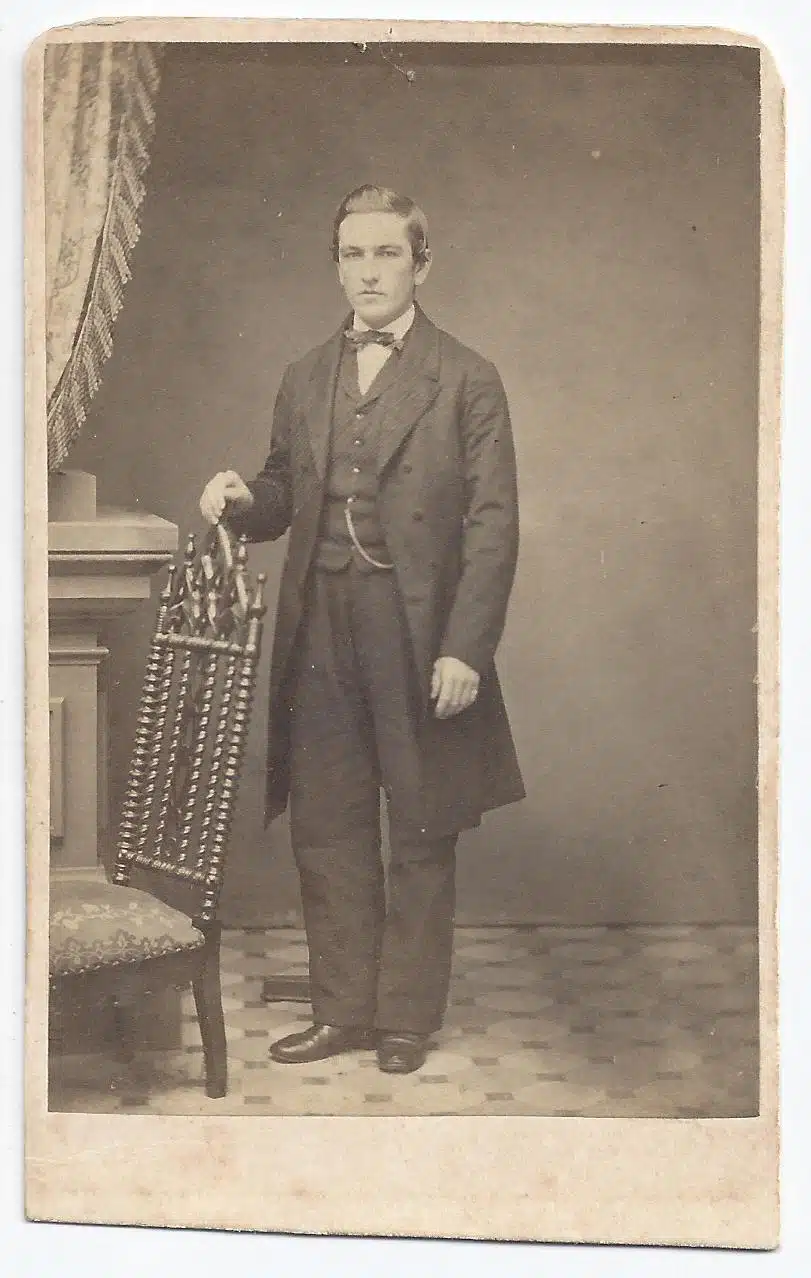
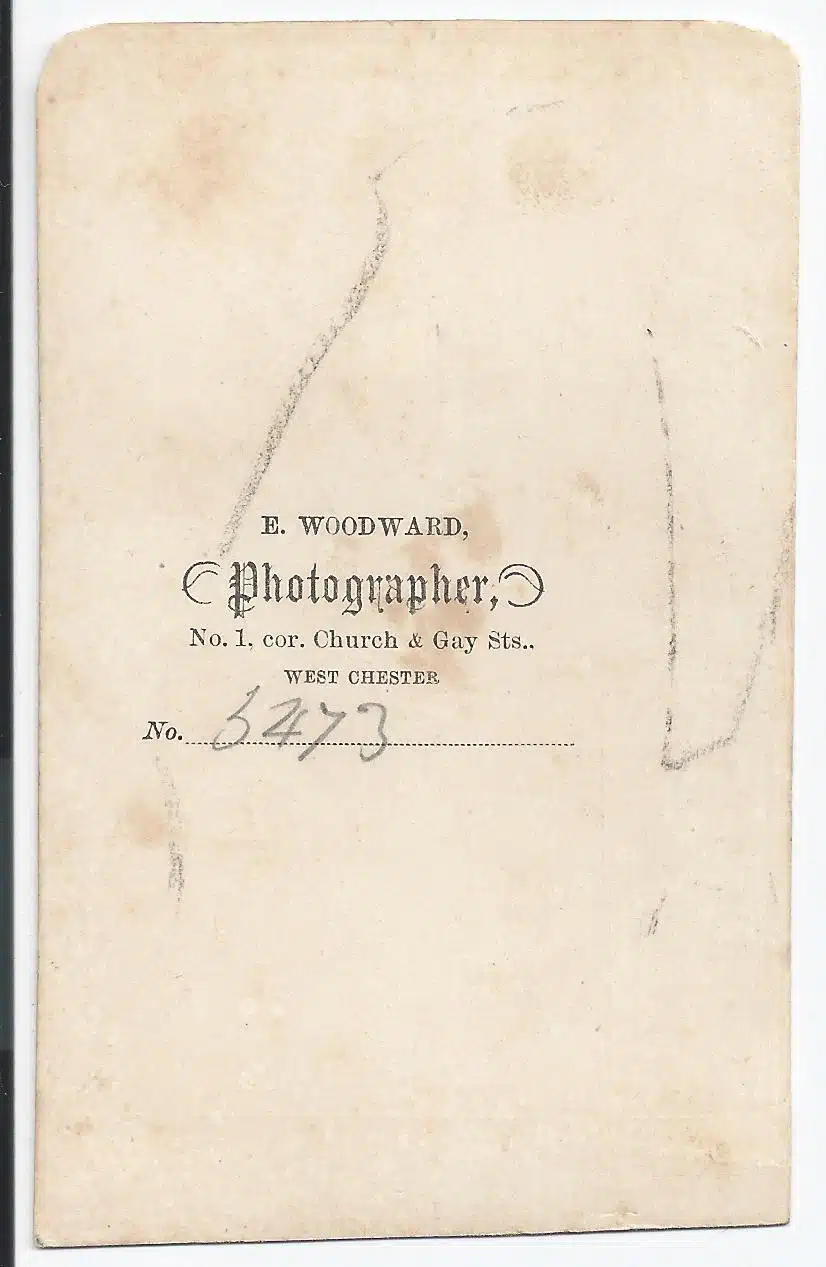
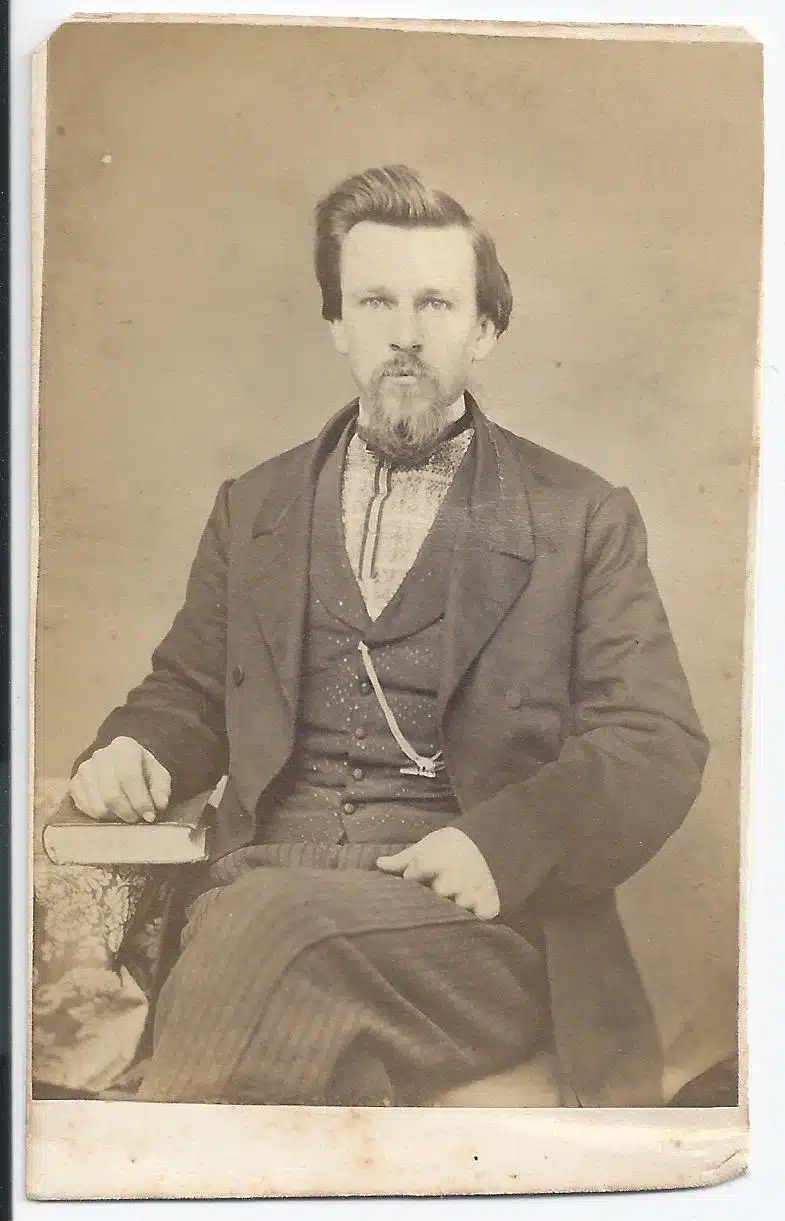
E. Woodward, Unidentified man wearing frock coat, [1862-1864], albumen carte-de-visite, West Chester, PA. Collection of the author. Note the ornate chair, negative #5473.
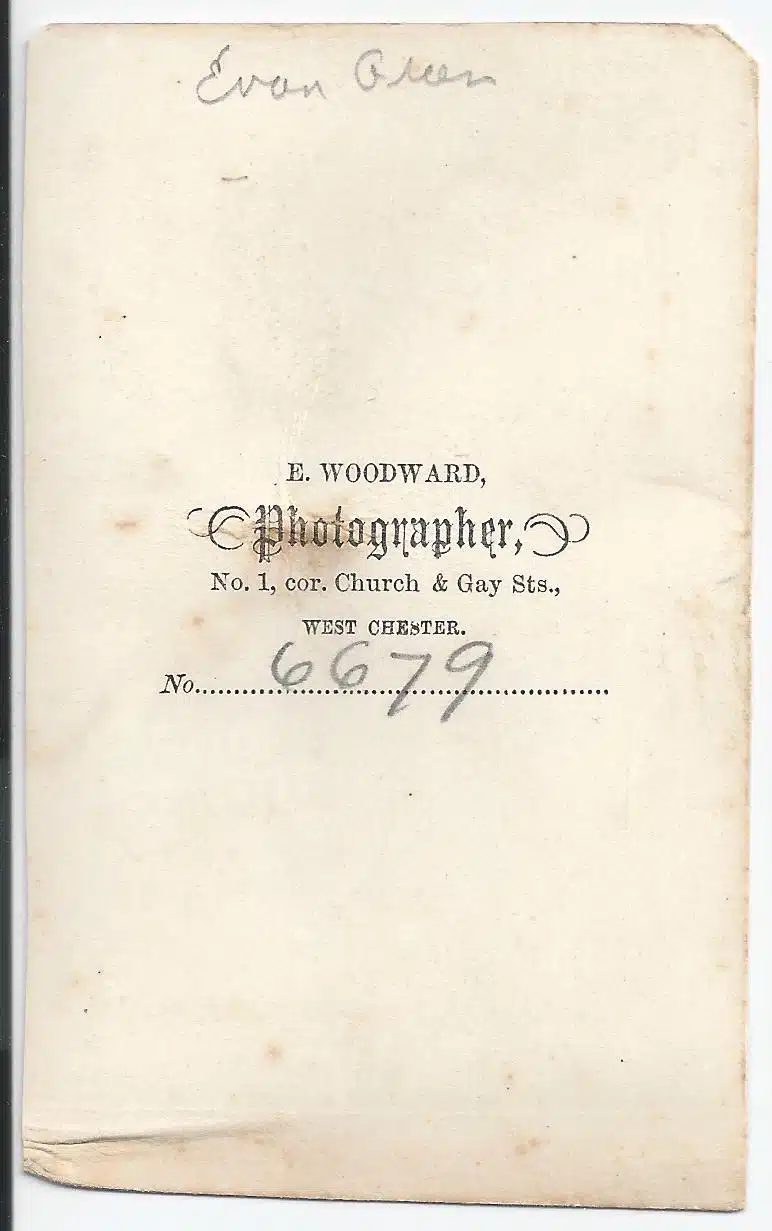
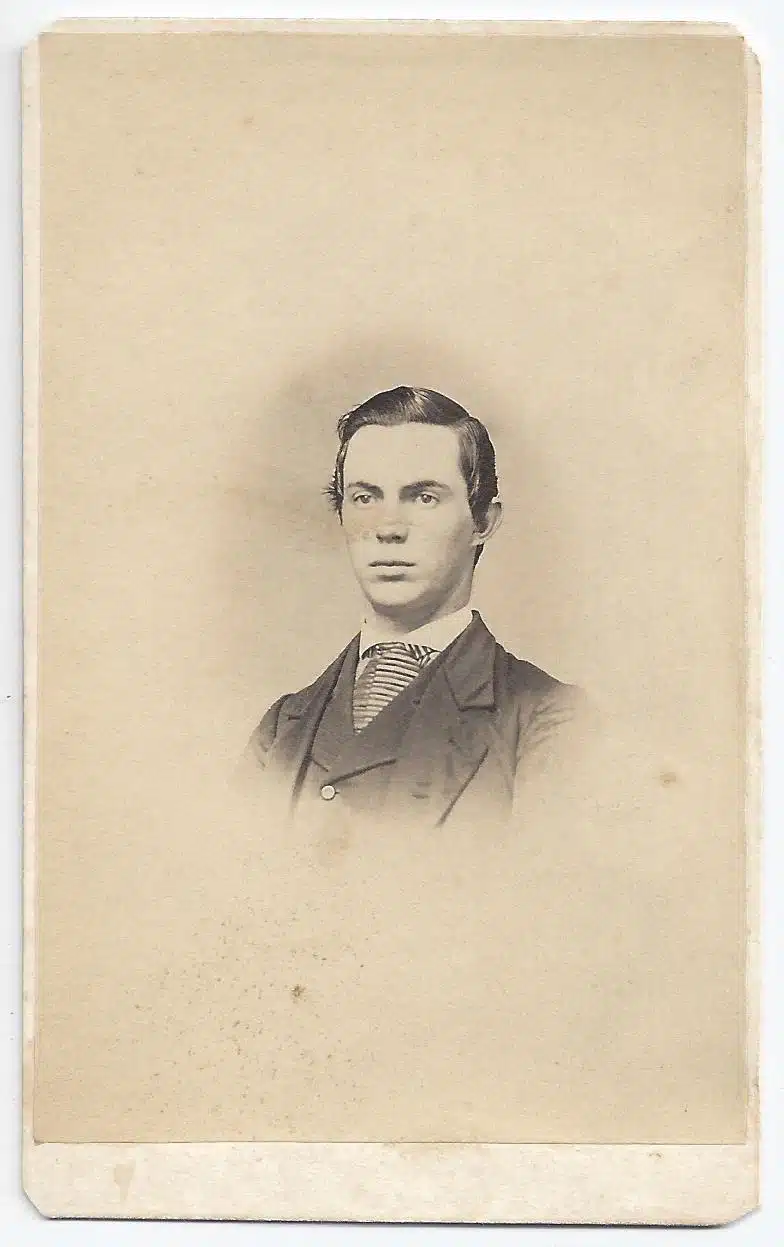
E. Woodward, Evan Green of Kennett Square (1836-1926), [1863-1864], albumen date-de-visite, West Chester, PA. Collection of the author. Negative number 6679.
E. Woodward, Unidentified young man, ca. 1865, albumen carte-de-visite, West Chester, PA. Collection of the author. Woodward’s imprint was almost the same throughout his career, this one is slightly different. Negative number barely visible, 9750.
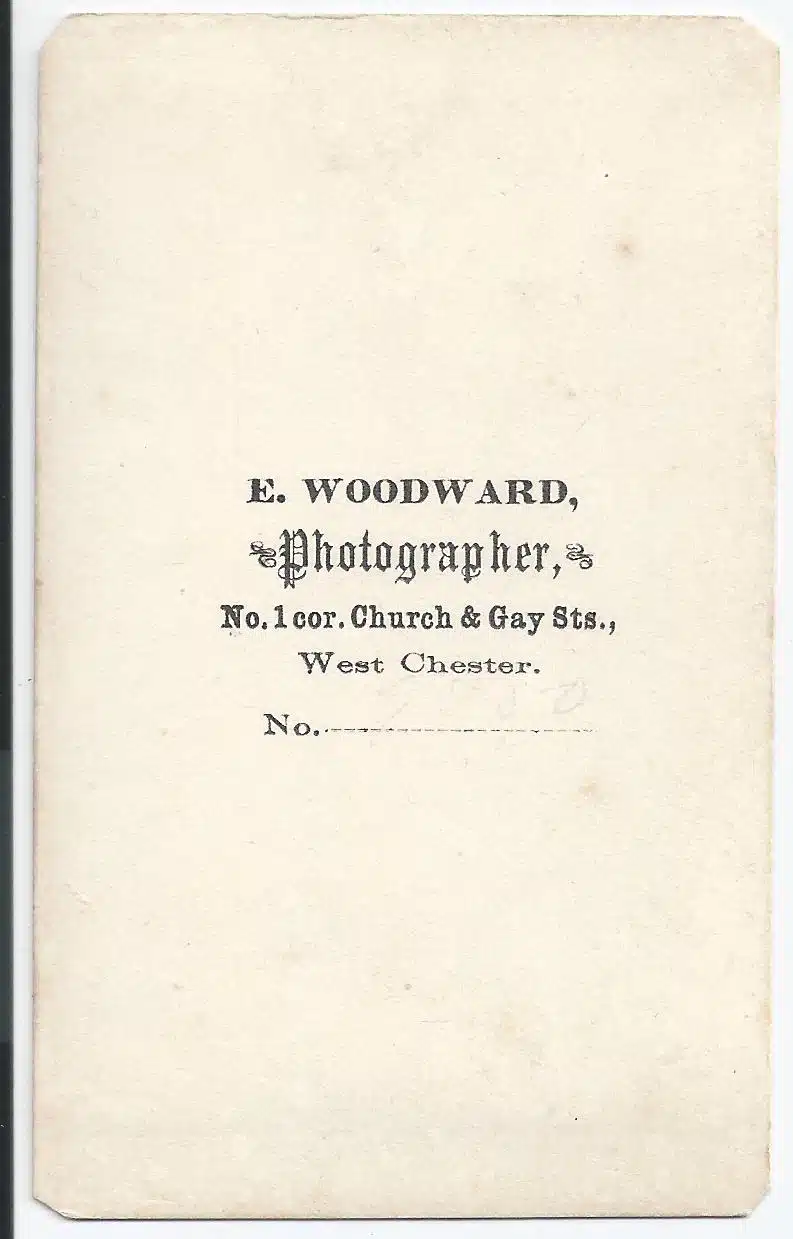
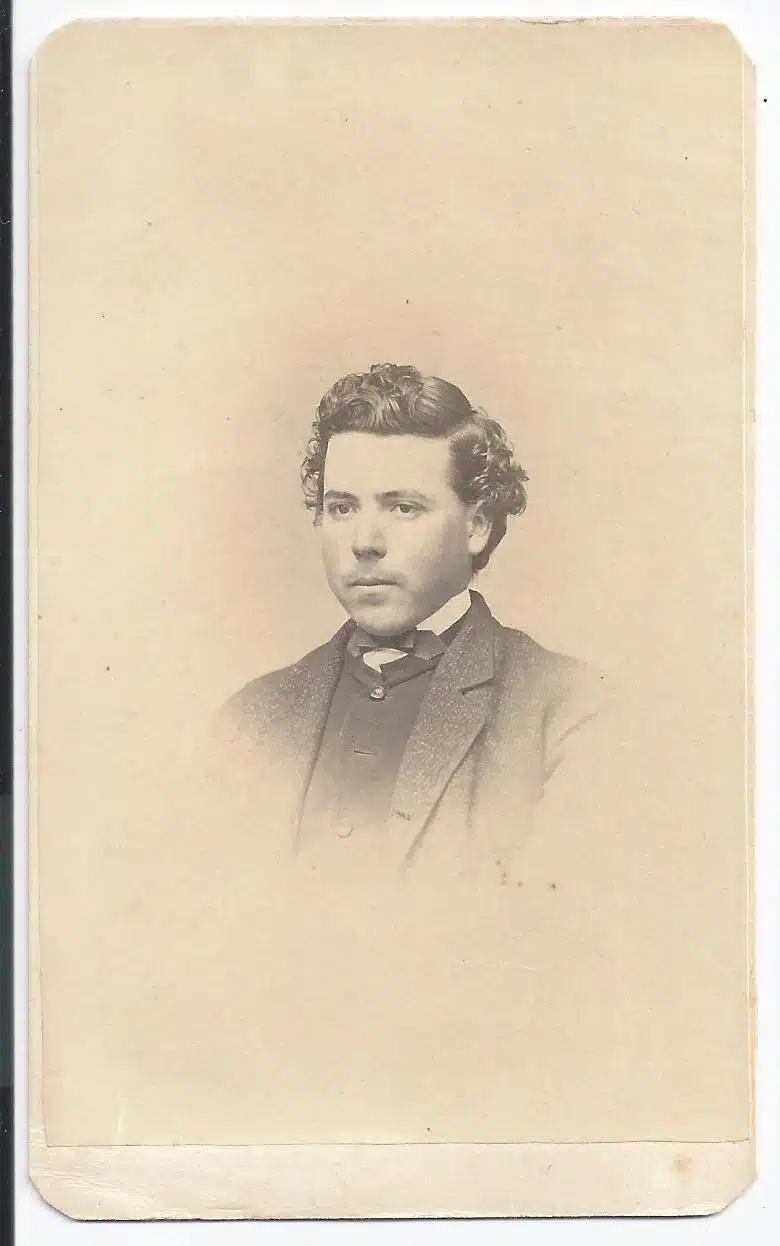
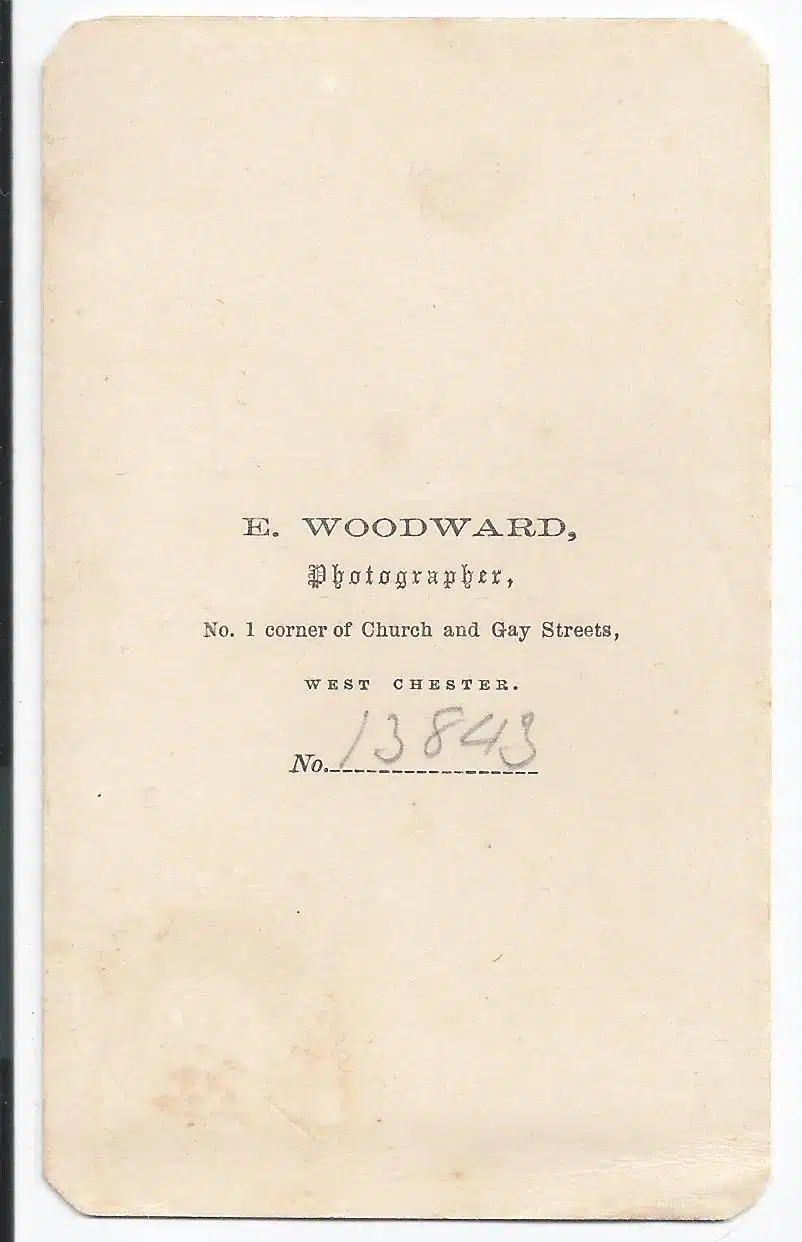
E. Woodward, Vignetted bust of a young man, 1866-67, albumen carte-de-visite, West Chester, PA. Collection of the author. Note the slight change in the typeface of the imprint, negative number 13843.
-
Lewis Woodward, comp. Genealogy of the Woodward Family of Chester County, PA, (Ferris Brothers: Wilmington, Delaware, 1879), 82. ↑
-
1850 Federal Census; Census Place: West Chester, Chester, Pennsylvania; Roll: 764; Page: 319A. ↑
-
Tax Lists, West Chester, PA. Chester County Archives & Records Services, West Chester, PA. ↑
-
1850 Federal Census; Census Place: West Goshen, Chester, Pennsylvania; Roll: 764; Page: 272B. ↑
-
Death Certificate, William G. Cheyney, Commonwealth of Pennsylvania, Bureau of Vital Statistics, File #91686, October 19, 1909. ↑
-
Village Record (West Chester, PA) 7 November 1854. ↑
-
Morning Republican, (West Chester, PA), 13 August 1896. ↑
-
American Republican (West Chester, PA) 26 February 1856. ↑
-
American Republican (West Chester, PA) 19 August 1856. ↑
-
Village Record, (West Chester, PA), 31 March 1857. ↑
-
American Republican (West Chester, PA) 25 March 1856. ↑
-
American Republican, (West Chester, PA), 19 August 1856. ↑
-
Directory of the Borough of West Chester for 1857. (West Chester, PA : Wood & James, 1857), p. 146. ↑
-
Levis H. Davis. Death Register 1893-1907, 2:56, Chester County Archives and Records Services, West Chester, PA. ↑
-
Note: it may be that some CDVs are extant in the collection of the Fame Fire Company, West Chester, PA. ↑
-
There were two people named Wilmer Worthington in West Chester at this time. One was a respected physician. I believe that Woodward’s partner was Wilmer Worthington (1828-1862), the son of John Worthington, who lived next door to Clinton Frame’s house, where Woodward first stayed when he came to the Borough. ↑
-
Jeffersonian, (West Chester, PA), 8 January 1859. ↑
-
Exhibition program, Chester County Agricultural Society, 1859, unpaged. ↑
-
Chester County Times (West Chester, PA) 25 June 1859. ↑
-
American Republican (West Chester, PA) 19 July 1859. ↑
-
Village Record, (West Chester, PA), 20 September 1859. ↑
-
Village Record (West Chester, PA), 3 December 1861. ↑
-
Deed Book K6 Volume 132, pages 386-7, Benjamin & Anna Gregg to Eber Woodward, March 29, 1859. Land Records, Chester County Archives & Records Services, West Chester, PA. ↑
-
See Deed Books R6 volume 139 page 573; R6 volume 139 page 574 and K7 Volume 157 page 111. Land Records, Chester County Archives & Records Services, West Chester, PA. ↑
-
Deed Book Q6 Volume 138 pages 482-3, John R. Pierce to Eber Woodward, April 6, 1861. Land records, Chester County Archives & Records Services, West Chester, PA. ↑
-
See biography of Edwin Long by Pamela Powell for full information. ↑
-
Bruce Baryla, Permission to Omit Stamps & Stamps Accompanying Monthly Returns, web.newsguy.com/bruceb/london/permission To Omit Stamps.htm ↑
-
Email, Bruce Baryla to Pamela Powell, 20 June 2012. ↑
-
Letter, Joseph J. Lewis, Treasury Department, Washington, D.C. to William Baker, Collector 7th District, West Chester, PA., May 11, 1865. Library Collection, Chester County History Center, West Chester, PA. ↑
-
Mary Buffington, by E. Woodward & Co., West Chester, PA, 1864, albumen carte-de-visite. CDV#213 Photo Archives Collection, Chester County History Center, West Chester, PA. ↑
-
Maryann Speakman & Carrie Damon by E. Woodward & Co., sixth plate ambrotype [between 1859-1862]. AM211 Photo Archives Collection, Chester County History Center, West Chester, PA. ↑
-
Deed book E7 volume 152 page 41, Eber Woodward et ux to George A. Mercer & Anna M. Mercer, March 28, 1866. Land Records, Chester County Archives & Records Services, West Chester, PA. ↑
-
Deed Book Z6 Volume 147 Pages 586-7. Henry Yetter & Wife to Eber Woodward, April 2, 1866. Land Records, Chester County Archives & Records Services, West Chester, PA. ↑
-
Morning Republican (West Chester, PA) 31 August 1896. ↑
-
Deed Book L7 volume 158 page 222. Eber Woodward & wife to Abram Huey, April 6, 1868. Land Records, Chester County Archives & Records Services, West Chester, PA. ↑
-
Jeffersonian (West Chester, PA) 6 November 1869. ↑
-
Note: Woodward owned 19, 21, 23, and 27 N. Church Street on the east side. ↑
-
Daily Local News (West Chester, PA) 19 July 1873. Note that after Woodward’s death, Thatcher purchases the store building. See: Deed Book V10 Volume 243 page 457. Hannah M. Woodward & David McFarland administrators Estate of Eber Woodward, to Jesse Thatcher, March 31, 1891. Land Records, Chester County Archives & Records Services, West Chester, PA. ↑
-
Daily Local News (West Chester, PA) 2 January 1882. ↑
-
Obituary, Daily Local News (West Chester, PA) 8 September 1888. ↑
-
Findagrave.com https://www.findagrave.com/memorial/60330207/eber-woodward ↑
-
Morning Republican, (West Chester, PA), 31 August 1896. ↑