Alexander McCormick
( 1824 – 1907 )
Oxford’s Photographer & Choral Director
Alexander McCormick’s career was governed by two passions, choral music and photography. Ironically it was choral music that led him to Charleston, South Carolina where he learned photography with George S. Cook. McCormick returned to Oxford in 1861 where he became the town’s photographer until he sold his gallery to John T. Barry in 1892. His Oxford Hall gallery was the place where everyone in Oxford and the surrounding region had their portraits made.
Nancie Wilson Dickey McCormick and Alexander McCormick, cartes-de-visite in Rutherford Family Album, Photo Album #9, Courtesy of Chester County History Center, West Chester, PA.

McCormick was born on May 24, 1824 in Oxford, Pennsylvania, one of eight children of Jesse and Elizabeth Taylor McCormick. His father supported this large family working as a hatter. Some years were difficult for the family, as can be seen by Alexander McCormick and two of his siblings recorded as “Poor Scholars” and were excused from paying their school tax in 1836.[1]
Jesse McCormick died when Alexander was a teenager.[2] As a young man he learned the trade of a saddler. The 1850 Census records him as a leather worker, living with his mother and younger brother and sister. In 1851 he was employed as a clerk for the Oxford Board of Elections. He was already an active member of the Presbyterian Church involved in church music and was known for his beautiful voice.
In 1854, at the age of thirty, he moved to Charleston, South Carolina to direct the choir at the Second Presbyterian Church. He held this position for six years. While he was there, he learned the art and business of photography from George S. Cook.[3] Cook’s Charleston gallery was located at 235 King Street above James E. Spear’s Jewelry Store. Along with daguerreotypes and ambrotypes, Cook introduced photography on paper in 1854 along with ivorytypes and shereotypes in 1856. Cook was a dynamic photographer and savvy businessman who was constantly on the move. His mode of operating was to establish or purchase a gallery, train an operator, then move on to another opportunity leaving the operator in charge. In 1856, Cook left Charleston for Philadelphia where he had purchased the renowned gallery of Marcus A. Root. Records show that McCormick was Cook’s operator in 1856 and 1860.[4] It may be that McCormick was there also in the intervening years.
National events however were to shape McCormick’s business decisions. On December 26, 1860 South Carolina succeeded from the Union. As the conflict between the North and South heated up, McCormick returned home to Oxford.
Using the local Chester County, Pennsylvania tax records, McCormick is first listed in the 1862 tax list for Oxford as a single freeman.[5] The tax list was compiled in the fall of 1861 and paid in the spring of 1862. So this indicates that McCormick may have opened his first gallery in Oxford by mid- 1861. He is also reported on the Civil War Draft registration records as an “artist” in 1862.[6]
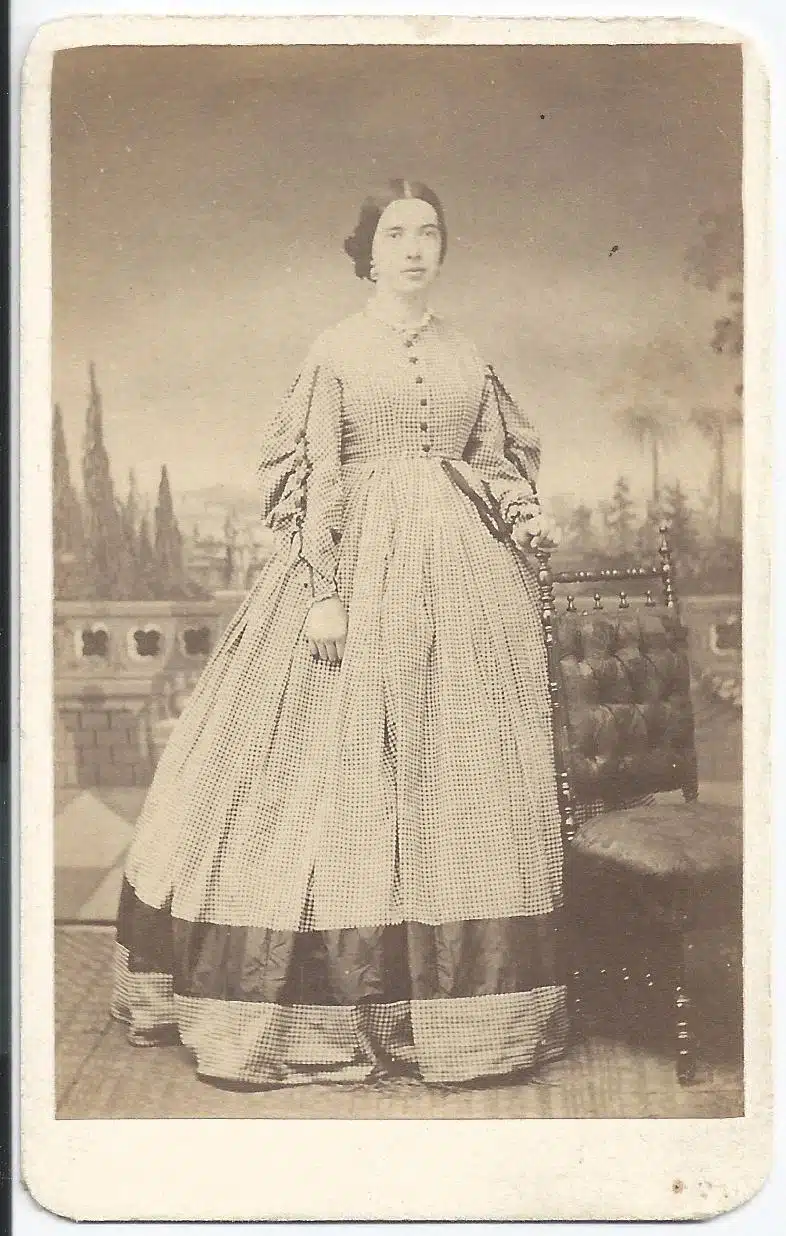
It also is not known where his first gallery was located in Oxford. There are four early McCormick cartes-de-visite in the Chester County History Center carte-de-visites collection in which the subject is posed before an elaborately painted background.[7] All of these date from the 1862-1864 period.
A. M’Cormick, Mary Garver Rogers, 1861-1863, albumen carte-de-visite, collection of the author. Note the painted backdrop in the studio and the absence of the small ‘c’ in the artist’s name.
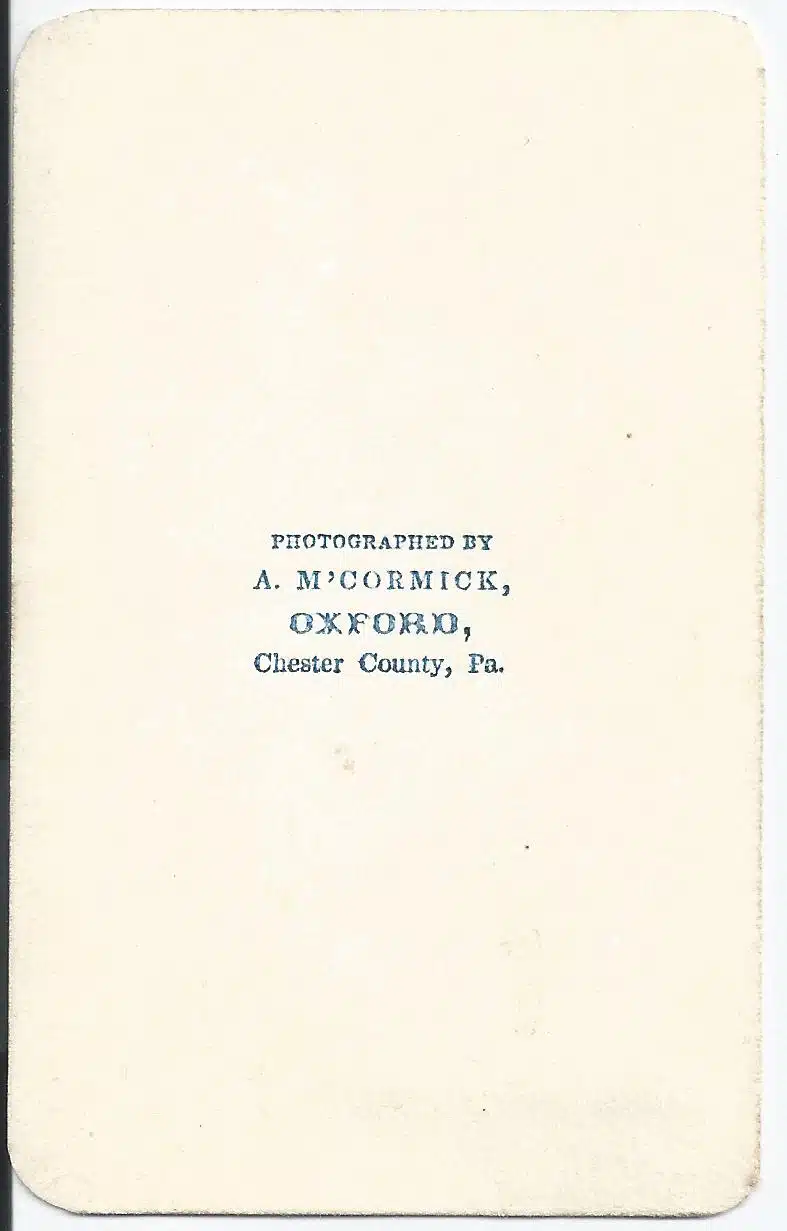
In 1864, partners Thomas Boland and J. Carpenter Worth sold shares of stock in order to construct the Oxford Hall. It was centrally located in the borough on the corner of Third and Market Streets. The Oxford Hall Association was incorporated by an act of Legislature in 1867.[8] It featured a department store on the first floor, a large meeting room with a stage on the second and a photograph gallery on the third floor. It is no surprise that Alexander McCormick had purchased a good number of shares of this stock. The Oxford Hall became the community center hosting lectures, theatrical entertainments, musical concerts and strawberry festivals. Everyone in town knew McCormick’s gallery was there.
McCormick became a prolific carte-de-visite artist during the Civil War years making hundreds of portraits for the residents of Oxford and the surrounding rural townships. Examples of his cartes-de-visite with IRS tax stamps can be seen in the Photo Archives of the Chester County History Center in West Chester, PA. He hired as his apprentice and assistant, his cousin, John B. Gibson.
McCormick placed an advertisement in the Oxford Press on March 28, 1866:
It was a surprise when McCormick sold his gallery in February of 1867 to John B. Gibson, his long- time assistant. The Oxford Press of February 13, 1867 reports: “The high reputation this gallery was won at home and abroad we are sure will be fully sustained under the management of our artist friend Mr. G., who has been with Mr. McCormick so long as to become perfect master of the business.” Why McCormick sold his gallery is an enigma.
Gibson, in April of 1867 entered into partnership with George D. Hayes, under the studio name of Gibson & Hayes.[9] That partnership is dissolved one year later on March 1, 1868, when Alexander McCormick bought back Gibson’s share in the business. The new gallery of McCormick & Hayes is advertised in the Oxford Press on March 18, 1868:
McCormick & Hayes, Unidentified Man, [March 1, 1868-Dec. 31, 1869], albumen carte-de-visite, collection of the author.


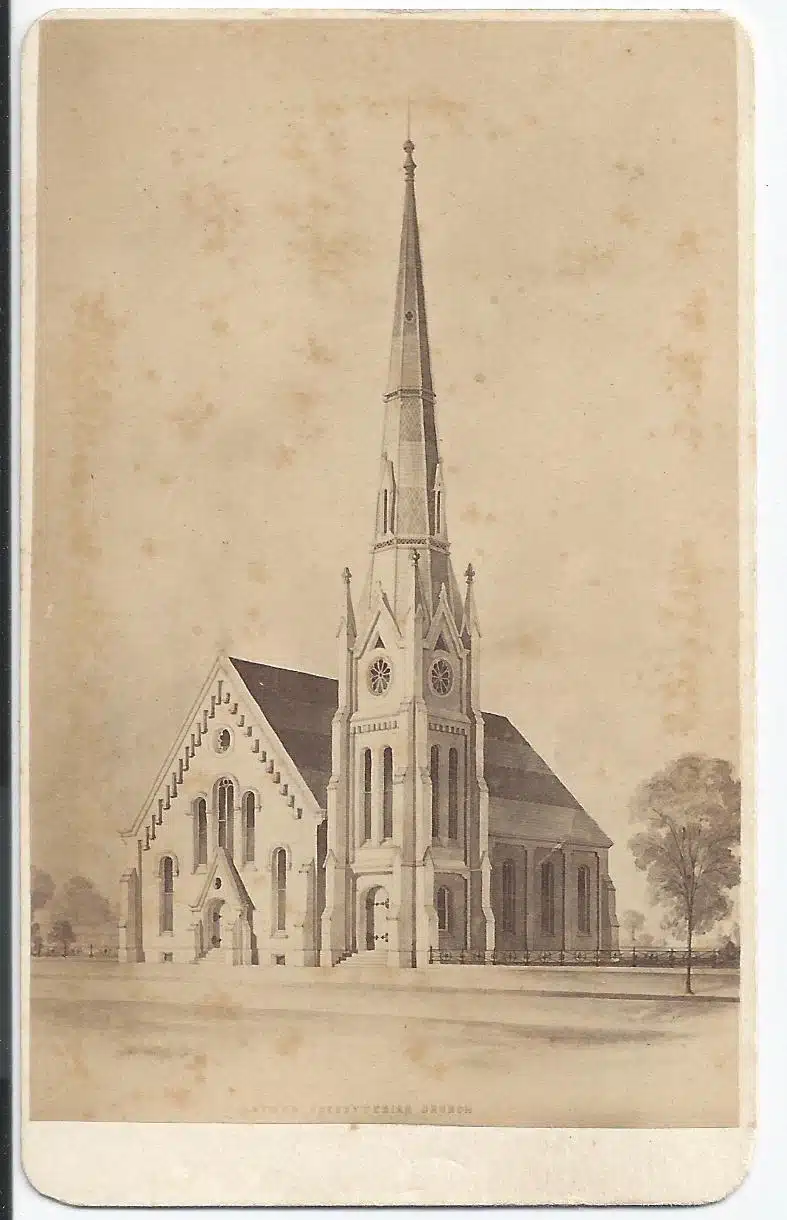
This is the first-time outdoor views are mentioned in his advertising. The Chester County History Center has in its collection views of the Oxford Presbyterian Church[10] and Session House[11] in carte-de-visite format.
It may be that McCormick returned to photography because he needed a steady paycheck since he was about to make a big change in his life. On April 21st of 1868, McCormick married Nancie Wilson Dickey[12], the widow of David D. Dickey[13] and mother of two children, Francis (age 15) and David, Jr. (age 12). When businessman & writer David Dickey died intestate, his extensive property holdings were sold and court appointed guardian, James R. Ramsey invested the proceeds such that Nancie Dickey and the two boys could live comfortably on the income.[14] McCormick and his new family lived in Nancie’s brick house on Fourth Street in Oxford.
George D. Hayes’s career path took him in a different direction however, he bought a half-interest in the Oxford Press.[15] As of January 1, 1870 he began work as an editor, leaving McCormick on his own as sole proprietor of his gallery. But McCormick needed help to keep up with his swift trade. So he took on John T. Barry as an apprentice.[16] Barry worked at Oxford Hall until March of 1872 when he became an itinerant photographer with his brother-in-law Samuel Bunting.[17]
The Oxford Press kept the local gentry up to date on anything new in the borough. Here is a tidbit from the August 10, 1870 Oxford Press: “ARTISTIC – The new specimens of photographic pictures placed in new cases at the entrance of the Gallery, and on the corner of Carharts’ store, are attracting much attention. They reflect great credit on the artist, Mr. A. McCormick, by showing that he is keeping up with the rapid advancement that has lately been made in the art of taking sunlight pictures. His specimens compare very favorably with those of the best Philadelphia Photographers.” McCormick’s portrait style was simple and straight forward – a well-lit subject was posed using a chair, table or drape with a plain background. Beginning in the later 1860s when vignetting became popular, McCormick added this technique to his repertoire.
McCormick took out a half page ad in the 1871 edition of Chester County, PA Business Directory to announce some new styles of photographs he had to offer:
These porcelain miniatures were photographic images on white milk glass – that were reminiscent of portrait miniatures painted on ivory. The photo crayons advertised were to become one of the most popular mediums for enlarged photographs to hang in your parlor or dining room. The process was a combination of photography and hand coloring. The weakly printed salted paper print was hand-colored with oil paint, pastels, chalk or India ink, giving the viewer the impression that it is a painting – but one that looks so realistic it could only be a photograph.
In 1872 McCormick found a way to expand his business by opening a picture frame manufactory. An advertisement in the Oxford Press on November 20, 1872 announced the enterprise:
McCormick’s reputation drew customers from a wide area. One of the most interesting sitters McCormick photographed was Ezekiel West who was born in 1755 and was 118 years old. The story was recounted in great detail in area newspapers in February of 1873. Mr. West who resided in New London came to the decision that he needed to be immortalized in a portrait photograph. The snow laid in a deep layer around the countryside with the thermometer below zero, so the plucky Mr. West embarked for Oxford in a sleigh with his son-in-law, Benjamin F. Davis. He arrived at the Oxford Hotel, where they took a room. That evening West commanded the attention of the other guests as he regaled them with stories about the days long ago around the fireside. The next day, he visited McCormick’s gallery and had his carte-de-visite made.[20] It is a simple straightforward half-length portrait of the old gentleman seated in a plain chair. A copy of the carte-de-visite is in the collection of the Chester County History Center.[21] I have also found it in other collections which leads me to wonder if McCormick made the cartes-de-visite for sale to the public after Mr. West’s departure. And yes, he really was 118 years old! He was born in Harford County, Maryland and was reported to be the oldest man in Pennsylvania.[22] West died two months after he was photographed.
McCormick’s business was so profitable, that he was able to close his studio for a vacation of two weeks to one month during the summer. An established gallery such as McCormick’s did not need to do much advertising, the local population was so familiar with him. However, McCormick turned his vacations into an opportunity for publicity. The closing of his gallery was announced in the Oxford Press and likewise advertised his services when it reopened.[23] Sometimes he had posters made announcing the reopening. His vacations began in 1875 and continued through the 1890s. Here is a sample of some of his announcements:
Oxford Press, August 4, 1875: “ Mr. McCormick, artist, has resumed business at his photograph gallery in the Oxford Hall building, where after his recuperative rest, he will be glad to see the countenances of his friends and public generally.”
Oxford Press, August 2, 1876, “Mr. McCormick has re-opened his photographic gallery and after his relaxation from labor during the heated term resumes his business with renewed energies. All wanting perfect likenesses should patronize Mr. M. No poor work goes out of the Oxford photograph gallery.”
Oxford Press, July 25, 1877, “The Oxford Photographic Gallery that has been closed for the last two weeks is now open again. NEW AND BEAUTIFUL STYLES OF PICTURES lately introduced, Small Pictures Copied And Enlarged To ANY SIZE. Frames for photographs, mottoes, hair flowers, wax flowers, &c. always on hand or made to order; also, frame mouldings of walnut wood, plain and polished, gilt, imitation rose wood, imitation walnut, rustic, &c., A. McCormick.”
McCormick decided to engage in a project that would benefit the community and bring public attention to his capability to take outdoor views,. The Oxford Press gave this report on April 12, 1878:
This series of views can be seen in the collection of the Chester County History Center cartes-de-visite.[24] This was not McCormick’s first show of support for the library. He was one of the initial stockholders when the Oxford Library Company was formed in 1868 and was elected as corresponding secretary.[25] Through the years he held posts of director, vice president and president an office held from 1874-1881.[26] McCormick planned and participated in the library’s fundraising events. On Christmas evening in 1876 he organized a musical concert for the community, with he and his wife as principal singers.[27]
Besides supporting the library, the photographer engaged in other community causes as well. The Oxford Press of March 2, 1870 reported that a temperance meeting was held in Oxford Hall organized by Rev. W. R. Bingham. Alexander McCormick was part of a committee tasked with creating a formal temperance organization in Oxford.[28] It was known as “Oxford Total Abstinence Society.[29] In October of 1875, he engaged the Oxford Press printing office to advertise a Temperance Meeting that was being held and to print 30 handbills for distribution.[30] The Oxford Presbyterian Church was an active promoter of temperance through sermons and meetings.
McCormick’s gallery in the Oxford Hall was a fixture in the community. McCormick had purchased enough shares that he was on the Board of Directors of the Oxford Hall Association and served as its Secretary from 1879 through at least 1897.[31] When McCormick’s skylight was broken, it was news. The Oxford Press reports on November 6, 1878, “Our photographic artist, A. McCormick, has replaced with new glass his skylight which was demolished by the wind on the 23nd ult., and is now better than ever prepared for business. Mr. McCormick’s pictures have a wide reputation and he is determined they shall equal the best. His facilities are excellent and orders are filled with dispatch.”
A. McCormick, Unidentified Young Woman, 1880s, albumen cabinet card, collection of the author.

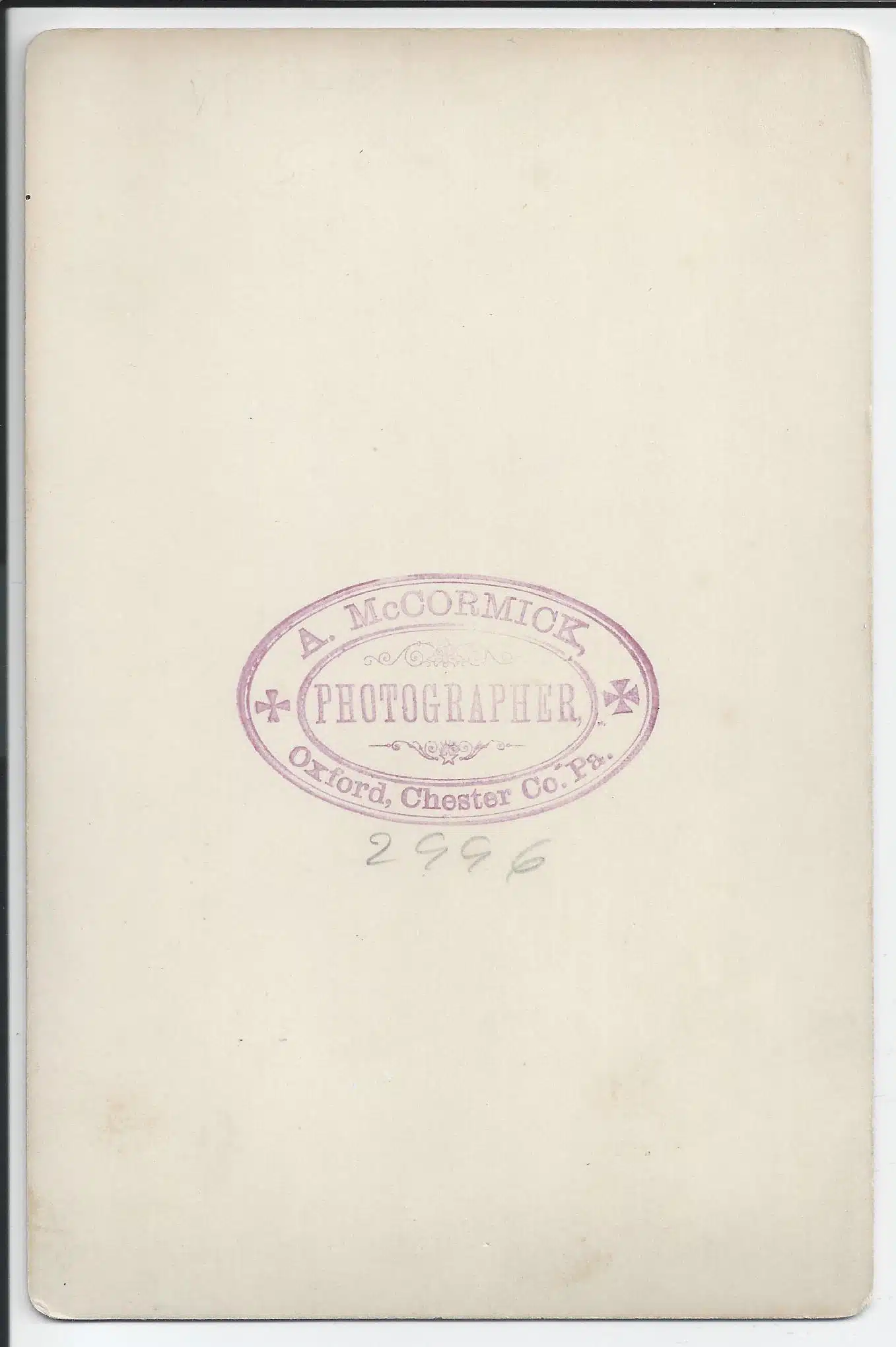
Two portrait formats in high demand in the 1870s and through the 1890s were cabinet cards and crayon portraits. The Oxford Press of November 16, 1879 had some laudatory remarks about McCormick’s skill: “Two handsome crayon portraits from the gallery of our artistic friend, A. McCormick, have been on exhibition in the window of Bowman’s book store for several days. They are pictures of two well known young men of Oxford, who have passed away, of whom these treasures of art are perfect likenesses. They are as handsome pictures as we ever saw and attract much attention.” McCormick’s cabinet card portraits offered the type of posing environment that customers of that era desired, with an architectural backdrop and a variety of upholstered furniture and jacquard weave drapery.
Since McCormick’s gallery had been in the community for so long, it became a resource, like an archives of local pictorial history. The Oxford Press reported on February 18, 1880, that McCormick was in correspondence with someone in Japan regarding photographs of an old home stead and relatives.[32]
During the 1880s, McCormick had some new competition. J. T. Wiley parked his traveling wagon frequently at Third and Locust Streets beginning in 1884 to take some of the trade. McCormick’s former pupil, John Barry, also returned to Oxford in 1884 and began assisting him in the studio.
A landmark was reached in McCormick’s musical life, when he resigned from directing the Oxford Presbyterian Church choir in October of 1891, after 36 years of service.[33] He had also directed the singing at the Mount Vernon Chapel in the 1850s and later in the 1880s as well.[34]
McCormick’s career was winding down, so at age 68 he decided to retire. He sold his gallery at Oxford Hall to his former pupil and assistant John T. Barry in 1892.[35] The Oxford Press made the announcement in the January 6th edition: “An Old Business in New Hands – The Oxford photographic and art gallery which has been under the management of Mr. A. McCormick, continuously with the exception of a few months, for over 30 years, has been purchased by Mr. J.T. Barry. Mr. Barry has been assisting with Mr. McCormick in the business for the past nine years…”[36] McCormick is still listed in Boyd’s Chester County Directory for 1893-94 as a photographer, but with no business address. In the 1896-97 edition, no occupation is given. According to the 1892 tax list McCormick’s occupation is now listed as “gentleman” meaning that he was living on his own means and not through employment.[37]
In 1893 McCormick was still steadfastly campaigning for the temperance cause. At a prayer meeting he read the following resolution: “Resolved, that we the people of Oxford and vicinity, believing the sale of intoxicating liquors is an evil, most earnestly request our representatives to the State Legislature to support the Local Option Bill now held before that body.”[38] Clearly he was respected as a leader in the community on this issue.
In 1895 Alexander McCormick desired to visit Charleston and travelled there once again. He revisited the church and business district finding it still in dilapidated condition following the Civil War. It was a great disappointment that he found only two of his old friends. He also saw Fort Sumter on Sullivan’s Island and spent some time in Richmond, Virginia on the way home.[39]
McCormick’s wife Nancie passed away in September of 1897 at the couple’s home on Fourth street in the borough of Oxford. Her funeral was conducted from home as was the custom. She was laid to rest in Oxford Cemetery beside her first husband, David D. Dickey,[40] who had died tragically at the age of 33 from typhoid fever.
After his wife’s death, Alexander McCormick boarded with the Snodgrass family on Pine Street. He is recorded in the 1900 Census as a “capitalist”[41] most likely, living off the interest of his investments. McCormick did work in his retirement as a notary public and is so listed in the publication of the Oxford Board of Trade.[42]
Alexander McCormick died on August 13, 1907 from “the accidental taking of an overdose of morphine”.[43] He was 83 years old and suffered from paralysis. It was reported that he had been ill for a day and a half.[44]
Despite his great love of music, his funeral was simple but impressive held at the Oxford Presbyterian Church. He requested no music or flowers. Only the bell tolled as his body was carried to out to the cemetery after a quiet service.[45] He had been a member of the Church for sixty years and an Elder for forty. The obituary from the Daily Local News remarked: “He spent his whole life in that borough and during his long experience as a photographer he took the likenesses of thousands of citizens and visitors.”[46]
When McCormick’s estate was settled his sixty-six shares of Oxford Hall Association stock was sold netting $931.50.[47] According to his will, predetermined amounts were distributed to his two step-sons, his many nieces and nephews and the Oxford Presbyterian Church, with the residual of $2798.85 going to the Board of Home Missions of the Presbyterian Church in New York City.[48]
© Pamela C. Powell, 2022.
Illustrations:
A. M’Cormick, Faithful Duffield Strawbridge, albumen carte-de-visite, 1861-1863, collection of the author. [Photo 59 front & verso] Note the absence of the small ‘c’ in the artist’s name.
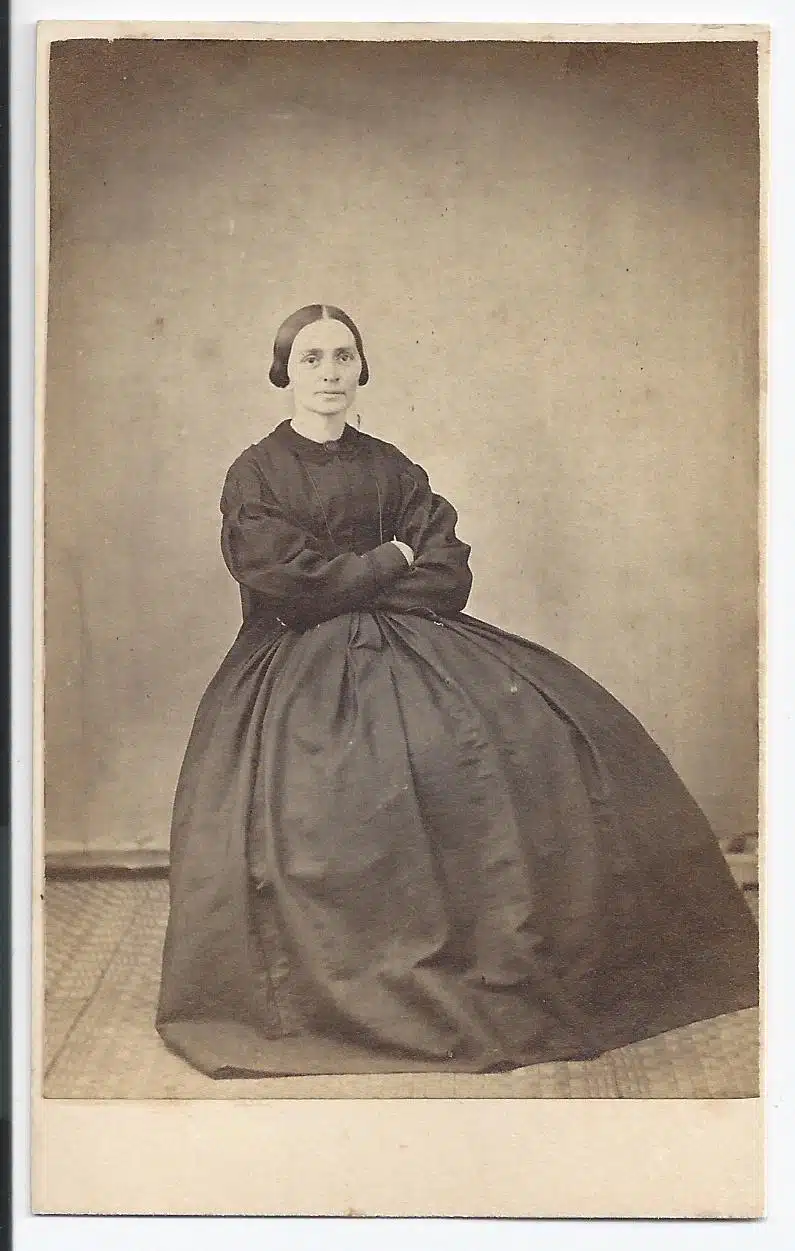

A. M’Cormick, Fashionable Young Woman, 1862-1863, albumen carte-de-visite, collection of the author. [Album123pg 41] Note the absence of the small ‘c’ in the artist’s name.
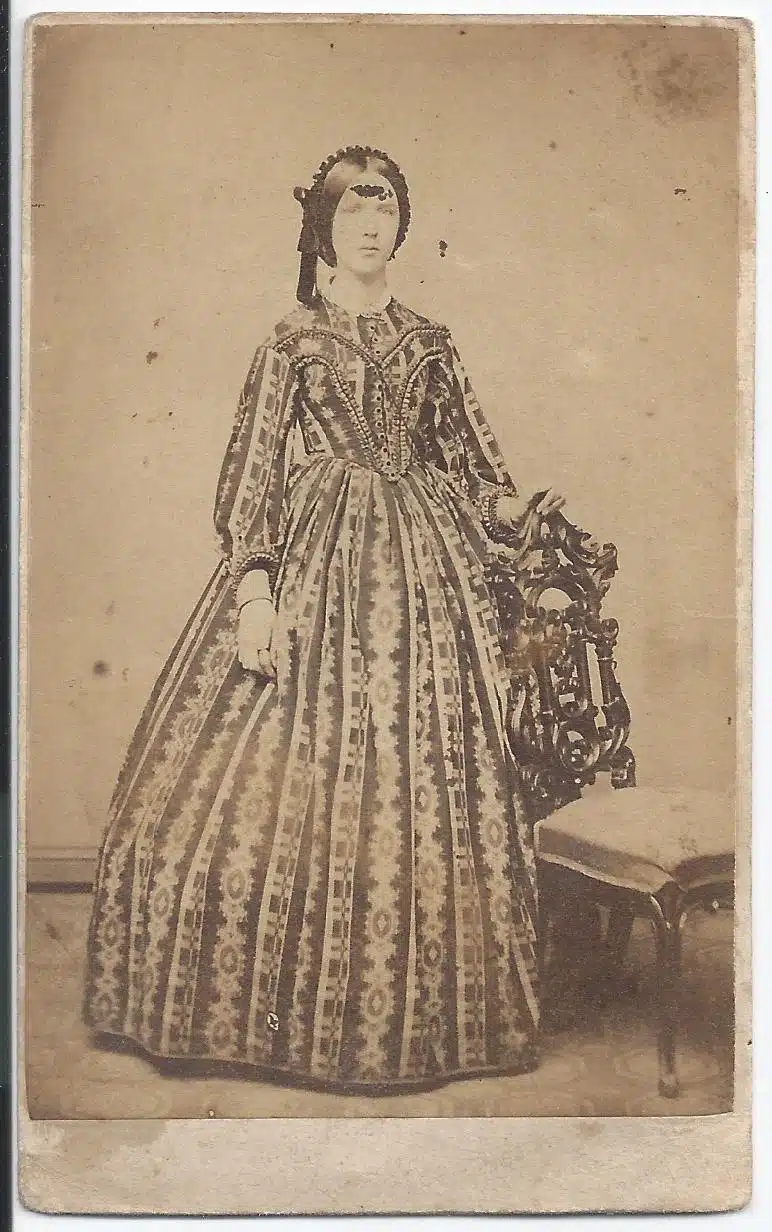
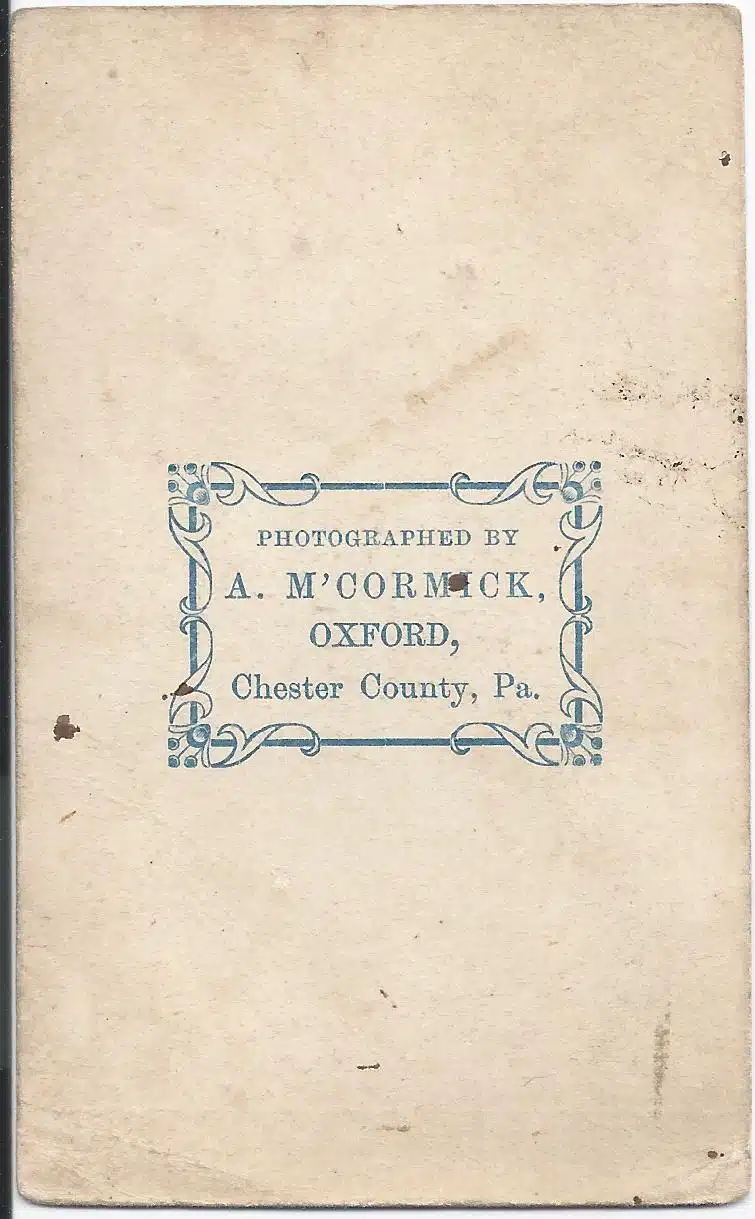
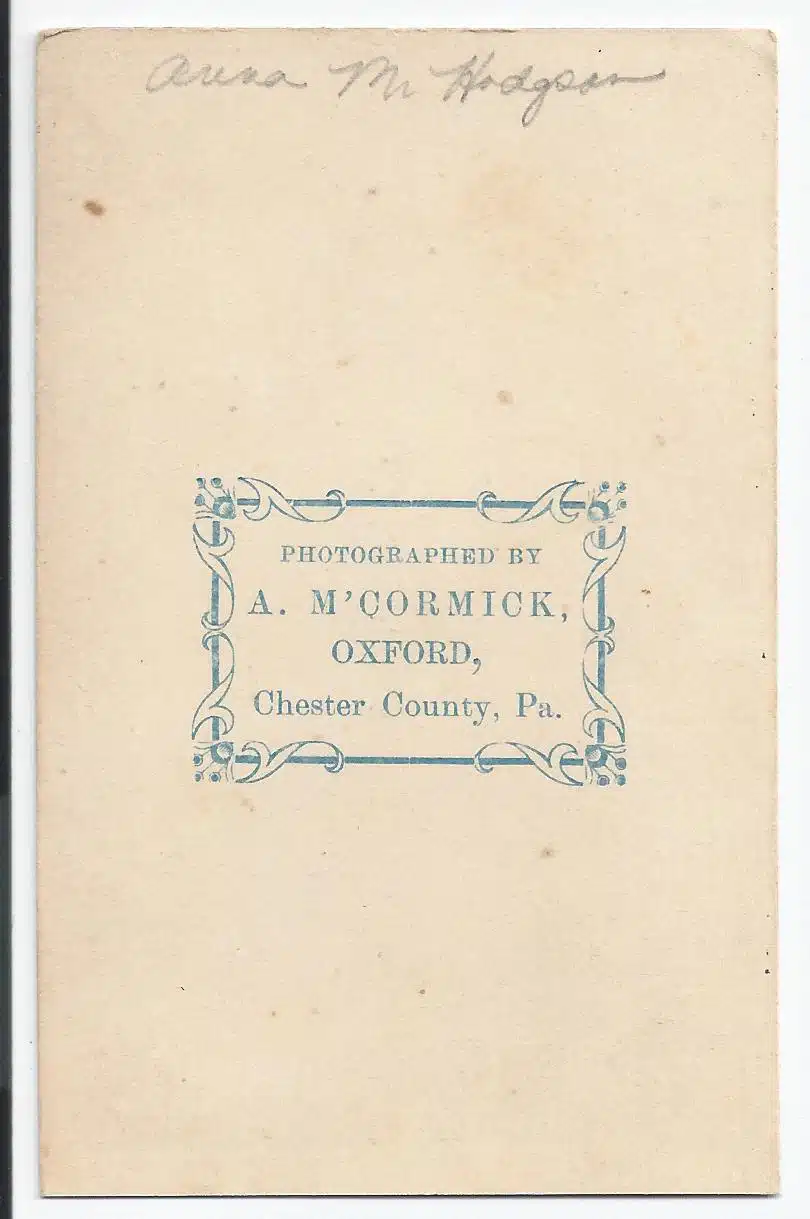
A. M’Cormick, Anna M. Hodgson (born October 1863), albumen carte-de-visite, 1863-1864, collection of the author. [Photo 60]. Note the absence of the small ‘c’ in the artist’s name.

A. McCormick, Unidentified Young Woman, 1865, albumen carte-de-visite, collection of the author. [Album123 pg. 40] Note residue where tax stamp was formerly affixed.


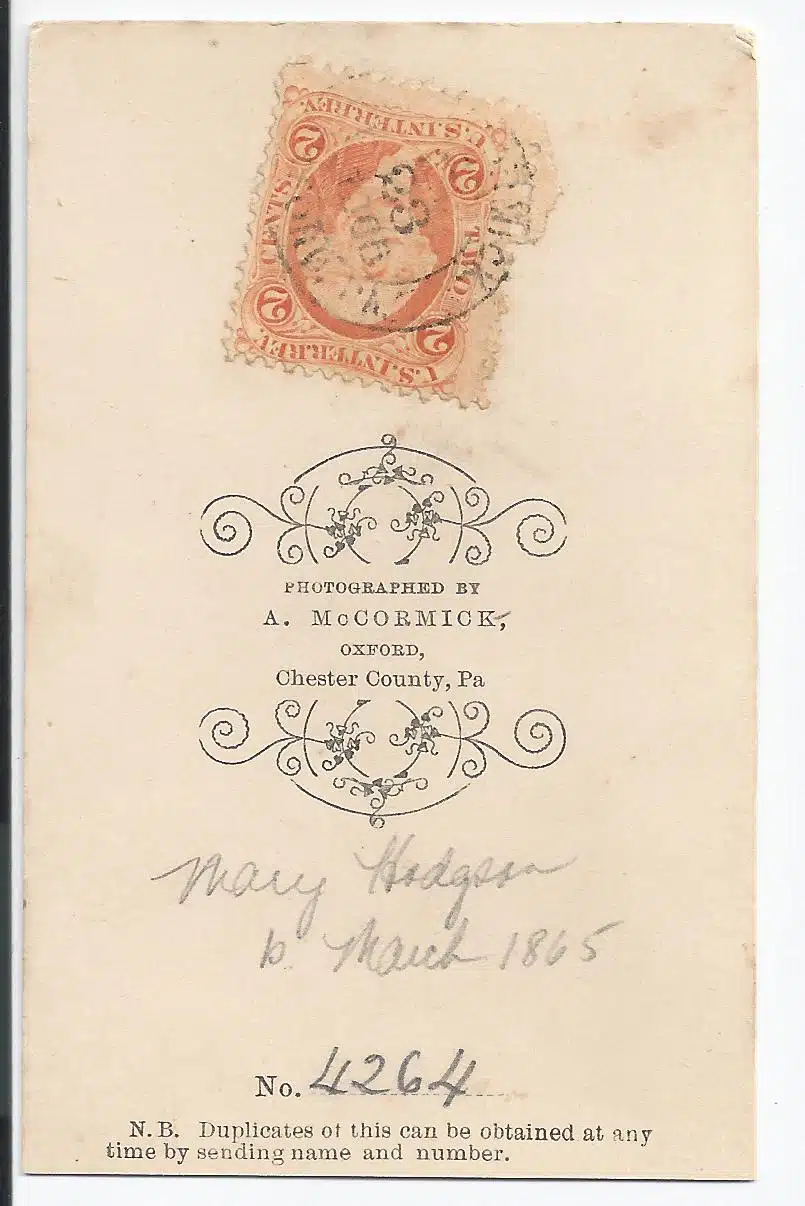
A. McCormick, Mary Hodgson, albumen carte-de-visite, 1865, collection of the author. [Photo 61] Note the IRS tax stamp dated 1865.
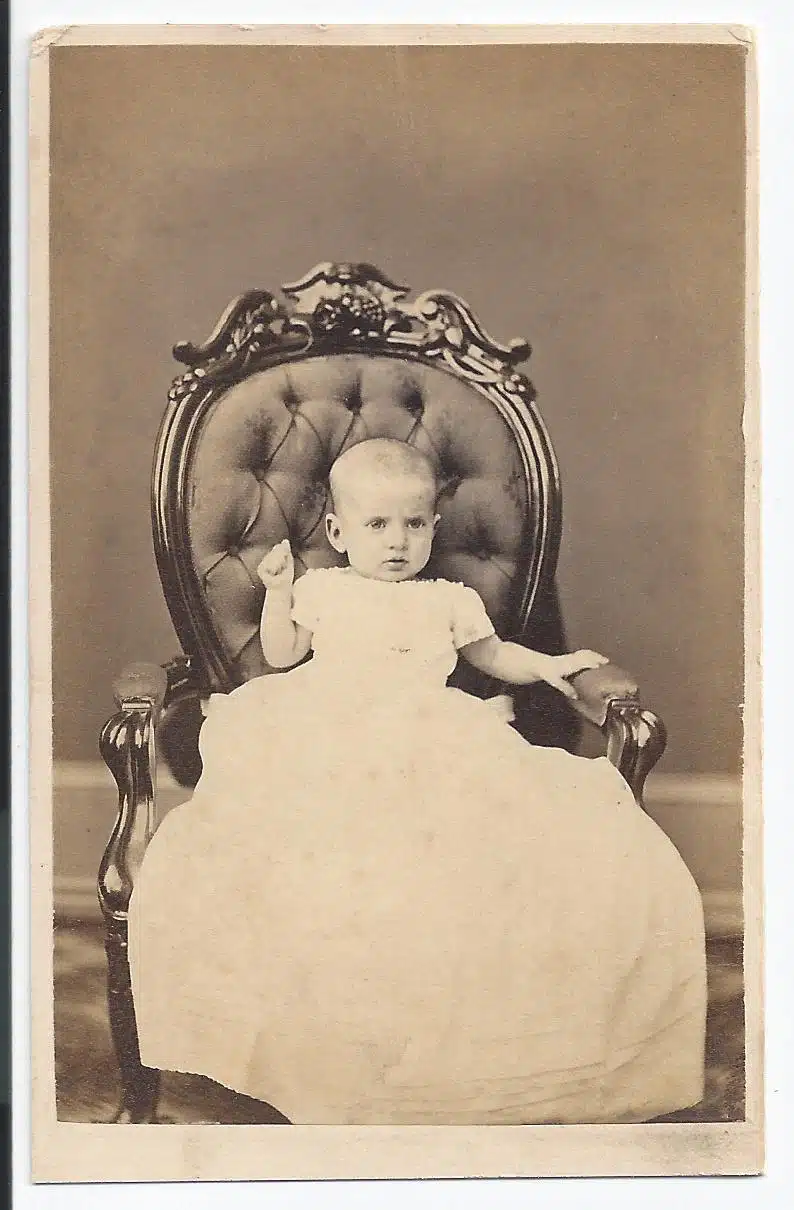
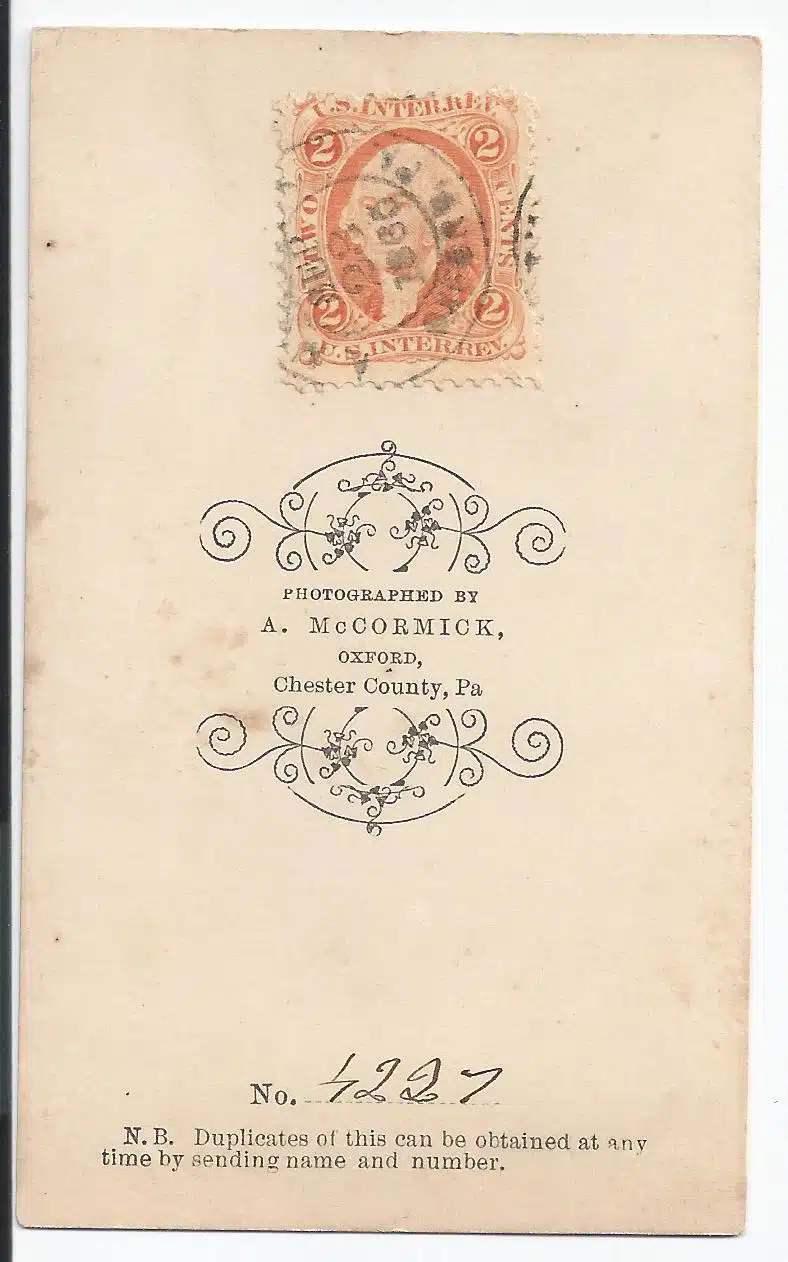
A. McCormick, Unidentified Young Girl, albumen carte-de-visite, September 23, 1865, collection of the author. [Photo 63] Note the IRS tax stamp dated September 23, 1865.

A. McCormick, Architectural drawing of proposed Oxford Presbyterian Church, ca. 1866, albumen carte-de-visite, collection of the author. This CDV may have been used as a fund raiser for the new church. [Album123 page 1]
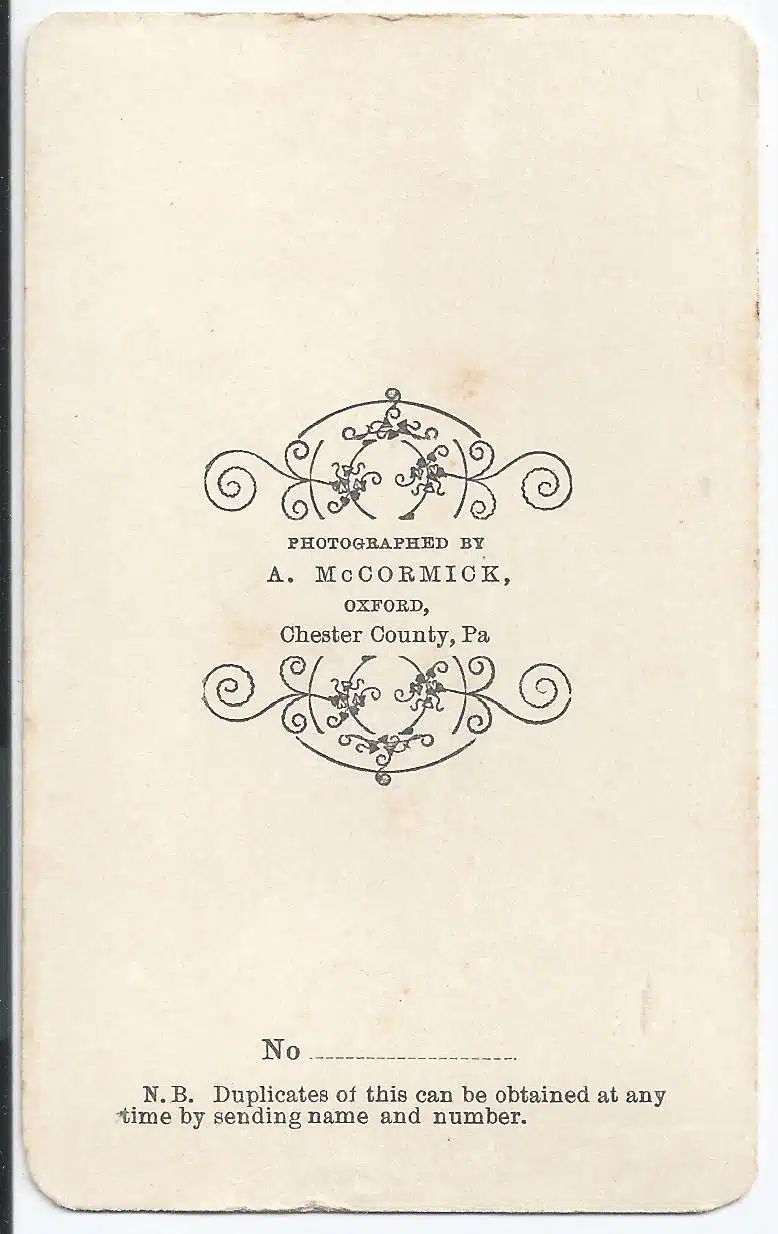
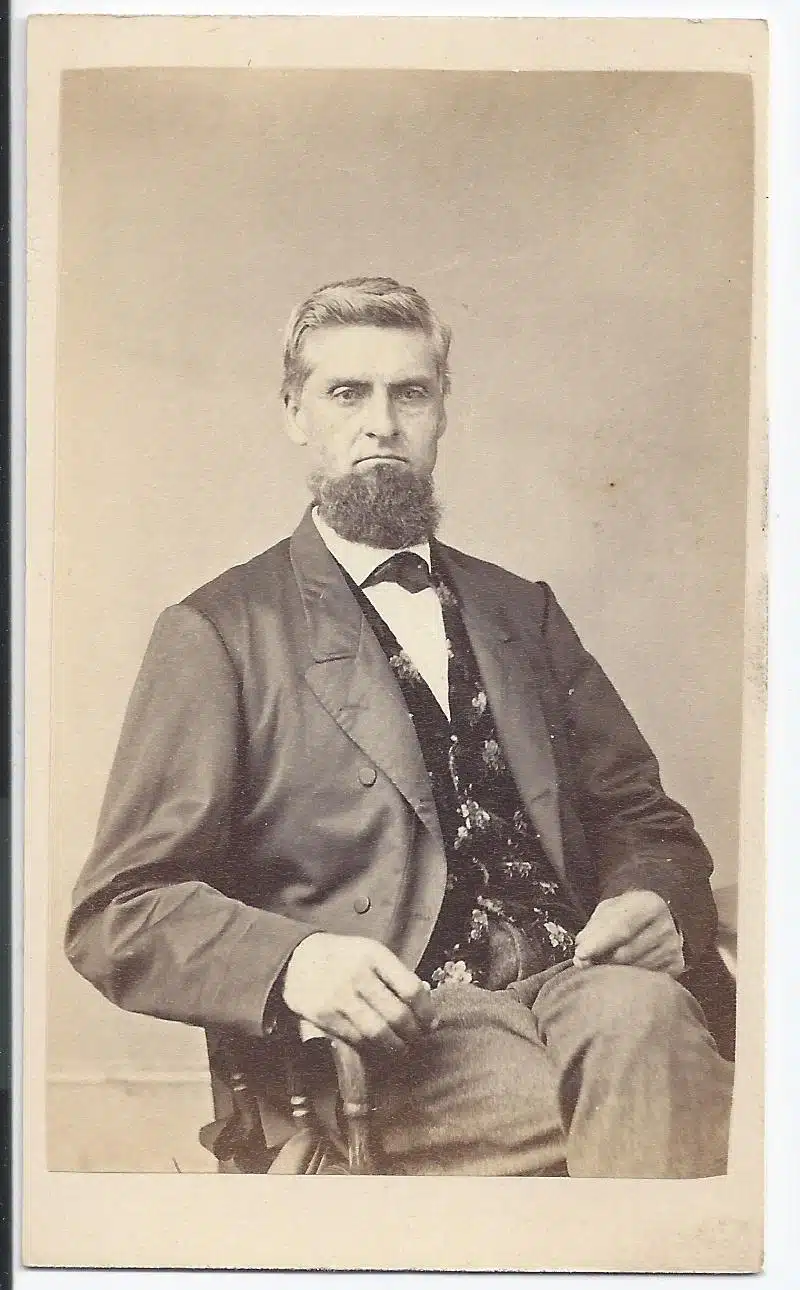
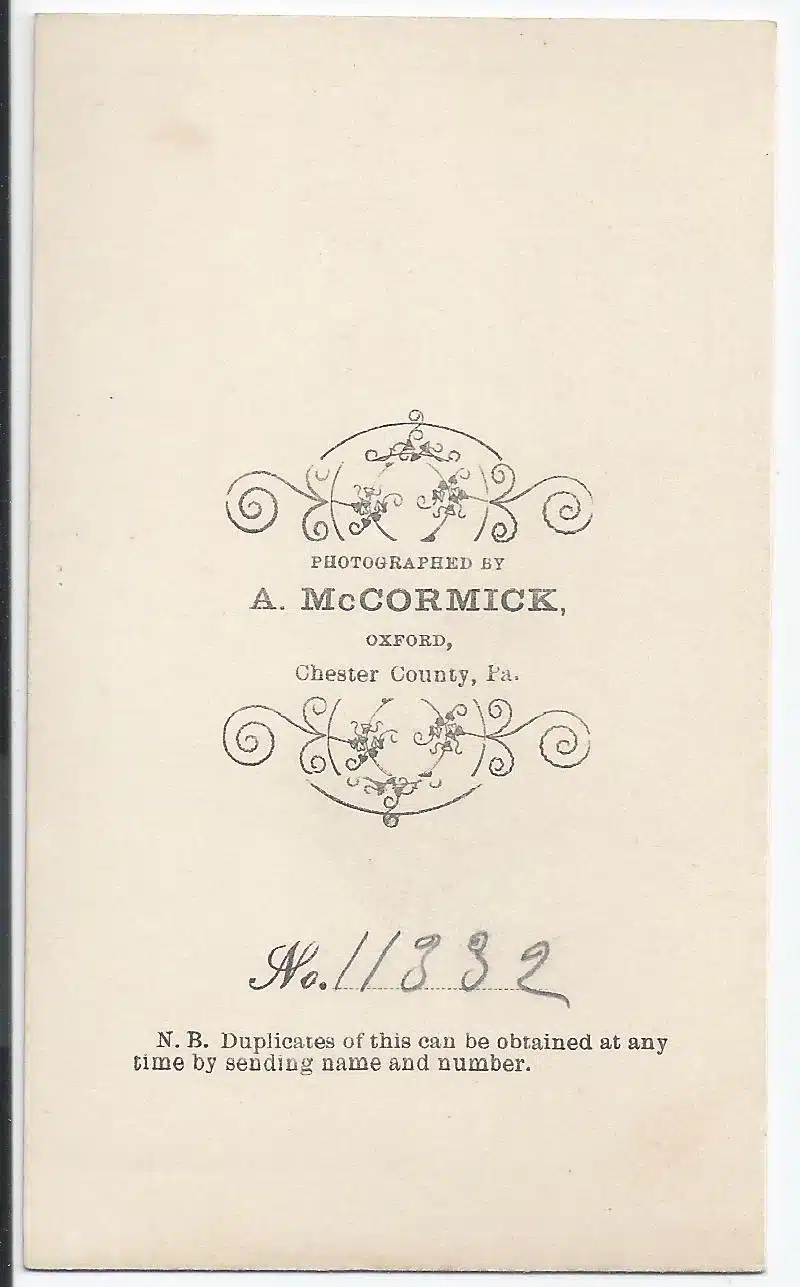
A. McCormick, Unidentified Seated Man with Chin Whiskers, 1866-1869, albumen carte-de-visite, collection of the author. [Album 123 p 18 ]. Note the negative #11332.
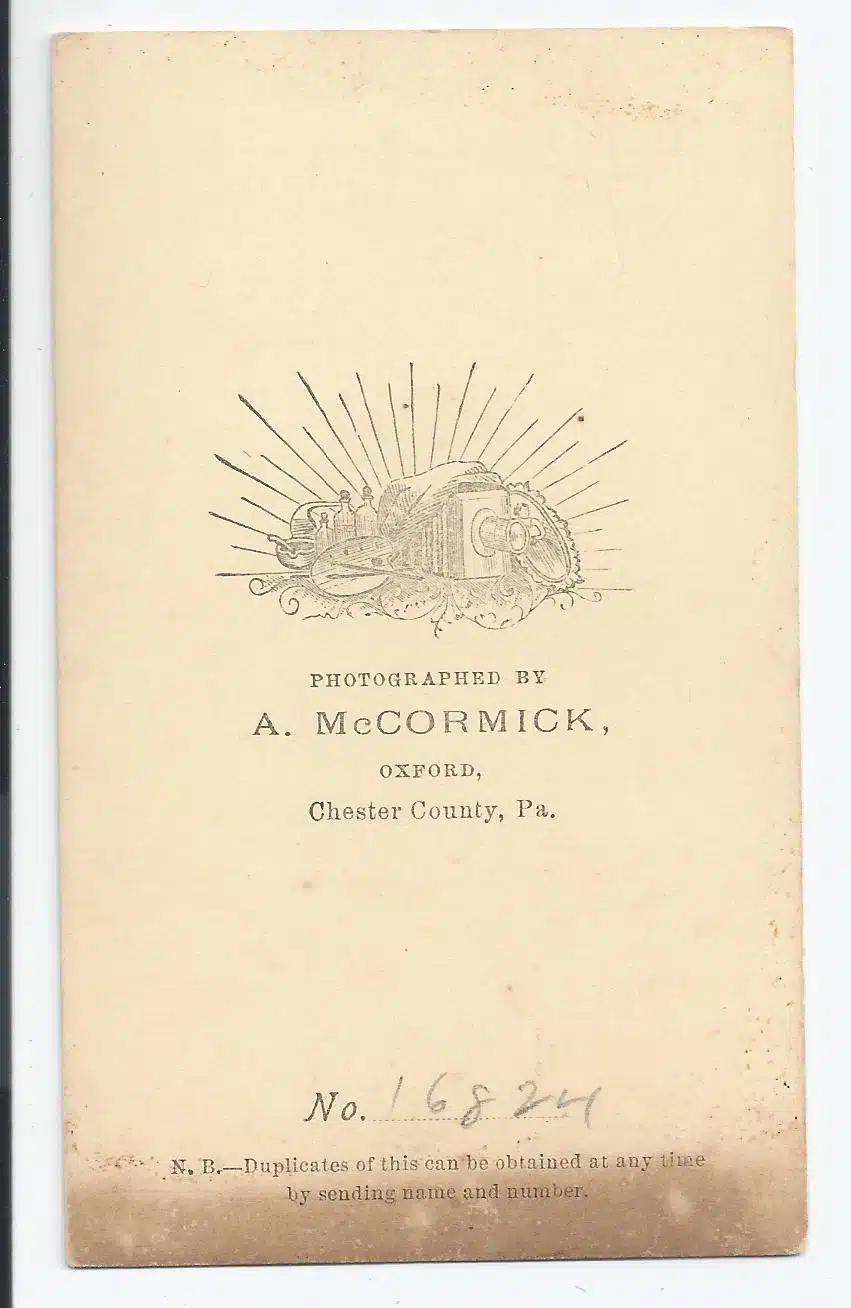
A. McCormick, Unidentified Couple, albumen carte-de-visite, ca. 1870, collection of the author. Note the yellow card stock. [Photo45]

A. McCormick, Mary Sylvannia Lantz, albumen carte-de-visite, ca. 1875, collection of the author. [Photo 46]. Note the card stock has a pink cast.


A. McCormick, Unidentified Couple, albumen cabinet card, 1880s, collection of the author. [Photo 108]. Note the hand stamped imprint on this cabinet card.

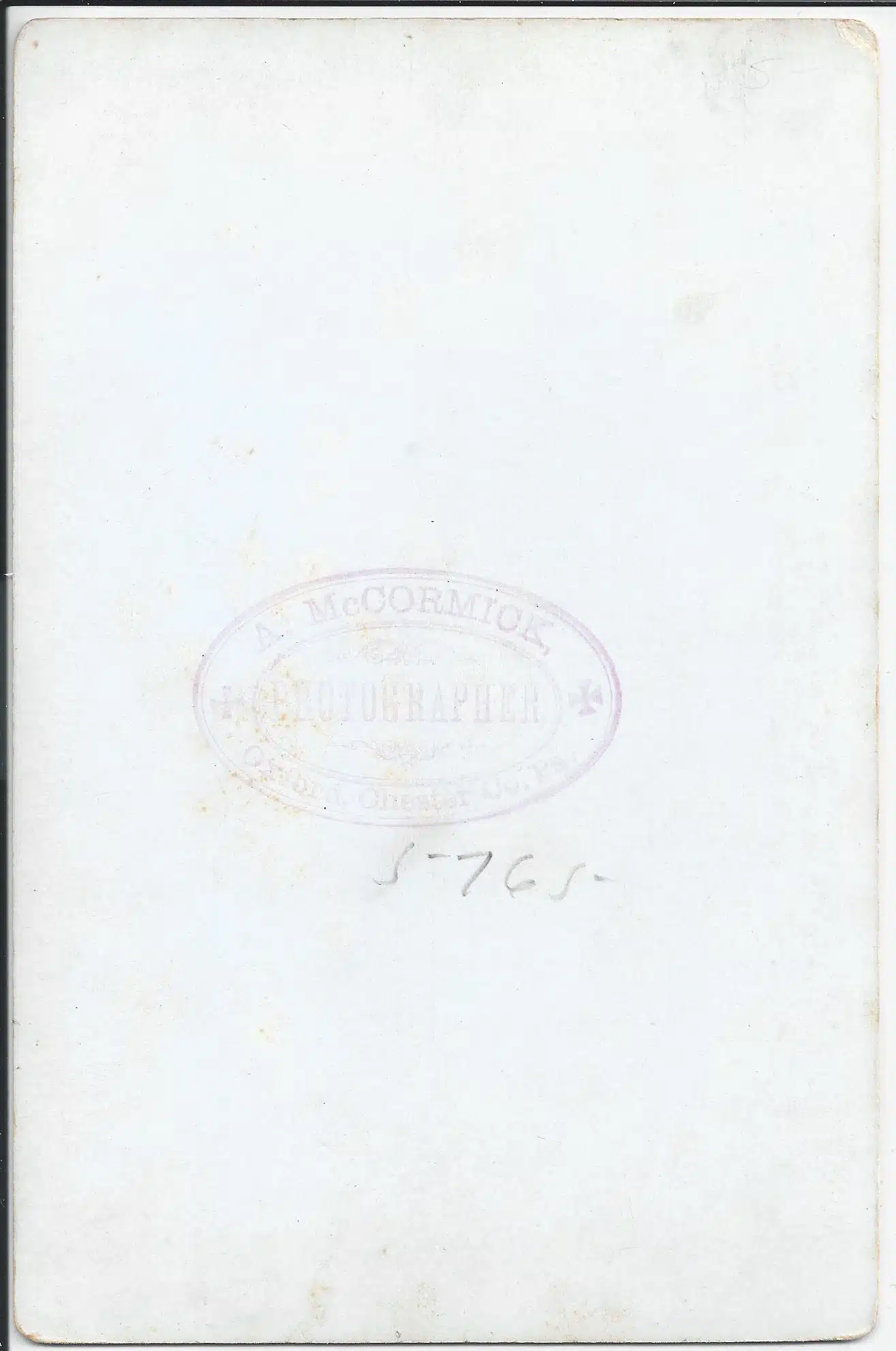
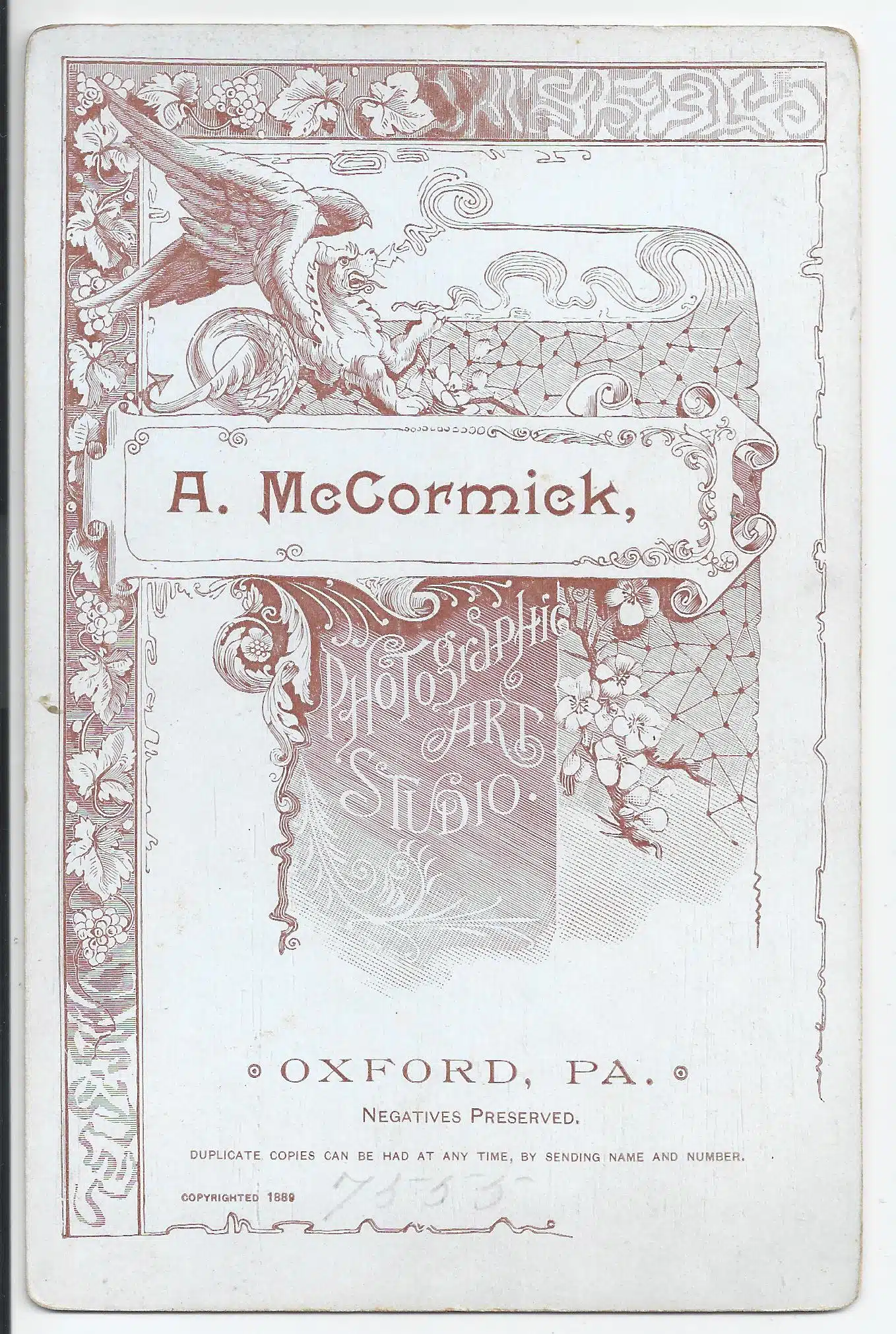
McCormick’s copyrighted 1889 imprint on his cabinet card.
- [1] Poor School Children, East Nottingham Township Tax List, 1836, Chester County Archives and Records Services, West Chester, PA.
- [2] Jesse McCormick Administration papers 1842, Will file #10332, Chester County Archives & Records Services, West Chester, PA
- [3] Oxford Press, (Oxford, PA), 21 November 1895.
- [4] John S. Craig, George Smith Cook, Craig’s Daguerreian Registry, Daguerreian Registry Home Page (craigcamera.com)
- [5] Oxford Tax List 1863, Chester County Pennsylvania Tax Records, Chester County Archives and Records Services, West Chester, PA.
- [6] Civil War Draft Registration, MS3012, Library, Chester County History Center, West Chester, PA
- [7] The McCormick cartes-de-visite taken using a background are those of Elizabeth B. Passmore (CDV1380); George B. Passmore (CDV1381); Rickey unidentified child (CDV2368); Susan Conard (CDV324).
- [8] Jeffersonian, (West Chester, PA), 27 April 1867.
- [9] Oxford Press, (Oxford, PA), 11 April 1867.
- [10] Alexander McCormick, Oxford Presbyterian Church, CDV#2305, Photo Archives, Chester County History Center, West Chester, PA.
- [11] Alexander McCormick, Session House, CDV2429, Photo Archives, Chester County History Center, West Chester, PA.
- [12] According to the 1860 Census Nancie Dickey and her sons lived next door to McCormick’s brother Jesse McCormick in Oxford, PA. See: 1860 Census, Oxford Borough, Chester, Pennsylvania, page 74.
- [13] David D. Dickey (1822-1856) was part of the Dickey family that founded the industries of Oxford. He married his distant cousin, Nancie Wilson. Dickey was very active in Whig politics, temperance, abolition and Sunday Schools. He collected funds to pay the legal expenses in the Rachel Parker kidnapping case. He became a regular correspondent for the Village Record newspaper in West Chester between 1851 and 1856. Under the pseudonym of Toby he wrote articles on everything from politics to farm news. Upon his death from typhoid fever in 1856 he was the first burial in the Oxford Cemetery he helped to found. See: John Bradley, The Dickey Family and the Growth of Oxford and Hopewell, 1990.
- [14] Deed James R. Ramsey & Nancie Wilson Dickey to Samuel J. Dickey & Ebenezer J. Dickey, March 16, 1859, Chester County, Pennsylvania Deed Book K Series 6 Volume 132, pages 379-381, Chester County Archives & Records Services, West Chester, PA.
- [15] George D. Hayes Obituary, The Oxford Press (Oxford, PA), 5 May 1898.
- [16] Year: 1870; Census Place: Oxford, Chester, Pennsylvania; Roll: M593_1324; Page: 388B; Family History Library Film: 552823.
- [17] Oxford Press, (Oxford, PA), 13 March 1872.
- [18] Samuel Alexander, comp., Chester County, PA., Business Directory containing the Names, Business and Address for the Merchants, Manufacturers and Professional Men throughout the County… 1870-1871. Albany, New York: Andrew Boyd, 1870.
- [19] This advertisement appeared in the Oxford Press between 20 November 1872 and May 14, 1873
- [20] American Republican, (West Chester, PA) 11 February 1873.
- [21] Alexander McCormick, Ezekiel West, CDV2143, Photo Archives, Chester County History Center, West Chester, PA.
- [22] Daily Local News (West Chester, PA) 6 February 1873.
- [23] Account book, the Oxford Press, 1875-1878, page 232; 1887-1891, page 358, Library, Chester County History Center, West Chester, PA.
- [24] Alexander McCormick, Birds’-eye-views of Oxford, PH62, Photo Archives, Chester County History Center, West Chester, PA.
- [25] Oxford Press, (Oxford, PA) 13 October 1869.
- [26] Newspaper clippings file: Oxford Organizations: Oxford Library, Chester County History Center library, West Chester, PA.
- [27] Oxford Press, (Oxford, PA), 20 December 1876 and 27 December 1876.
- [28] Oxford Press, (Oxford, PA), 2 March 1870.
- [29] Oxford Press, (Oxford, PA), 30 March 1870.
- [30] Account book, The Oxford Press, October 27, 1875, page 232, Library, Chester County History Center, West Chester, PA.
- [31] Oxford Press, (Oxford, PA), 2 April 1879; 16 March 1881; 22 March 1882; 16 March 1893; 19 March 1896; Morning Republican, (West Chester, PA), 29 April 1897.
- [32] Oxford Press, (Oxford, PA), 18 February 1880.
- [33] Daily Local News, (West Chester, PA), 7 October 1891.
- [34] Letter, Thomas A. Urbine, Jr. to F. McCormick Moore, January 28, 1976, Thomas A. Urbine, Jr. Collection, Box 9 File 151, Library, Chester County History Center, West Chester, PA. See also: Daily Local News, (West Chester, PA), 21 June 1887.
- [35] Board of Trade, Oxford, a representative Pennsylvania Borough, (Oxford, PA: The Oxford Press, 1894), p. 70.
- [36] The Oxford Press, (Oxford, PA), 6 January 1892.
- [37] Tax List 1892, Oxford Borough, Chester County, PA. Chester County Archives and Records Services, West Chester, PA.
- [38] Oxford Press, (Oxford, PA), 6 September 1893.
- [39] Oxford Press, (Oxford, PA), 21 November 1895.
- [40] Oxford Press, (Oxford, PA), 9 September 1897.
- [41] Year: 1900; Census Place: Oxford, Chester, Pennsylvania; Page 3; Enumeration District:0086: Family History Library microfilm: 1241393.
- [42] Board of Trade, Oxford, a representative Pennsylvania Borough, (Oxford, PA: The Oxford Press, 1894).
- [43] Death Certificate, Alexander McCormick, 1907.
- [44] Daily Local News, (West Chester, PA), 15 August 1907.
- [45] Daily Local News, (West Chester, PA), 19 August 1907.
- [46] Daily Local News, (west Chester, PA) 15, August 1907.
- [47] Twenty-five years ago column, Oxford Press, (Oxford, PA), 31 August 1933.
- [48] Alexander McCormick Estate, December 1908, Chester County, Pennsylvania Orphan’s Court Files #8818, Chester County Archives & Records Services, West Chester, PA.