C. Alfred Garrett – Part 2
( 1840 – 1891 )
Studios in New Jersey & Pennsylvania
C. Alfred Garrett came from a family of Wilmington, Delaware photographers that included his father, aunt, and two younger brothers. After learning the art from his father, he struck out on his own, operating studios in Louisville, Kentucky (1860-1861), Salem, New Jersey (1863-64), West Chester, Pennsylvania (1864-1871) and Philadelphia (1871-1881). He also traveled to Yosemite California with his brother Maurice to make views. This is the second chapter in his biography covering his studios in New Jersey and Pennsylvania.
At the close of his military service in 1863, Garrett opened his own photograph studio in Salem, New Jersey. Here he made cartes-de-visite on Fenwick St., above Rumsey’s Building in Salem, New Jersey[1].
C. A. Garrett, Standing portrait of a young man, ca. 1863, albumen carte-de-visite, Salem, New Jersey. From the collection of Pamela C. Powell, Photo 192.


Why would Garrett choose Salem as a location for his gallery? Salem was located in New Jersey just across the Delaware River from Wilmington, and just three miles from the mouth of the Salem River. Salem had been established as an early port town and had an active ship building industry. In 1863 when Garrett came to town the first railroad was established, connecting the port to Camden, Philadelphia and New York. A lucrative glass blowing business, Salem Glass Works had just opened its doors. Salem was an up-and-coming town for establishing a new photograph gallery.
Garrett’s life took a new direction in 1864 when he married Sarah Sutton Hendrickson on June the second in a Presbyterian service in Wilmington, Delaware[2]. The couple moved in December of 1864 to West Chester, Pennsylvania where Alfred opened a studio over George F. Worrall’s bookstore at 7 E. Gay Street[3].
Advertisement from The Village Record, December 13, 1864. Courtesy of Chester County History Center, West Chester, PA.

Here he continued to use his carte-de-visite mounts, pasting a label over “Salem, New Jersey” with his new town location. The author has seen other examples where Salem was crossed out and West Chester, PA was written in by hand.
C.A. Garrett, Verso, 1866, albumen carte-de-visite with tax stamp inscribed: CAG 66. Note the pasted over label for his new West Chester location. From the collection of Pamela C. Powell, [Photo 139]
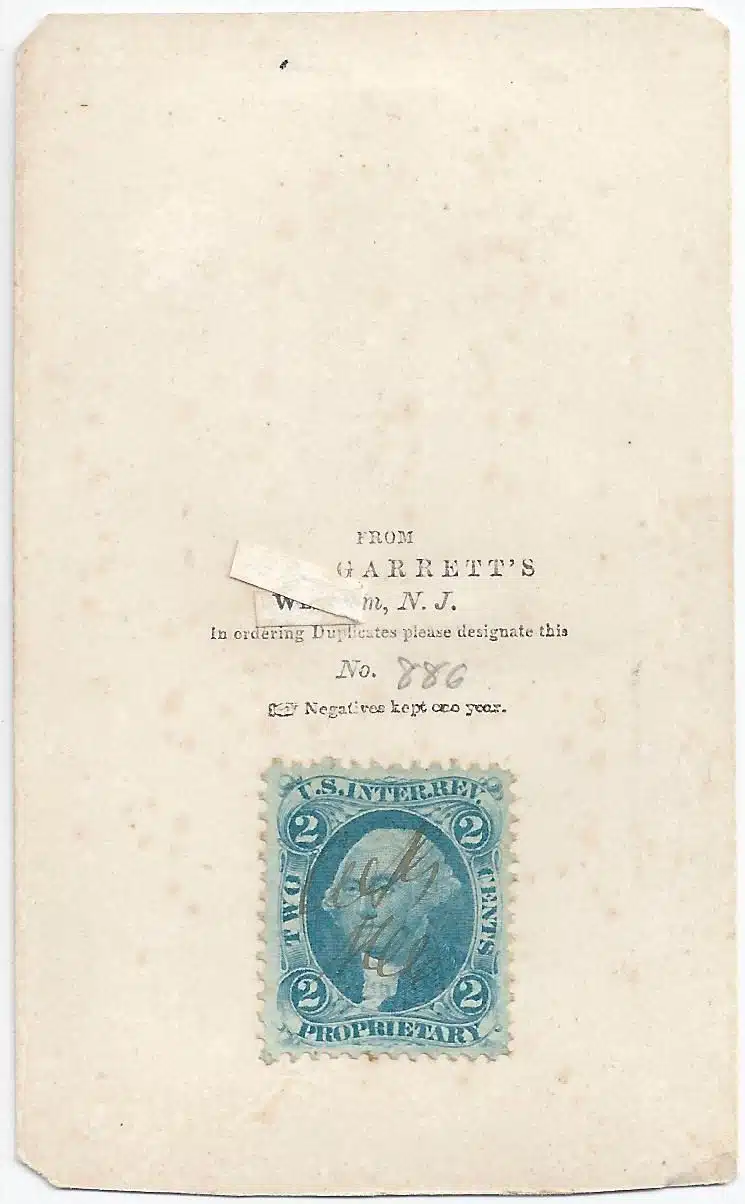
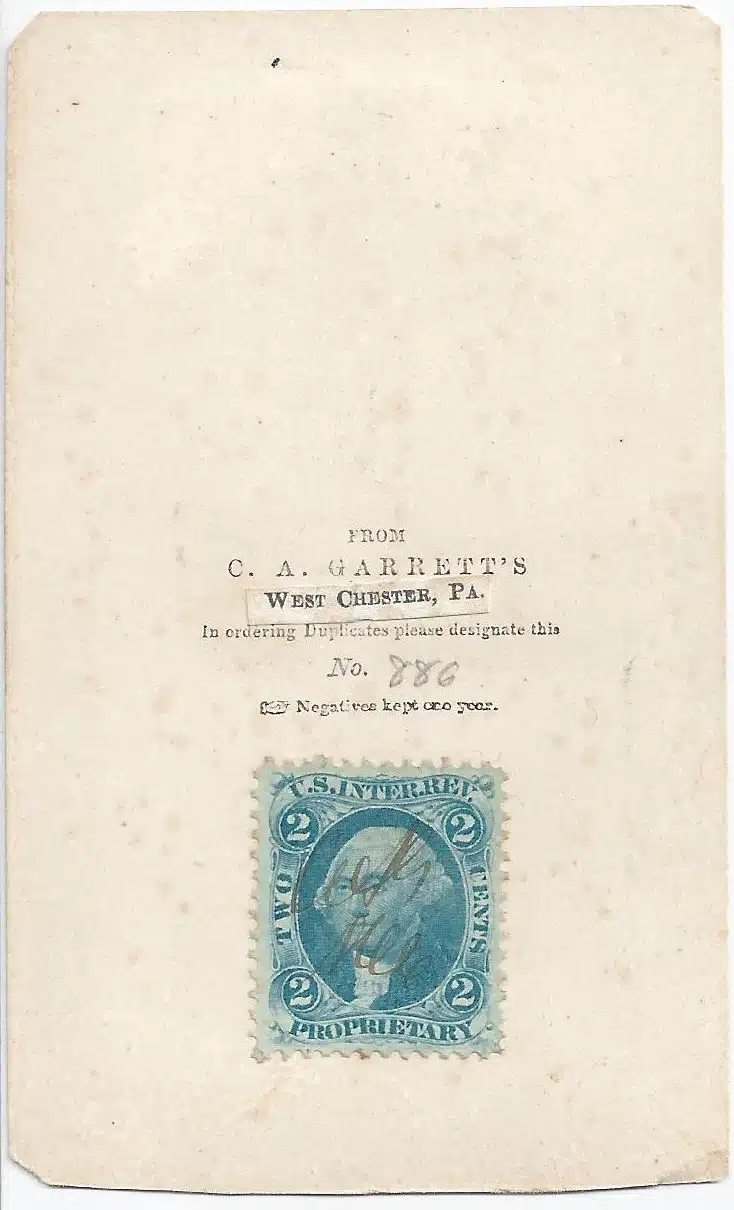
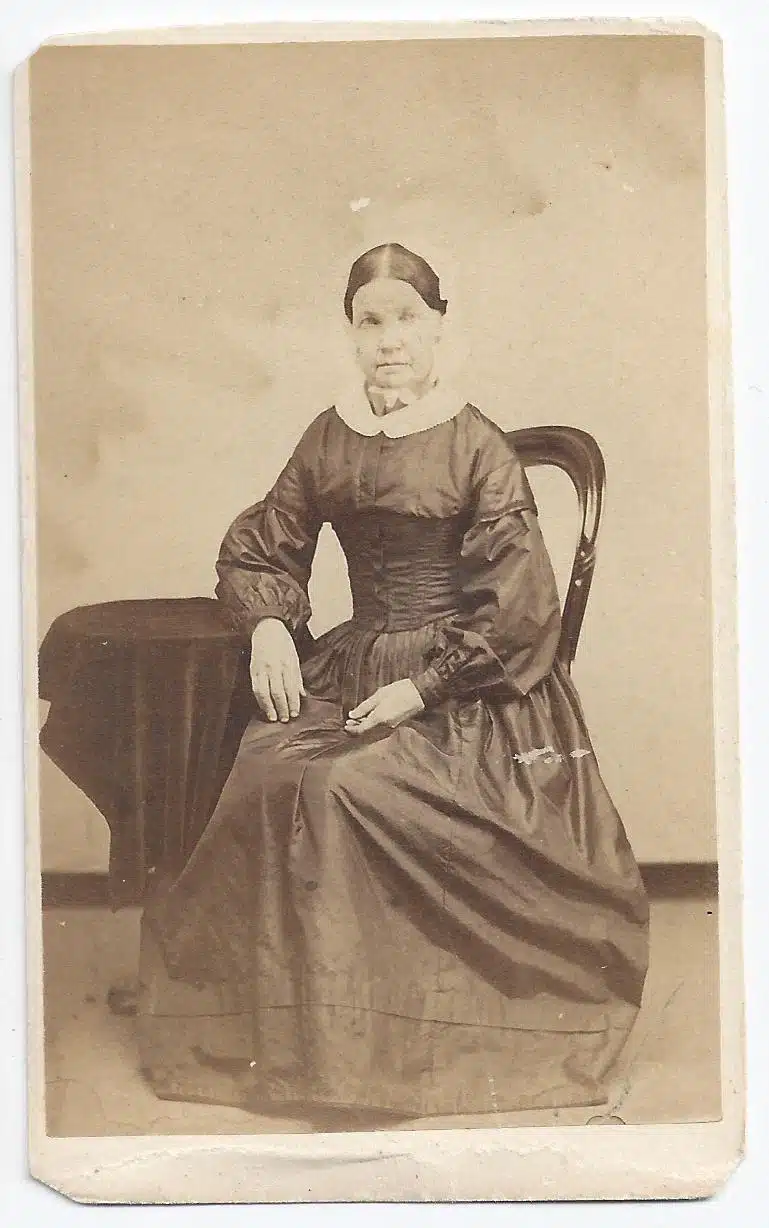
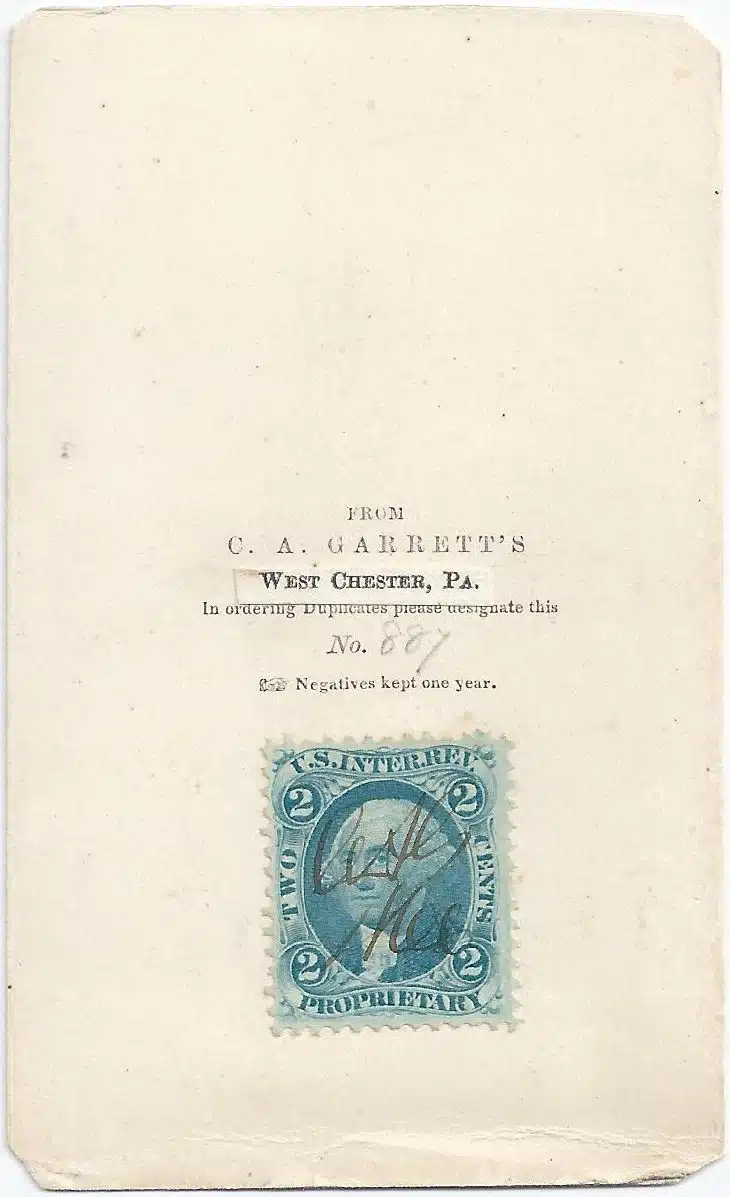
C.A. Garrett, Martha Haines Darlington, 1866, albumen carte-de-visite with tax stamp inscribed: C.A.G. 66. From the collection of Pamela C. Powell, [Photo 140] Verso, note “West Chester, PA.” label glued on the back.
West Chester offered the young photographer an upscale community at this county seat. The town hosted advanced schools for young men and women, banking and legal services, and a brisk retail economy. He knew that his aunt, Sally Hewes, in partnership with Samuel Broadbent, had operated a daguerreotype studio in West Chester in 1850.
Among his services he advertised making ivorytypes and plain photographs colored in oil, watercolor, India ink or pastels.
C.A. Garrett, Full-length portrait of a young woman, ca. 1865-1866, albumen carte-de-visite with cancelled tax stamp. From the collection of Pamela C. Powell, [Photo 138]
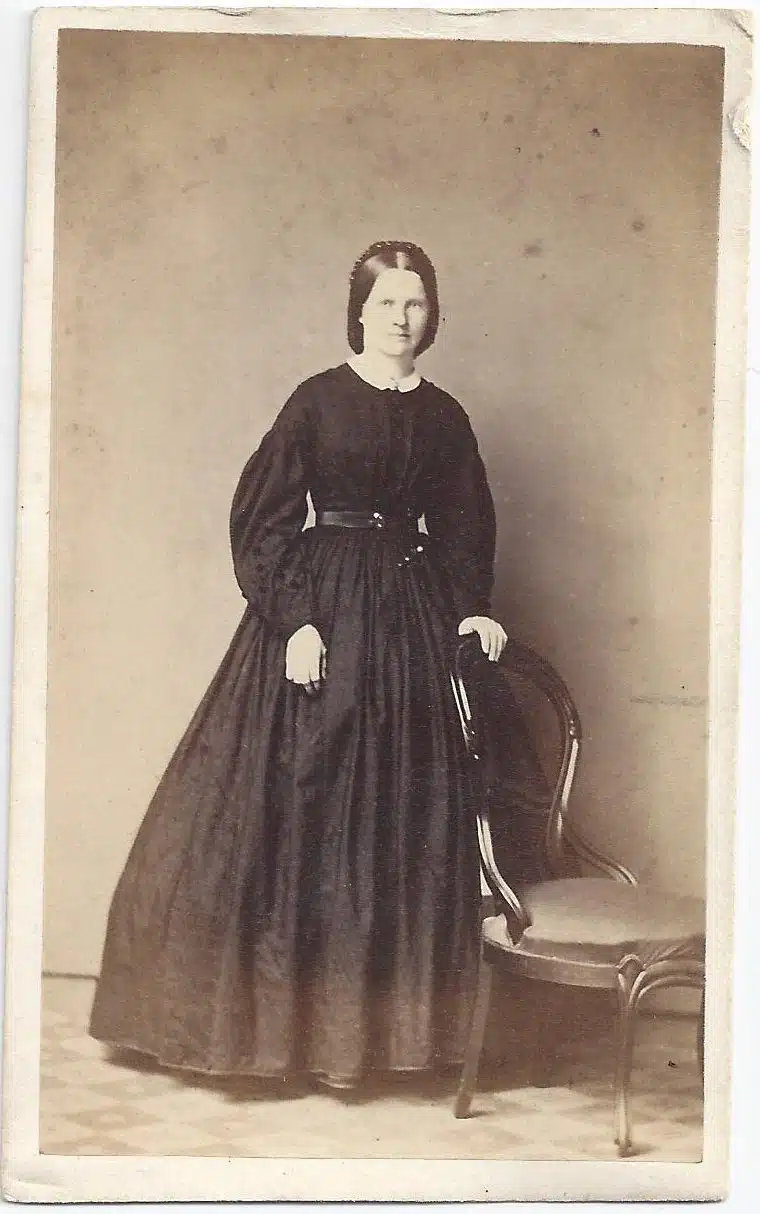
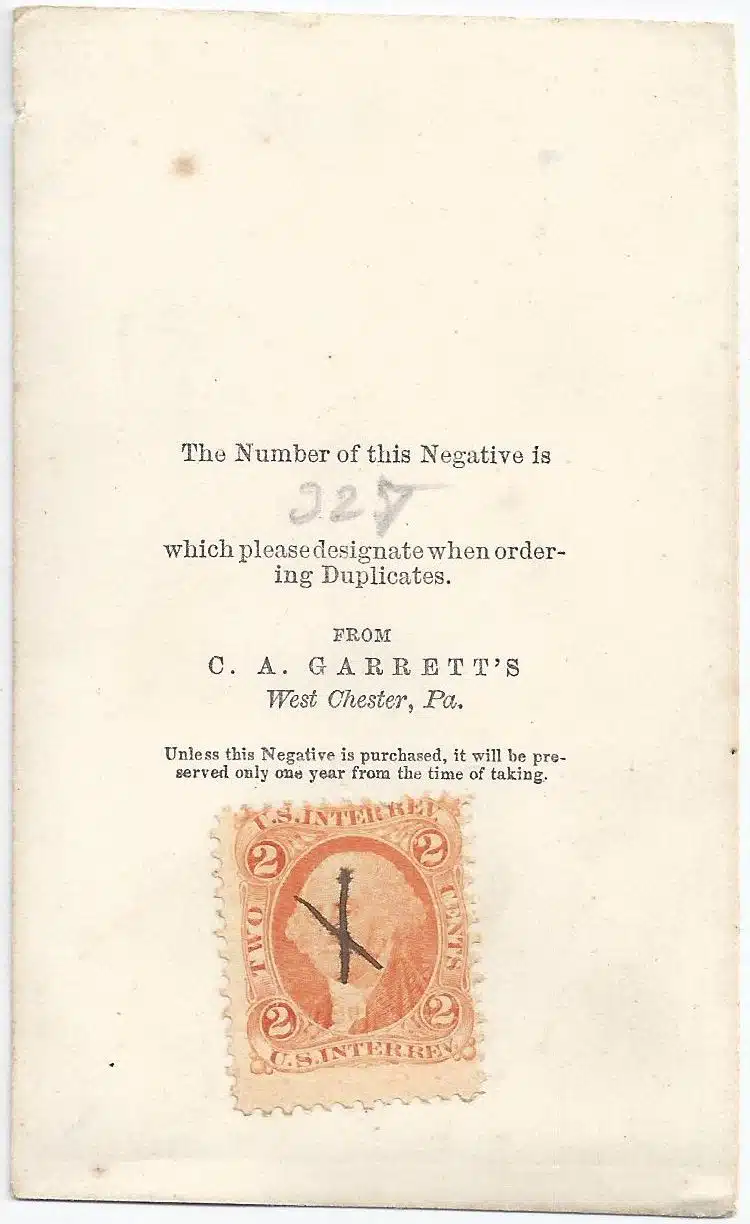
The couple’s first child, Herbert, was born April 17, 1865 and died that same day[4]. Tragedies like this were not uncommon in that time, still hit the couple hard.
He improved his situation in October of 1865 moving his studio above Travilla’s carpet store at 13 W. Gay Street where he had improved skylights and side lights for portraiture[5]. News articles in 1865, remarked about the beauty of his photographs on porcelain[6], as being a new service never before seen in the borough of West Chester.
The couple’s life was improving. According to the 1866 Chester County Tax List, they were living in a 22 ft. dwelling rented from William Everhart on “P. Row.[7]” Today this address would be recognized as portico row, a line of graceful brick townhouses adorned with classical pillars on the three hundred block of West Miner Street[8]. On June 13, 1866, Sarah gave birth to a healthy daughter named Alice[9].
C. A. Garrett, Judge Townsend Haines, (1792-1865), copy photograph, albumen carte-de-visite, courtesy Chester County History Center, West Chester, PA, CDV#745. Note the crossed-out Salem New Jersey address on the card mount.


Garrett was also featured in an article in the Village Record on June 23, 1866 when he executed an outstanding portrait of Judge Haines, a beloved figure who had died recently[10]. Garrett created a life-sized portrait of the judge finished in India ink which the reporter thought worthy of permanent inclusion in the collection of the Chester County Cabinet of Sciences, a local natural history museum. However the portrait was purchased for the sum of $50 by a local lawyer, J.P. Wilson for his private collection[11]. Clearly, he distinguished himself from the competition of the other photographers in West Chester with his artistic enhancement of portraits.
C. A. Garrett, Unidentified Quaker women, ca. 1866, albumen carte-de-visite. from the collection of Pamela C. Powell, [Photo 166]

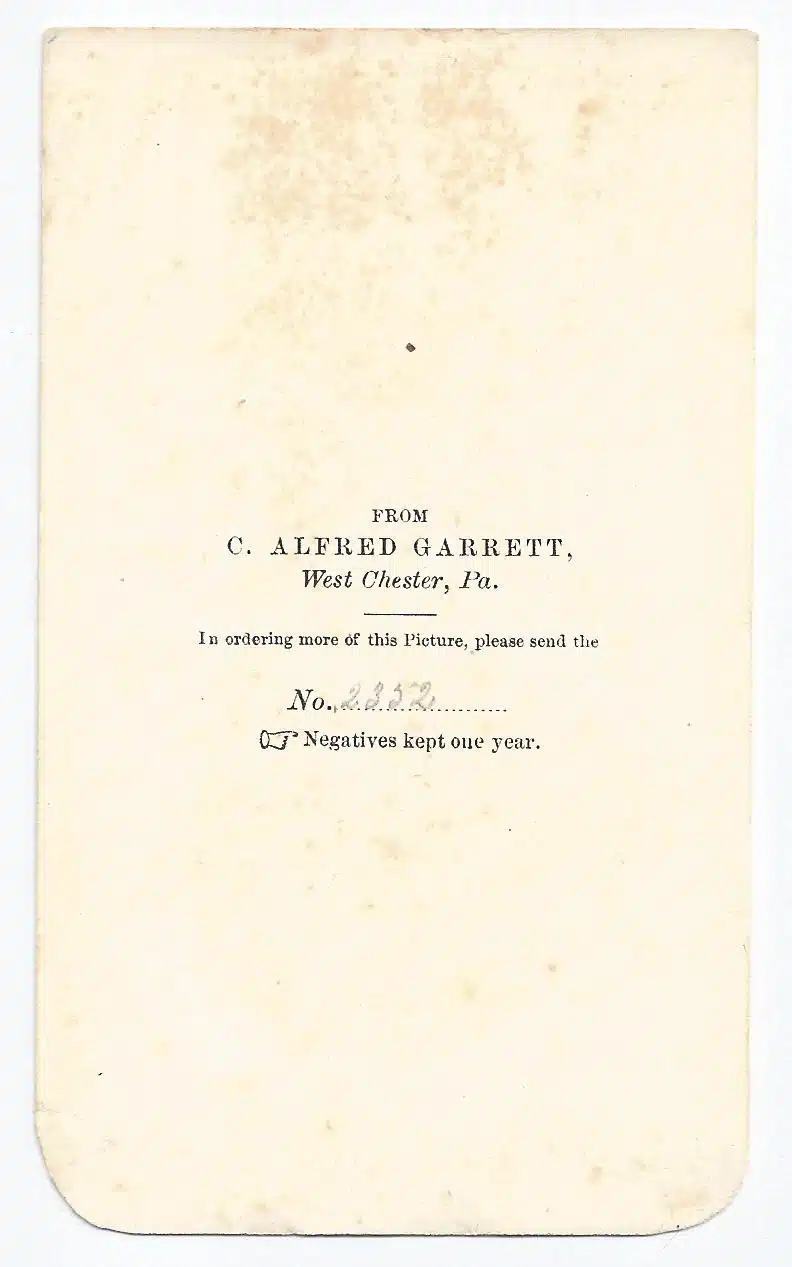
Some of the more unusual cartes-de-visite taken by Garrett in Chester County History Center collection include outdoor views of the Church of the Holy Trinity, the Hickman Fountain, and group photographs of the students at Barnard Street School and High Street Friends School, both of West Chester, PA.
C. A. Garrett, Two African American Women, ca. 1866. albumen carte-de-visite, courtesy of Chester County History Center, West Chester, PA, CDV collection.

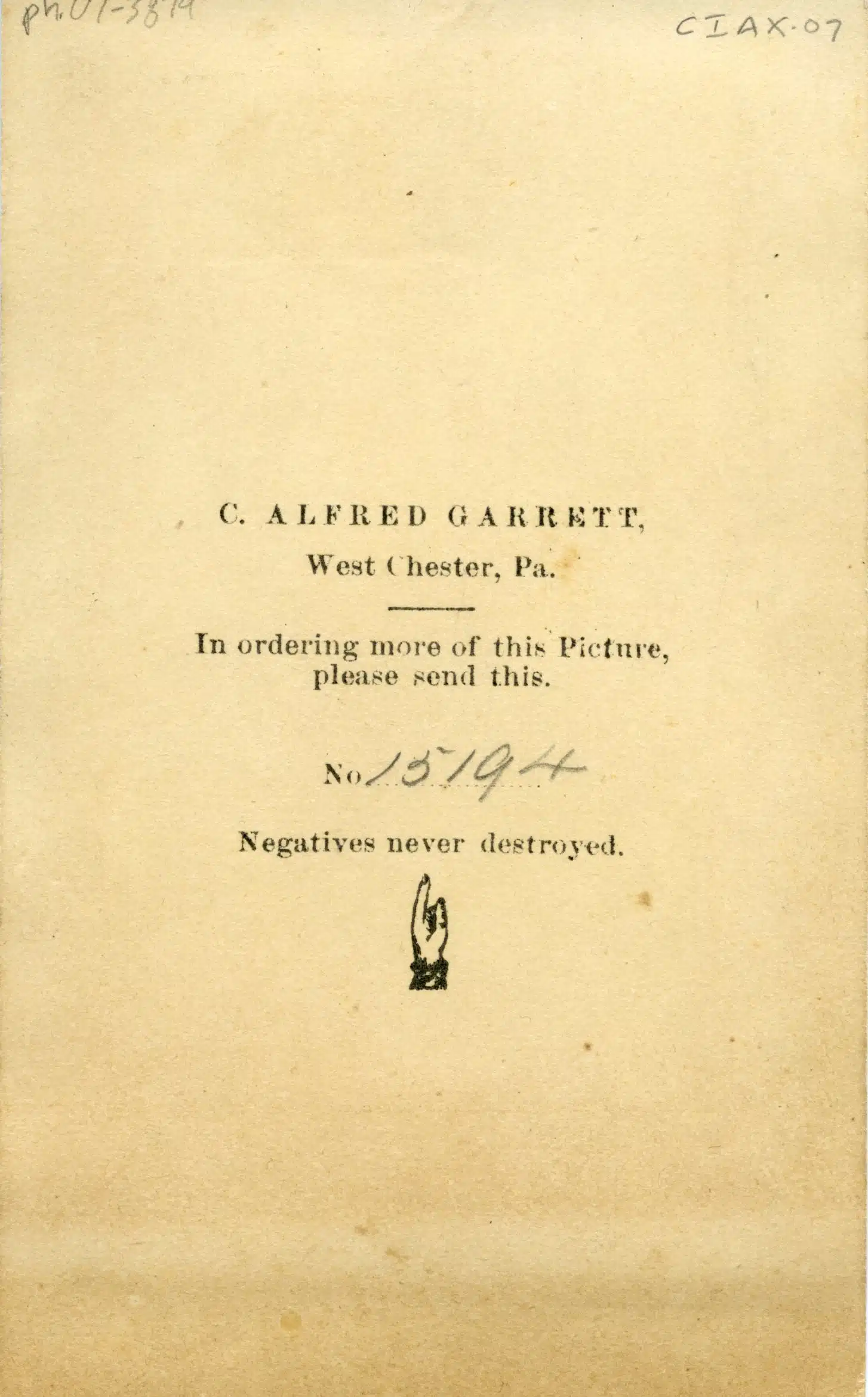
Like his family, Garrett took an active interest in bettering the lives of those who had formerly been enslaved. Volunteers from the Chester County Freedman’s Relief Association met in Garrett’s reception room above Travilla’s store every Thursday from 10 a.m. to 5 p.m. to collect donated clothing beginning in March of 1866[12]. The Chester County branch of the Pennsylvania Freedman’s Relief Association was organized in the fall of 1863 to collect clothing, bedding and funds to support and educate emancipated people in need[13]. In 1865 over 600 garments, some made by underemployed local women were sent for free on the West Chester & Philadelphia Railroad to the Friends Association in Philadelphia for distribution in the south[14]. Lectures were also held to raise money to provide food and education. Garrett’s father was also involved in a Quaker organization providing funding for African American education[15]. He served as President of the African School Society in Wilmington, Delaware from 1885 until his death in 1910[16].
Advertisement, The Jeffersonian, 27 April 1867.
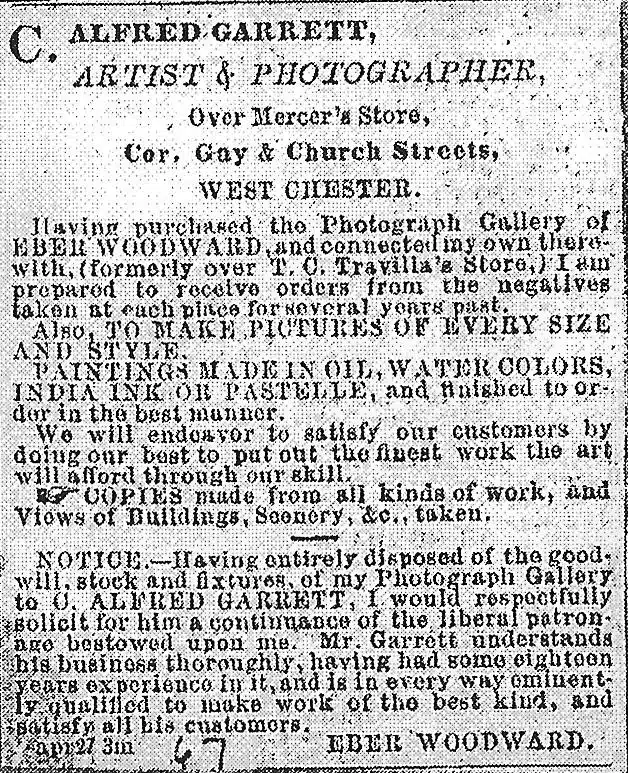
Garrett enriched his business again in April of 1867 when he purchased the long-established studio of Eber Woodward, which included all his equipment and file of negatives. He moved into Woodward’s studio above Mercer’s Store on the prominent northwest corner of Church and Gay Streets. Woodward gave him a glowing endorsement in the April 27, 1867 issue of the Jeffersonian, citing that he had 18 years in the business[17]. Garrett offered to print from the stock of negatives amassed by both studios. A specialty was copying and painting in oil, watercolor, ink, or pastels. For the first time he advertised views of buildings and local scenery.
C. Alfred Garrett, Vignetted portrait of a young man, gem tintype in carte-de-visite mount, 1869. From the collection of Pamela C. Powell. [Photo24] Tintype verso. Note that Anna Maria Mercer sold the Church and Gay street store to B. Tevis Hoopes on March 31, 1869. [Chester County, PA Deed Book P7, Vol. 162, p. 549.]
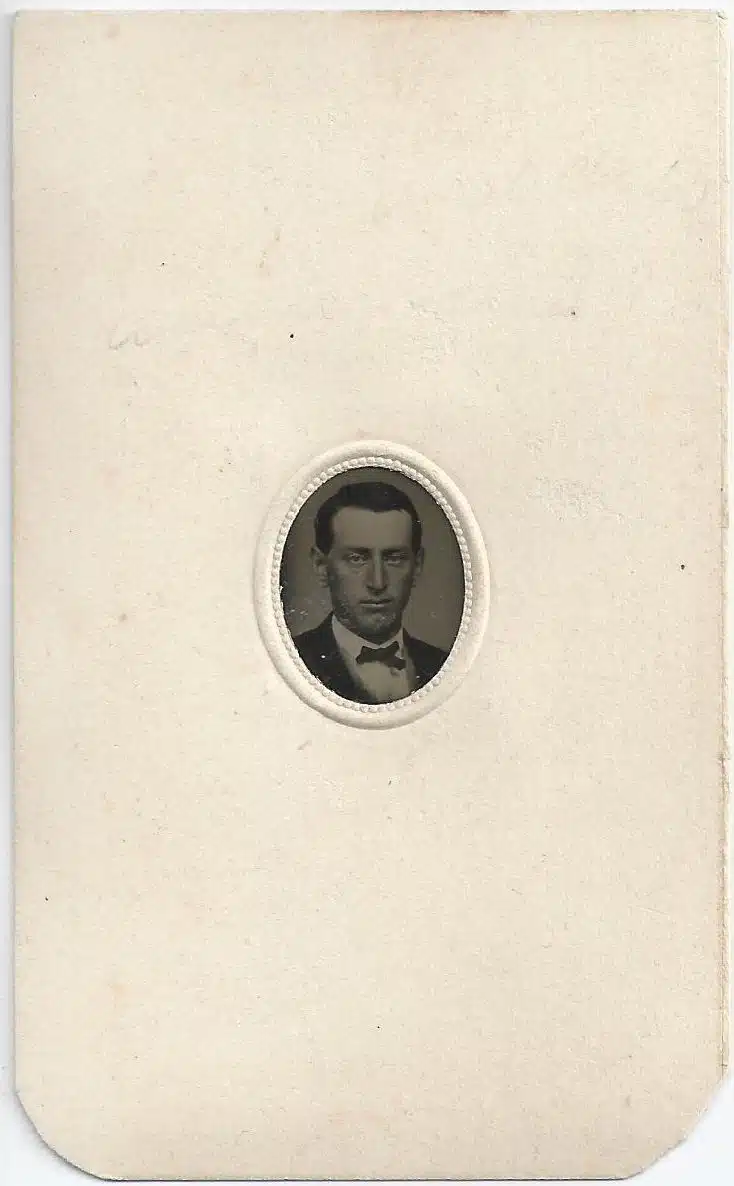
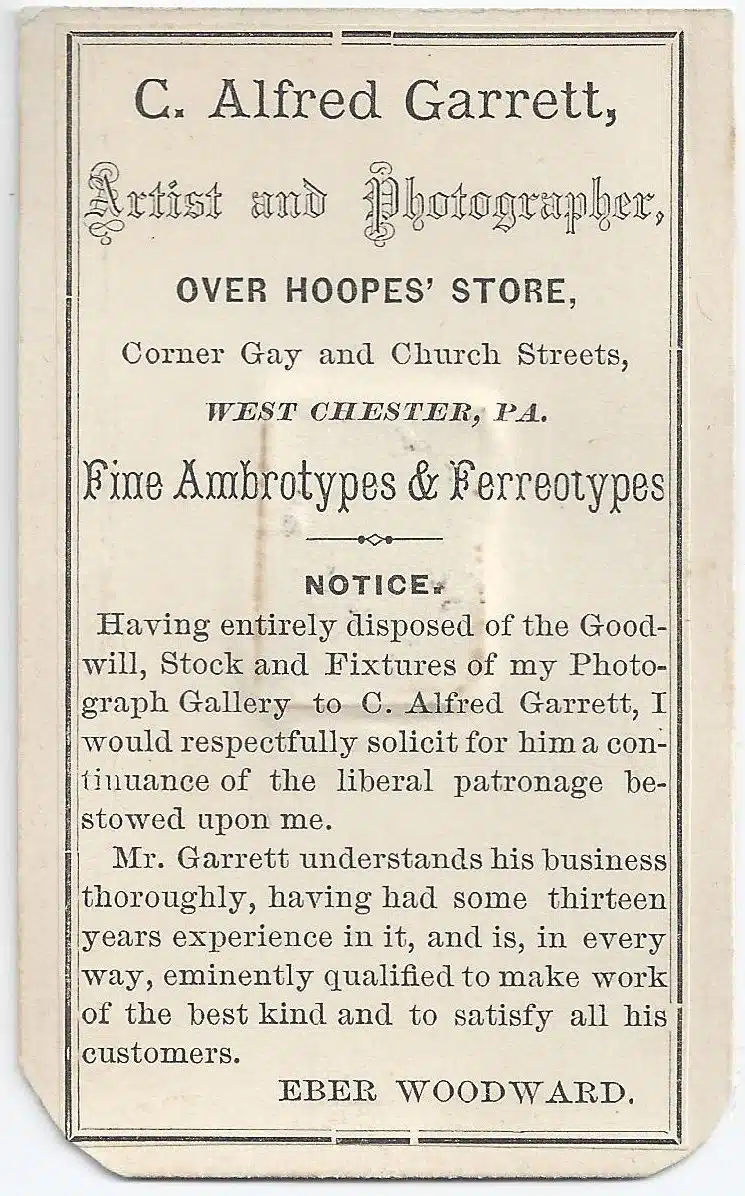
Garrett got a good commission when he was asked to photograph the fiftieth wedding anniversary party of Benjamin and Jane Price. About two hundred people, all descendants and family members held a reunion at the home of Dr. Jacob Price in West Chester on June 12, 1867[18]. Garrett sold many copies of this premier Golden Wedding event in the borough.
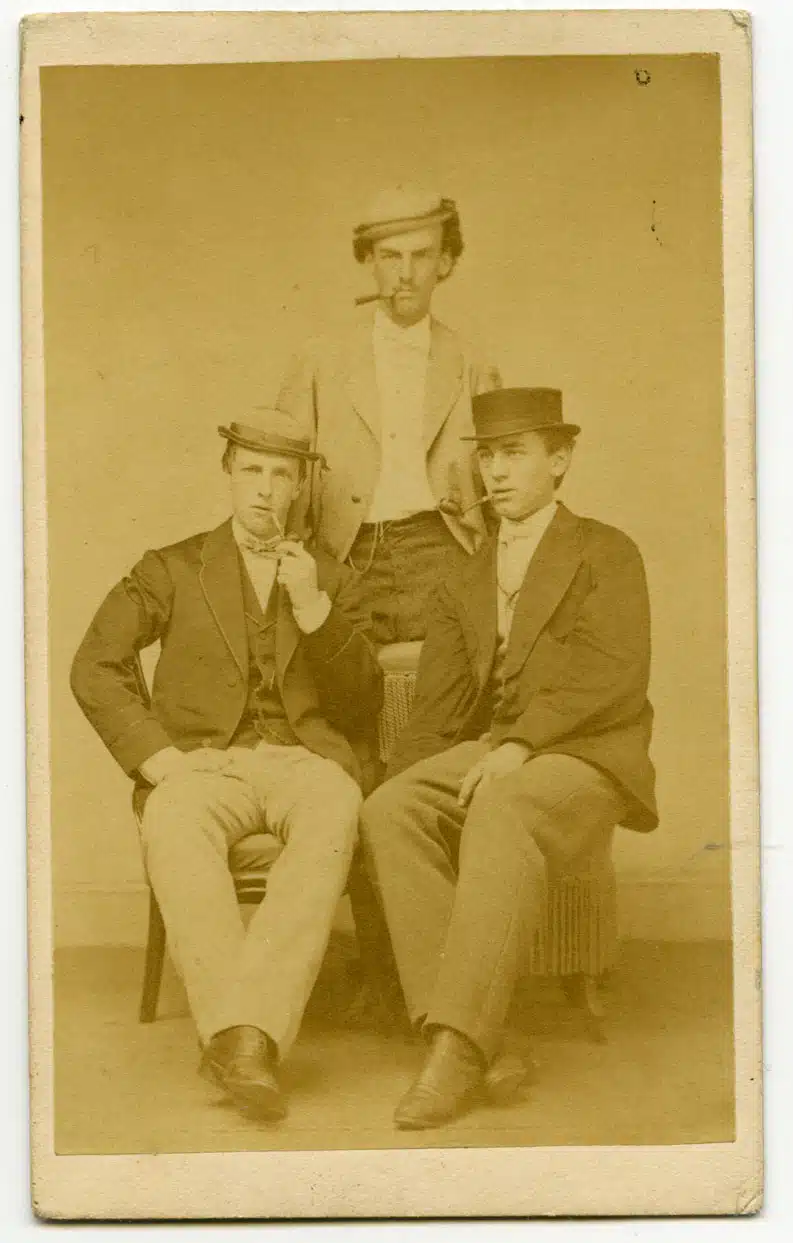
C. Alfred Garrett, Earnest C. Bliss (seated right) and friends, 1867, albumen carte-de-visite. Courtesy of Chester County History Center, West Chester, PA, CDV#120 Note Verso: Garrett has used CDV card mounts from Woodward’s studio that he purchased. Woodward’s name is heavily crossed out and Garrett’s name is stamped above it.

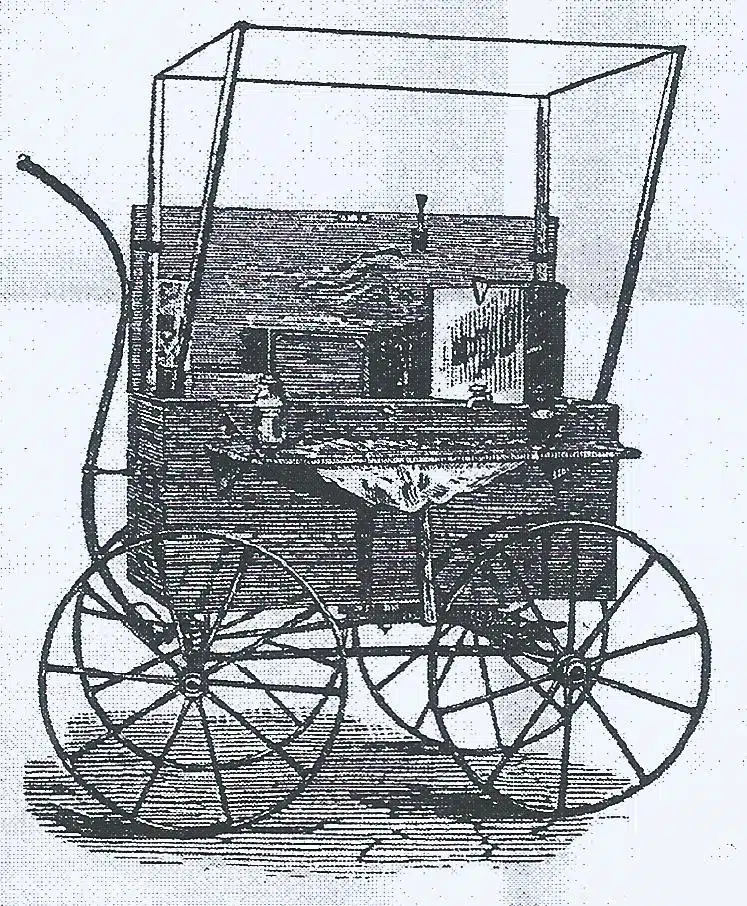
In October of 1867, Garrett was featured in the Philadelphia Photographer as the inventor of a compact dark tent on wheels that had all necessary chemicals efficiently at hand[19]. The portable tent had the look of a converted baby carriage. Layers of yellow and black chintz shielded out the sunlight. Its sink could handle processing whole plate negatives down to stereograph negatives. The juvenile coach wheels had a suspension system of hickory which was strong and flexible, not susceptible to rust. The chemical bottles where fastened with gum bands to their shelf. The whole apparatus cost only $17 to create.
Mobile dark tent on wheels, as described in The Philadelphia Photographer, October 1867.
Garrett was also active in the Grand Army of the Republic Post No. 31 in West Chester. An article in the August 18, 1868 American Republican, named him as being on a committee that documented all of the soldiers, sailors and marines graves in the cemeteries surrounding the borough[20]. A Roll of Honor was created to distribute flowers on the soldier’s graves on decoration day ceremonies.
Receipt, from C. Alfred Garrett to Honorable Washington Townsend, January 1, 1870, for 1 dozen cartes-de-visite of daughter Maggie.
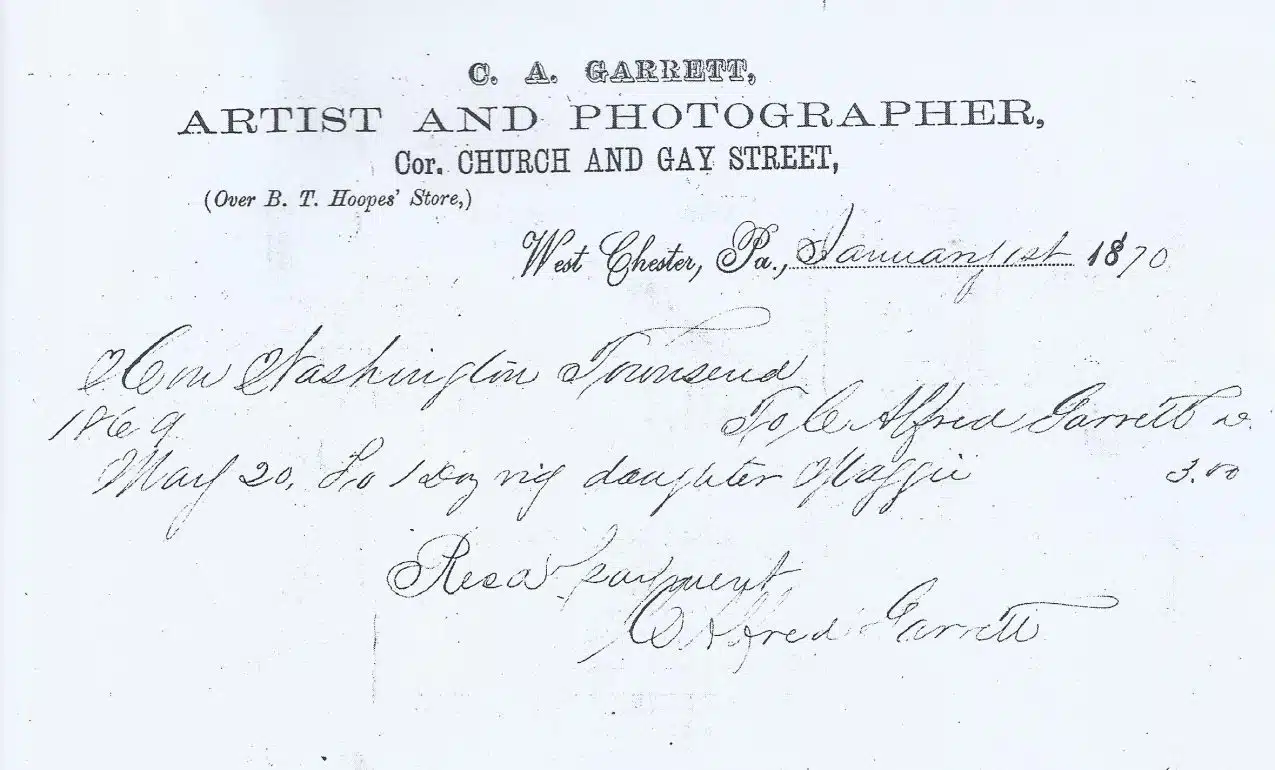
Garrett’s fortune as a photographer was good, his property assessed at the value of $5000 according to the 1870 census and he had a family with two young daughters[21]. A second daughter, Mabel was born March 5 of that year[22]. Unfortunately, his health was failing, and his physician recommended that he get outdoors to improve it. So in the spring of 1871 he went on a trip to California leaving his studio in charge of “competent persons.[23]” This may have been his studio assistant, Edward S. Marshall[24] or others.
C. Alfred Garrett, Hickman Fountain, ca. 1870, albumen carte-de-visite, courtesy of Chester County History Center, West Chester, PA CDV#2308. This fountain, situated before Chester County Courthouse provided watering ports for people, horses and dogs. It was designed by Rev. John Bolton, Rector of the Church of the Holy Trinity.


Before going on the trip, Garrett obtained a passport in Philadelphia on February 27, 1871. In the days before it was required for photographs to be attached to the document, a verbal description of the person had to suffice. The clerk described Garrett as follows: height; 5 feet 5 inches, hair; dark brown, eyes: hazel, complexion: light, nose: ordinary, mouth: large.
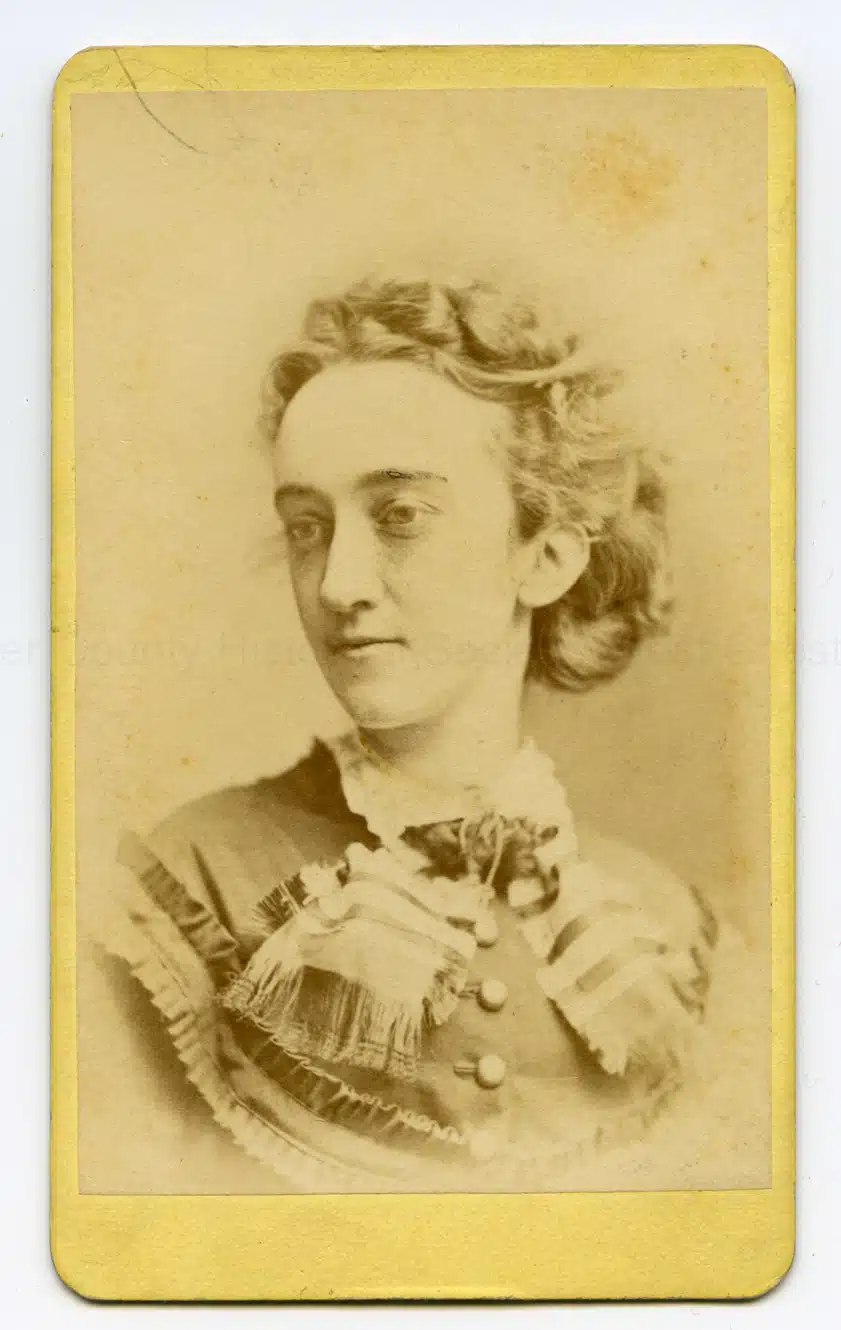
C. Alfred Garrett, Lucille Jefferis, 1871, albumen carte-de-visite, courtesy of Chester County History Center, West Chester, PA, CDV#1009.

While in California, it was reported in local papers that he made some handsome 8 x 10 views of Yosemite and other locations. The whereabouts of these views has not been determined.
Researchers, Robert O. Brown and Carl Mautz located information that an M. Garrett of Wilmington, Delaware traveled to Yosemite in the spring of 1871. From this, we can safely theorize that Alfred Garrett traveled to the west with his brother Maurice. Mautz wrote, “ M. Garrett …traveled to Yosemite area in California, spring 1871, hauling a photo tent and equipment; a pack mule fell in the river in the dark and all of the photographer’s photo traps were soaked. All of Garrett’s plates were albumenized and were reported as “fogging.” Garrett sent to San Francisco for more supplies and chemicals to continue his work in Yosemite.[25]”
C. Alfred Garrett, Thomas C. Spackman, killed at Gettysburg, copy photograph, albumen carte-de-visite 1869-70, courtesy of Chester County History Center, West Chester, PA, CDV#1783.


Returning to West Chester in the fall of 1871, Garrett’s health was improved. Once again he wanted to make a change in his life. His studio had stiff competition in the borough from Thomas W. Taylor and Jacob Beecher. Garrett decided to move his family to Philadelphia where he opened a new studio in partnership with Thomas P. Garrett at 828 Arch St.[26] Although the new studio is named Garrett Bros., in fact Thomas P. Garrett is C. Alfred’s cousin, the son of Uncle Henry Garrett.
The firm by the name as Garrett Brothers is listed in Philadelphia directories at the 828 Arch Street address from 1873-1879[27]. According to Gopsill’s Philadelphia City Directories, C. Alfred is listed as being in partnership with Thomas P. Garrett from 1873-1875[28]. Thomas is even living with C. Alfred and his family at 1205 N. 29th Street. A change comes in 1876 when Thomas is no longer listed, but brothers Maurice and Warren are now pitching in to help their brother. Both are listed in the directories for 1876 & 1877 as still living in Wilmington, Delaware,[29] but in 1878 Warren moves in with C. Alfred[30]. During these years when Maurice and Warren are helping C. Alfred in Philadelphia, they are also listed in city directories for Wilmington, Delaware as operating the photographic firm M. & W. Garrett[31].
Garretts, George Morris Philips, 1874, albumen carte-de-visite, courtesy of Chester County History Center, West Chester, PA, CDV#1453. Philips later became Principal of West Chester State Normal School, today West Chester University. Note the unique logo with the devil in an egg coming out of the camera. Garrett is poking fun at the concept that capturing images are blasphemous.


However, in 1879 C. Alfred is listed on his own[32]. Even the Daily Local News follows up with West Chester’s former photographer on August 1, 1878 by announcing a change in the firm; C. Alfred now the sole proprietor of the Philadelphia gallery while his brother has returned to a gallery in Wilmington, Delaware[33]. Garrett’s studio was noteworthy in the news in 1879 for taking a handsome photograph of the singer Miss Detchon, who played Hebe in a local production of H.M.S. Pinafore[34].
Beginning in 1880, the 828 Arch Street address is no longer given in city directories, only his home address of 1205 N. 29th Street, and he now identifies himself as an artist[35].
His health was still an issue and a physician advised that he seek a warmer climate. In 1881, Garrett closed his Philadelphia studio[36]. He moved to North Carolina in about 1886. It is not clear how Garrett continued in his profession.[37] This author did not find any studio advertisements in available newspaper databases or in photographer directories[38]. When it became apparent that the end was near, he longed for home[39].
Garrett returned to Wilmington, the place of his birth, and there died of consumption at the home of his daughter Alice and son-in-law George Comly on July 27, 1891[40]. Today we know this deadly and debilitating disease as tuberculosis. Garrett was only 51 years old. He was buried at Wilmington & Brandywine Cemetery in New Castle County, Delaware in the family plot[41]. He was survived by his wife Sarah Sutton Garrett (1835-1921), and two daughters, Alice Comly (1866-1966) and Mabel Garrett (later Craig) (1870-1955).
© Pamela C. Powell, 2025. The author wishes to thank Gary Saretzky for sharing the notes he had been compiling on Garrett for many years to assist in the writing of this biography.
Post Script: Some Observations on Garrett and the Underground Railroad
Isn’t it curious that every town where Garrett opened a gallery was also a well-known location associated with antislavery activities and the Underground Railroad? As photo historian Gary Saretzky astutely observed, Garrett chose towns associated with abolitionist activity as locations for his studios[42].
Louisville, Kentucky was a notorious slave market where people were “sold south” never to see their families again. Louisville offered the last desperate chance to escape the hopeless fate of the deep south. A network of activists both black and white conducted freedom seekers across the Ohio River.
Salem, New Jersey was an important link on the Eastern Line of the Underground Railroad. Freedom seekers crossed the Delaware River from nearby slave states Delaware and Maryland to connect with conductors to secrete them north in wagons. Salem was just five miles from the mouth of the Chesapeake and Delaware Canal making it a prime location for the crossing for freedom seekers. Here a large free black population would assist runaways to “hide in plain sight” until they could be moved on.
West Chester, Pennsylvania was 30 miles north of the Mason-Dixon Line offering freedom seekers a chance to breathe while blending into the vibrant black community before continuing north. The conductors and station masters are well documented in this area due to the recording of the stories of the Underground Railroad written down in later years. Abraham Shadd, Samuel Painter, and others kept a sharp eye out for slave catchers.
Taking into consideration C. Alfred Garrett’s parentage and upbringing it is easy to assume that the whole family played some role in Thomas Garrett’s Underground Railroad operation in Wilmington. What of Elwood Garrett’s move “for his health” to a Maryland farm for a few years – then when he moved back to Wilmington his sash factory was destroyed by arson? Sounds like the work of angry slave catchers or slighted owners. But can we make this assumption? Thomas Garrett had to endure heavy fines and loss of his property for his work in the Underground Railroad. Was the whole family willing to risk that?
Complete secrecy was the ingredient necessary for the success of the Underground Railroad. There could be no written records. No risks were taken where conversations could be overheard. Trust between the participants was essential.
The only way we know these stories today are through publications written mostly after the Emancipation Proclamation. Only a few individuals created contemporary written records. One of those was William Still, who later published them in 1872 as “The Underground Railroad.” Another was David Evans, who recorded in his diary the number of “packages” received through his station in Sugartown, Chester County, Pennsylvania. It is highly unusual that anyone would keep records of something that could aid in his own prosecution. His diary is now in the collection of the Chester County History Center and has been completely transcribed.
Other histories written regarding Chester County, Pennsylvania’s role in the Underground Railroad and based largely on oral histories are R. C. Smedley’s History of the Underground Railroad in Chester and Neighboring Counties published in 1883, and Francis Cloud Taylor’s “The Trackless Trail” published in 1976 and “The Trackless Trail Leads On” published in 1995.
But what of C. Alfred Garrett? We know his belief was strong enough to fight for freedom for enslaved people by joining the 5th Delaware Infantry which cost him his birthright membership in the Society of Friends. We also know that he joined in the effort to aid recently emancipated people through his work in the Chester County Freedman’s Aid Society. This issue was important enough to have his studio used as a collection point for clothing – and to have it published in the newspaper. His stand on the issue of caring for the African American population was made plain to all his potential customers in West Chester. The borough has been a sharply divided town on the issue of race as reflected through the Copperhead newspaper The Jeffersonian and Jim Crow local policies that extended well into the twentieth century.
Or when Garrett established studios in Louisville, Salem and West Chester was he simply choosing these locations because they had Quaker communities? Even though he had been read out of meeting for his military service and later became a Presbyterian, did these communities feel comfortable and familiar to him? Friends tend to go where there are other Friends. But here again, his family’s Underground Railroad connection branded them as radicals within the Society of Friends.
So far no written stories or oral histories have been unearthed to document conclusively his participation in antislavery societies or the Underground Railroad. Without any evidence to confirm our theories we cannot say for sure if C. Alfred Garrett was part of this secret organization.
-
Gary Saretzky, New Jersey Photographers List, gary.saretzky.com/photohistory/njphotographers.html ↑
-
1864 June 2 – Delaware Public Archives, Dover, DE, Marriage records 1744-1912 ↑
-
Daily Local News, (West Chester, PA), 13 December 1864. ↑
-
Benjamin R. Shoemaker, comp., Genealogy of the Shoemaker family of Cheltenham, Pennsylvania, (Phildaelphia: J. B. Lippincott Co., 1893), p. 440. ↑
-
Village Record, (West Chester, PA), 24 October 1864. ↑
-
Village Record, (West Chester, PA), 27 May 1865. ↑
-
Tax List, Chester County Pennsylvania, 1866, Book SW, p. 1006, Chester County Archives and Records Services, West Chester, PA. ↑
-
Architectural historian Alice Kent Schooler attributed Portico Row to architect Thomas U. Walter, best known for designing the dome of the U.S. Capitol in Washington, D. C. She describes the houses built in the 1849-1859 period as being in the Greek Revival style in her May 1, 1980 report, West Chester Historic Site Survey, #42-029-WC-18A-5, presented to West Chester Board of Historical Review and Pennsylvania Historic & Museum Commission. ↑
-
Benjamin R. Shoemaker, comp., Genealogy of the Shoemaker family of Cheltenham, Pennsylvania, (Phildaelphia: J. B. Lippincott Co., 1893), p. 440. ↑
-
Village Record, (West Chester, PA), 23 June 1866. ↑
-
Note: see CDV 745 Judge Townsend Haines, dated 1864 by C. Alfred Garrett in Photo Archives, Chester County History Center, West Chester, PA. ↑
-
American Republican, (West Chester, PA), 6 March 1866, p. 3. ↑
-
Village Record, (West Chester, PA) 23 April 1864. ↑
-
Village Record, (West Chester, PA) 15 April 1865. ↑
-
William A. McKay, A Directory of Delaware Photographers 1839-1900 and Beyond, (New Castle, Delaware: Oak Knoll Press, 2018), p. 94-95. ↑
-
Jeffersonian, (West Chester, PA), 27 April 1867. ↑
-
American Republican, (West Chester, PA) 18 June 1867, p. 3. ↑
-
The Philadelphia Photographer, (Philadelphia, PA), October 1867. ↑
-
American Republican, (West Chester, PA), 18 August 1868, p. 1. ↑
-
Year: 1870; Census Place: West Chester, Chester, Pennsylvania; Roll: M 593_1325; Page 184B: Family history Library Film: 552824. ↑
-
Benjamin R. Shoemaker, comp., Genealogy of the Shoemaker family of Cheltenham, Pennsylvania, (Phildaelphia: J. B. Lippincott Co., 1893), p. 440. ↑
-
Jeffersonian, (West Chester, PA), 18 February 1871. ↑
-
See the biography elsewhere on this website of Edward S. Marshall for more information. ↑
-
Carl Mautz, Biographies of Western Photographers, expanded & revised ed. (Nevada City, California: Carl Mautz Publishing, 2018), 558. ↑
-
Obituary, Daily Local News, (West Chester, PA), 30 July 1891. ↑
-
Gary Saretzky, Philadelphia Photographers List, http://gary.saretzky.com/photohistory/philadelphiaphotographers.html ↑
-
Isaac Costa, comp. Gopsill’s Philadelphia City Directories 1873, (Philadelphia: James Gopsill, 1873), p. 535-536; 1874: p.521-522; 1875: p. 568. ↑
-
Isaac Costa, comp., Gopsill’s Philadelphia City Directory, 1876, (Philadelphia: James Gopsill, 1876), p. 565. ↑
-
Isaac Costa, comp., Gopsill’s Philadelphia City Directory, 1878, (Philadelphia: James Gopsill, 1878), p. 582. ↑
-
William A. McKay, A Directory of Delaware Photographers 1839-1900 and Beyond, (Delaware: Oak Knoll Press, 2018), p. 96-97. ↑
-
Isaac Costa, comp., Gopsill’s Philadelphia City Directory, 1879, (Philadelphia: James Gopsill, 1879), p. 598. ↑
-
Daily Local News, (West Chester, PA) 1 August 1878. ↑
-
News Journal, (Wilmington, DE) 27 February 1879, p. 3. ↑
-
Isaac Costa, comp., Gopsill’s Philadelphia City Directories 1880 & 1881, (Philadelphia: James Gopsill, 1880 & 1881), 1880: p. 634; 1881, p. 607. ↑
-
Obituary, Daily Local News, (West Chester, PA), 30 July 1891. ↑
-
According to some research notes received from Gary Saretsky, 6/6/2024, “Michael McCue of Polk County Historical Association, Columbus, NC owns a holograph letter by Garrett dated June 14, 1890, from the McAboy Hotel near Tryon, NC. McCue has speculated that the 1895 edition of Resorts of the South includes a new of this hotel by Garrett.” ↑
-
No listing for Garrett appears in Stephen E. Massengill, comp. Photographers in North Carolina, the First Century, 1842-1941. (Raleigh: North Caroline Office of Archives & History, 2004.) ↑
-
News Journal (Wilmington, DE) 28 July 1891, p.1. ↑
-
Obituary, Daily Local News, (West Chester, PA), 30 July 1891. ↑
-
Findagrave.com, Charles Alfred Garrett (1840-1891) – Find A Grave Memorial ↑
-
Email from Gary Sarezky to Pamela Powell, December 9, 2006. ↑