How to use the Working Dates List
Here is a handy tool for assigning a date for a nineteenth century photograph. If you are working on your genealogy or local history project, the Working Dates List will save you considerable time and move your research ahead.
You are lucky indeed if you have cartes-de-visite or cabinet cards in your family archives. Have you ever heard of these? The carte-de-visite is a small business card sized photograph attached to a mount 2 1/2” x 4”. They were popular in the United States from about 1858 into the late 1890s. Their peak popularity came during the Civil War when the small format was easy to carry into the battlefield.
The cabinet card is its larger cousin, a photograph on a mount measuring 4 1/4 x 6 1/2” first introduced in 1865, it came into popularity in the 1870s through the early 20th century. These standard formats can be seen in the arched windows of the tooled leather and velvet covered albums that were crafted to store them.
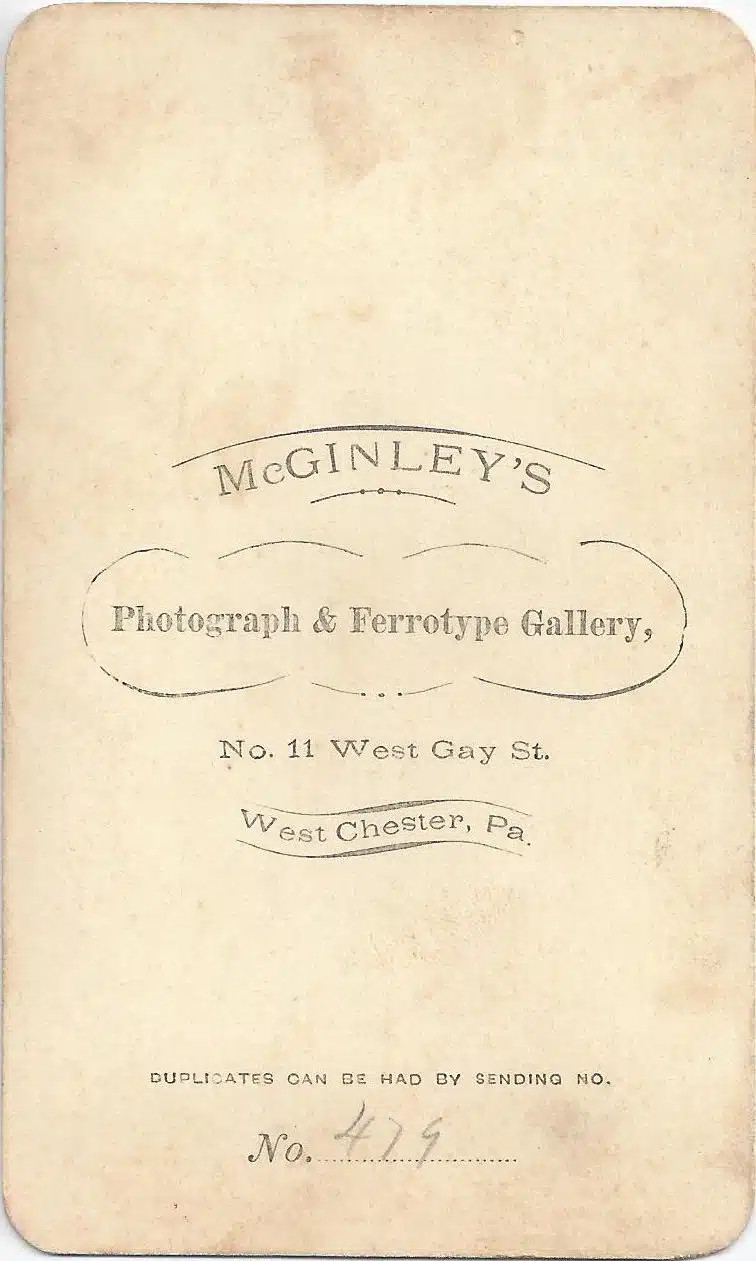
Photographers usually had an imprint on these card mounts with their name or name of gallery, and an address or at least a place name in smaller towns. We can use this information to find a date range for the photograph. Some photographers stayed at the same location for their entire careers, but many were on the move to different towns and locations. You will be lucky to have one with a short stay in a town to get a narrow date range.
So how do you use the Working Dates List? Go to the Working Dates Page either from the big red button on the home page or through the Photographer’s Tab on the mega-menu. Here you can type the photographer’s name into the search box to filter the data on the list.
You can search for other terms too. If the photographer’s name is obscured on the photograph, type in the address and you get a filtered list of all the photographers who worked there.
The data on the working dates list has been compiled using tax lists and county records from the Chester County Archives; county directories, local newspaper advertisements, manuscript material and ephemera from the Chester County History Center in West Chester, Pennsylvania. Every time I find new information, I update the list. So let me know if you have something I don’t. The goal is to build an accurate reference resource.
We will talk more about assigning a date to historical photographs in future blogs.
T. B. McGinley had a studio in West Chester at 11 West Gay St. from 1871 until March 1, 1873 when he sold it to William H. Ingram.